The Architecture of Consistency: Decoding the Herschel Walker Training Phenomenon

"I did push-ups and sit-ups every day. I never stopped." — Herschel Walker
In the annals of athletic history, few figures command the same level of mystique regarding physical conditioning as Herschel Walker. The Heisman Trophy winner, Olympian, and professional mixed martial artist is often remembered for his freakish, chiseled physique that remained virtually unchanged for decades. While observers often attribute his longevity to genetic luck, the reality of Walker’s regime is far more calculated.
Walker did not achieve his legendary volume through "grinding"—the standard industry term for brutal, high-intensity sessions that leave an athlete shattered. Instead, he approached his physical training the way water carves rock: a little at a time, distributed across the entire day, performed with unyielding consistency for over forty years. This article explores the mechanics of that system, dissecting why his "all-day" philosophy provides a blueprint for sustainable, high-volume conditioning that transcends the limitations of traditional gym culture.
The Main Facts: The "Whole Day" Philosophy
At its core, Walker’s training was defined by a shift in perspective. Most gym-goers view exercise as an event—a 60-to-90-minute block where one enters a facility to "destroy" muscles. Walker viewed exercise as a practice, a constant state of being.
The Numbers Game
Depending on his career phase, Walker’s daily targets ranged between 1,500 and 3,500 push-ups and a comparable number of sit-ups. To the uninitiated, these figures sound like a recipe for chronic inflammation and tendonitis. However, the secret lies in the distribution. Walker never attempted these totals in a single workout. By breaking his goal into micro-sets of 10 to 20 reps, he avoided the metabolic buildup of lactic acid that causes failure and fatigue.
The Mechanism of Recovery
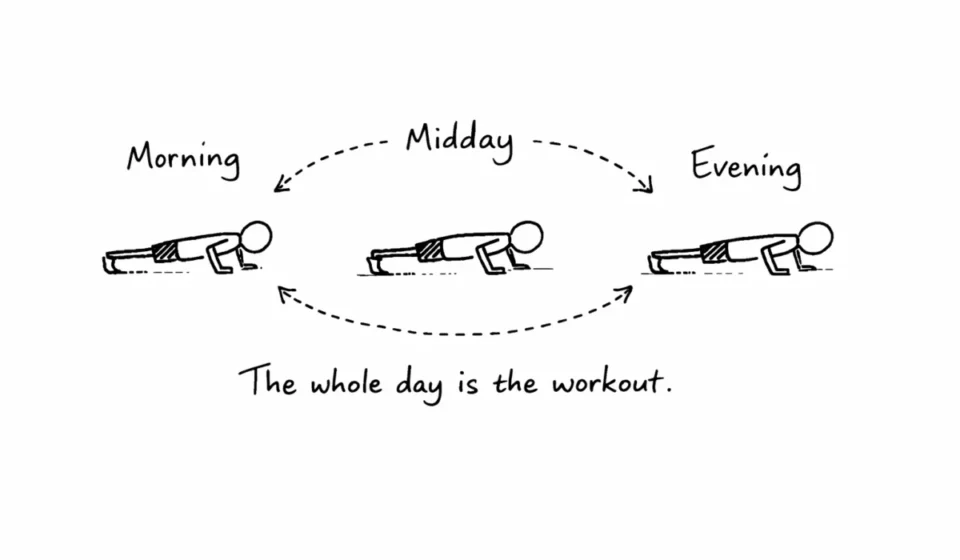
By keeping every set "sub-maximal"—performing far fewer reps than his absolute limit—he kept his central nervous system fresh. This method, often referred to in modern strength coaching as "greasing the groove," allows an athlete to perform an immense volume of work without ever triggering the systemic exhaustion that requires a "rest day." For Walker, the whole day was the workout.

Chronology: From Childhood to Elite Performance
The evolution of Walker’s conditioning did not happen overnight; it was a decades-long accumulation of habits.
The Formative Years
Walker has frequently recounted his childhood in rural Georgia, where he wasn’t a gifted athlete. In fact, he was a self-described "small kid" who struggled with a speech impediment. His entry into fitness was born out of a desire for self-improvement. Starting with humble goals—barely managing 10 push-ups and 10 sit-ups—he began his daily ritual. There was no "program" that jumped him to thousands of reps; there was only the gradual, incremental increase in volume over thousands of days.
The Collegiate and NFL Peak
By the time Walker reached the University of Georgia, his conditioning had become his calling card. Teammates and coaches noted that while others were hitting the heavy weights in the weight room, Walker was often found in the corner, knocking out rapid-fire sets of calisthenics. During his professional NFL career, he maintained this regime, effectively using it as a form of active recovery that kept his connective tissues supple and his muscular endurance at levels far exceeding his peers.
The MMA Transition
When Walker entered the world of professional MMA in his late 40s, his training became a point of intense public scrutiny. Skeptics wondered how a man nearing his 50th birthday could compete with younger, stronger fighters. The answer remained the same: his volume-based calisthenics had built a foundation of work capacity that allowed him to train at an intensity level that younger athletes could not sustain for the duration of a camp.
Supporting Data: Why "Low Intensity" Produces High Results
The efficacy of Walker’s approach can be explained through several physiological lenses.
1. The Principle of Progressive Volume
Traditional training focuses on intensity—moving heavier weights to force adaptation. Walker focused on volume—moving his body weight frequently to force adaptation. Over decades, this constant stimulus built a high level of "work capacity," the ability to perform high-quality work for extended periods.

2. Avoiding Systemic Fatigue
When you reach muscular failure, your body requires significant downtime to repair the micro-tears in the muscle fibers. By staying far from failure—performing 20 reps when capable of 80—Walker bypassed the prolonged recovery period. He effectively kept his muscles in a state of constant, mild activation, which promotes blood flow, nutrient delivery, and structural integrity without the "burnout" associated with heavy, low-rep sets.
3. The Role of Connective Tissue
Heavy weightlifting can be brutal on joints and tendons, especially over 40 years. Bodyweight training, particularly when done with high volume and perfect form, acts as a form of physical therapy. It strengthens the tendons and ligaments around the joints, creating a "bulletproof" physique that is less prone to the catastrophic injuries often seen in athletes who rely solely on external loading.
Official Perspectives and Expert Analysis
In his book, Herschel Walker’s Basic Training, Walker outlines a philosophy that challenges the modern fitness industry. Experts who have analyzed his routine often highlight the contrast between his approach and the current "optimization" culture.
- The Simplicity Trap: Most modern programs are overly complicated, requiring periodization, macro-nutrient tracking, and expensive equipment. Walker’s program is the antithesis of this. It requires nothing more than gravity and the floor.
- Consistency over Intensity: Dr. Michael Yessis, a prominent sports scientist, has often noted that the most successful athletes are those who can maintain a high training frequency without injury. Walker’s system is essentially a masterclass in injury prevention through movement efficiency.
- The Psychological Component: Perhaps the most overlooked aspect is the mental discipline required to perform the same task every single day. For Walker, the push-up was a meditative practice. It was not a chore to be completed, but a component of his identity.
Implications for Modern Fitness
What can the average person learn from a man who performed thousands of push-ups a day? The lesson is not that everyone should aim for 3,000 reps, but that the architecture of his routine is universally applicable.
Implementing the Walker Method
- Redefine the Workout: Instead of thinking of exercise as a one-hour event, identify ways to integrate movement into your day. Whether it’s 10 push-ups every time you go to the kitchen or 20 squats during commercial breaks, the goal is to accumulate volume without exhaustion.
- Prioritize Frequency: The body adapts to the frequency of the stimulus. By performing an exercise daily, you "teach" your nervous system to become more efficient at that movement.
- Manage the "Failure" Threshold: Stop your sets when they still feel "easy." If you can do 30 push-ups, do 10. By avoiding the point of failure, you remain energized and ready to perform another set an hour later.
- Patience as a Metric: The most critical takeaway is the timeline. Walker didn’t look for 12-week results; he looked for 12-year improvements. True, lasting change in body composition and strength is a result of long-term consistency, not short-term bursts of intensity.
The Conclusion
Herschel Walker’s career stands as a testament to the idea that simplicity, when married to unyielding patience, creates results that are impossible to ignore. He did not need high-tech machines, complex supplements, or a gym membership to maintain a world-class physique. He needed a floor, a schedule, and the discipline to never stop.
As we navigate an era of fitness trends that come and go with the changing of the seasons, the "Walker Method" remains a timeless reminder: The best program is the one you can do every single day, for the rest of your life. The secret isn’t in the number of push-ups, but in the decision to never stop pushing.