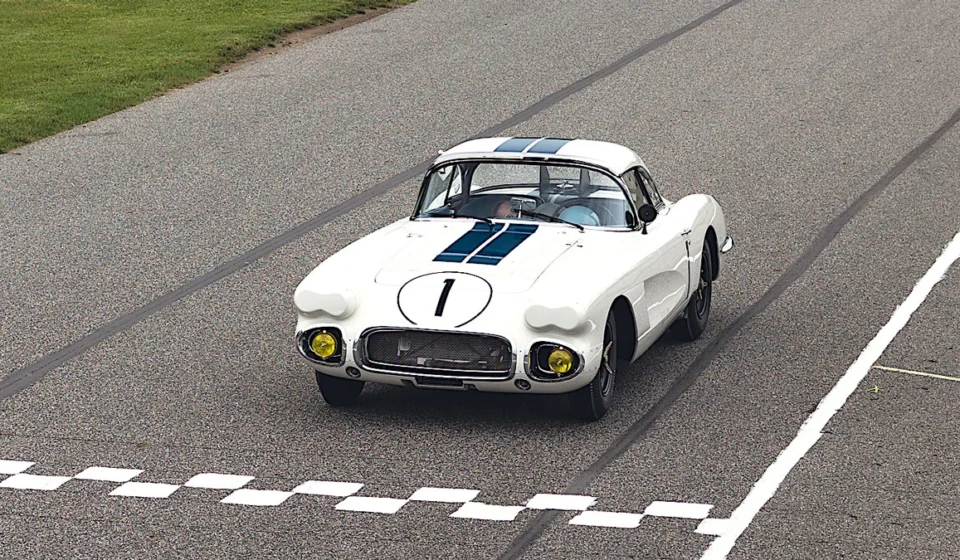

In the annals of American motorsport, few narratives carry the weight, the drama, and the sheer audacity of the 1960 24 Hours of Le Mans. It was a time when the Circuit de la Sarthe was a playground for European titans—Ferrari, Aston Martin, Porsche, and Jaguar—each vying for dominance on the world’s most grueling stage. Yet, amidst the sea of foreign engineering, a trio of Stars and Stripes contenders arrived, backed by the indomitable spirit of Briggs Swift Cunningham.
The heir to the Procter & Gamble fortune and a legendary race-car builder in his own right, Cunningham was not merely a participant; he was an ambassador for American performance. Today, that legacy has been thrust back into the spotlight. One of those original three Corvettes, Chassis No. 3535, is emerging from the shadows of history. Following a painstaking, multi-year, $500,000 restoration, the vehicle is set to cross the block at RM Sotheby’s Monterey Auction this August. It is more than just a car; it is a piece of kinetic history, representing the moment the Chevrolet Corvette truly earned its stripes as “America’s Sports Car.”
The Genesis: A Secret Mission at Le Mans
The story of Chassis No. 3535 begins in the autumn of 1959. At the time, General Motors was navigating a precarious political landscape. Following the catastrophic 1955 Le Mans disaster, which claimed over 80 lives and led to a temporary withdrawal of major manufacturers from global racing, American automakers were officially prohibited from competing.

However, Zora Arkus-Duntov, the visionary engineer and undisputed "Godfather of the Corvette," refused to let the brand sit on the sidelines. He approached Cunningham with a covert plan: a team of Corvettes would tackle the 24-hour race, but they could not be officially factory-backed. To maintain the ruse, the cars were funneled through Don Allen Midtown Chevrolet in New York. From there, they were sent to the Queens-based shop of Alfred Momo, a master of race preparation.
Inside the shop, the stock Corvettes were transformed into formidable endurance machines. Arkus-Duntov’s team provided race-spec, fuel-injected small-block V-8 engines, while the cars were fitted with lightweight Halibrand magnesium wheels, Koni competition shocks, and massive fuel tanks for long-distance efficiency. In a stroke of wartime ingenuity, the interior bucket seats were sourced from a Douglas C-47 Skytrain military transport aircraft, providing the necessary support for the grueling 24-hour slog.
The 1960 Campaign: Glory and Heartbreak
When the team arrived in France in June 1960, they brought with them a sense of American optimism. Briggs Cunningham himself took the first stint, sprinting across the track at the start of the race to pilot Corvette No. 1. Alongside him was Bill Kimberly, a scion of the family behind the consumer-goods giant Kimberly-Clark.

The Corvettes performed admirably, showcasing the raw power and reliability of the small-block V-8. However, the fickle nature of the Circuit de la Sarthe soon intervened. On lap 26, after a scheduled pit stop, Kimberly took over the helm. As he crested the hill past the infamous Arnage corner, he encountered a sudden, torrential downpour. The Corvette, light and powerful, hydroplaned uncontrollably, leaving the track and rolling end-over-end.
In a twist of fate, the car landed upright, allowing Kimberly to walk away unscathed. The Corvette, however, was not as fortunate. It suffered extensive fire damage, melted wiring, and a crumpled chassis. While the car was effectively sidelined, the effort had been made. The dream had been tested, and the foundation for future American success at Le Mans had been laid.
A Four-Decade Seclusion
Following the race, the three Corvettes were shipped back to the United States on the RMS Queen Elizabeth. Once in New York, the factory-supplied race engines were removed, and the vehicles were sold off. Chassis No. 3535 began a long, strange journey through the hands of various collectors.

It was initially purchased by Marshall “Perry” Boswell Jr. of Delray Beach, Florida. Perhaps unaware of the car’s provenance, Boswell undertook a series of aesthetic modifications that obscured its heritage. He altered the front end to adopt a single-headlight look, installed a custom hood scoop, reshaped the rear, and painted the car black.
In 1966, the car was sold to Robert Lee Bollinger, who resprayed it yellow. By the 1970s, it had passed through several other owners before ending up in the hands of Richard Carr in St. Petersburg, Florida. For the next 40 years, the car remained hidden, locked away in a warehouse, entirely forgotten by the racing world. It was not until 2011, during the settlement of the Carr estate, that his son discovered the vehicle, now painted a faded burgundy, tucked away in the shadows of the warehouse.
The Restoration: 5,000 Hours of Resurrection
The rediscovery of the car sent ripples through the collector car community. Historian Larry Berman confirmed its identity as the legendary Chassis No. 3535. After an initial auction appearance in 2021, where it sold for $785,000, it was acquired by the Cunningham family—a fitting homecoming.

Determined to return the car to its 1960 glory, the family commissioned Kevin Mackay of Corvette Repair, Inc., to undertake a full, body-off restoration. Mackay, who had previously restored the No. 3 Cunningham Corvette, faced a daunting challenge. “The car was a train wreck when we got it,” Mackay recalls. “Strange bodywork, missing interior, and that burgundy paint. The chassis and doors were the only real survivors.”
Over the next two years, Mackay’s team poured more than 5,000 hours into the project. They relied on forensic evidence, period photographs, and the architectural blueprint of the sister cars to ensure historical accuracy. The result was a stunning revival, a perfect mechanical recreation of the car as it stood on the grid in 1960. When the finished vehicle was finally unveiled to the Cunningham family, it served as a poignant tribute to the late Briggs Cunningham.
The Market Perspective: An American Ferrari 250 GTO
As the car prepares to cross the auction block in Monterey, industry experts are closely watching the proceedings. Harvey Stanley, director of Private Sales for RM Sotheby’s, believes the car’s value extends far beyond its historical provenance.

“This car belongs in the very best collections of great American sports racers, sitting right alongside the greatest Shelby Cobra or the Le Mans-winning GT40,” Stanley says. “This is the American Ferrari 250 GTO, only rarer.”
The significance of the timing cannot be overstated. As the United States celebrates its 250th anniversary, the offering of such a foundational piece of American automotive history is expected to generate significant interest from global collectors. With an estimated value between $2 million and $2.5 million, the Corvette is poised to reset the market for historic American racers.
Implications for Automotive History
The journey of Chassis No. 3535 from a high-speed wreck to a silent warehouse prisoner, and finally to a masterpiece of restoration, reflects the broader narrative of the Corvette itself. It is a story of trial and error, resilience, and the relentless pursuit of performance.

By taking on the European elite in 1960, Briggs Cunningham and Zora Arkus-Duntov proved that the Corvette was not just a boulevard cruiser, but a legitimate contender on the world stage. Today, the car serves as a bridge between the humble, experimental roots of the 1950s and the technological marvels that modern Corvettes have become.
For the lucky bidder who claims this car in August, they are not just buying a vehicle; they are acquiring a legacy. They are buying the story of a man who loved racing, a brand that dared to dream, and a machine that refused to be forgotten. As the sun sets on Monterey Car Week, the gavel fall on this 1960 Chevrolet Corvette will echo far beyond the auction tent—it will be a final, triumphant salute to the golden age of American road racing.