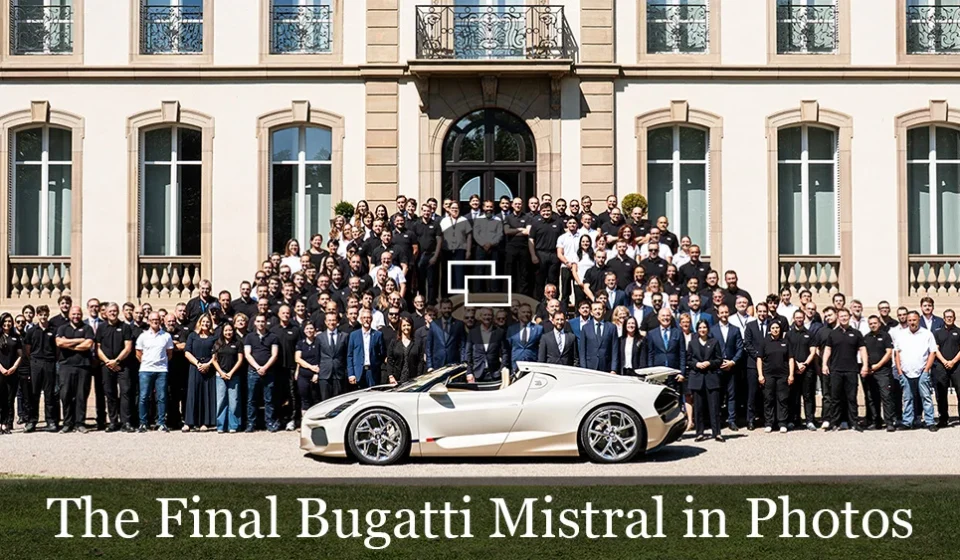

The history of the internal combustion engine is punctuated by moments of sheer engineering audacity, but few chapters carry the weight, majesty, and sheer mechanical ferocity of Bugatti’s W-16 era. That era has now reached its definitive conclusion. On Thursday, the French hypercar marque unveiled the 99th and final unit of the Bugatti Mistral, a roadster that stands as a valedictory monument to one of the most significant powerplants ever conceived by man.
With the delivery of this final series-production vehicle from the Molsheim atelier, Bugatti officially moves into a new epoch. The Mistral, aptly christened "The Last of Its Kind," marks the end of a lineage that defined the modern hypercar, signaling a transition toward the hybrid-electric future embodied by the incoming Tourbillon.
The Weight of History: The W-16 Legacy
It is nearly impossible to overstate the seismic impact the W-16 engine has had on the automotive landscape. Since Volkswagen Group took the helm of the storied French brand in 1998, the mandate was clear: to create the most sophisticated, powerful, and luxurious vehicle the world had ever seen. The solution was the W-16—a complex, four-bank engine block that essentially fused two V-8 engines into one cohesive, pulse-pounding masterpiece.
This engine became the heartbeat of modern Bugatti. It powered the Veyron, the car that effectively invented the 1,000-horsepower production hypercar category, and it carried that mantle forward through the Chiron and its countless specialized derivatives. The W-16 was not merely a motor; it was a statement of intent, a defiant rejection of constraints that pushed the boundaries of metallurgy, thermodynamics, and aerodynamics.

A Chronology of Power
To understand the significance of the final Mistral, one must look at the timeline of the W-16’s dominance:
- 1998: Volkswagen Group acquires the rights to Bugatti. Engineering begins on the W-16 concept, a gargantuan 8.0-liter, quad-turbocharged beast.
- 2005: The Bugatti Veyron 16.4 enters production, shattering the 250-mph barrier and fundamentally changing the performance car hierarchy.
- 2016: The Chiron is introduced, further refining the W-16 platform, increasing output to 1,500 horsepower, and cementing Bugatti’s reputation for extreme engineering.
- 2022: Bugatti debuts the Mistral, the final roadster to utilize the legendary engine, paying homage to the classic Type 57 Roadster Grand Raid.
- 2024: A special Mistral prototype captures the world record for the fastest open-top production car, hitting 282 mph.
- 2026: The 99th and final production Mistral is unveiled, marking the official end of the W-16 series-production run.
"The Last of Its Kind": Design and Engineering
The final Mistral is a visual and mechanical tour de force. Valued at approximately $5 million, the vehicle is finished in a bespoke two-tone color scheme: "Pearl" and "Sparkle." This aesthetic choice serves to accentuate the roadster’s fluid, muscular lines, which were sculpted not just for beauty, but for the extreme downforce required to keep a 282-mph vehicle pinned to the tarmac.
The interior is an exercise in bespoke craftsmanship, draped in Magnolia and Grey Carbon Matt leather. A subtle, poignant detail lies in the headrests, where the signature of Ettore Bugatti is meticulously stitched, serving as a reminder of the founder’s legacy that has been carried forward by this monumental engine.
Under the rear deck, the 8.0-liter, quad-turbocharged W-16 remains the star of the show. It produces an earth-shattering 1,578 horsepower and 1,180 ft-lbs of torque. This immense power allows the car to sprint from 0 to 62 mph in a mere 2.4 seconds. Yet, it is the top speed—282 mph—that defines its legacy. Achieving this speed in an open-top configuration is a feat of engineering that requires mastery over airflow and structural rigidity, proving that even at the end of its life, the W-16 remains the king of the hypercar mountain.

A Changing of the Guard: The Road Ahead
The retirement of the W-16 comes at a time of profound corporate transformation for the marque. Earlier this year, Porsche divested its 45 percent stake in Bugatti Rimac, effectively concluding the Volkswagen Group’s direct operational control over the entity. This shift signifies a new, more agile era for the company, now under the stewardship of Rimac’s technical prowess.
The successor to the W-16 era is the Bugatti Tourbillon. This new flagship represents a complete departure from the "W" configuration, featuring a naturally aspirated, three-foot-long V-16 engine paired with a trio of electric motors. This hybrid setup represents the brand’s pivot toward the future—a future where raw combustion is augmented by instant, high-torque electrical assistance. While purists may mourn the loss of the quad-turbocharged roar of the W-16, the Tourbillon promises a level of performance and technical sophistication that is expected to redefine the hypercar once again.
The "Programme Solitaire" Loophole
While the 99th Mistral marks the end of series production for the W-16, it is not necessarily the final time the engine will ever be heard. For the brand’s most elite and loyal clients—those with the deepest pockets and the most significant history with the marque—there remains an avenue: Programme Solitaire.
This exclusive division is dedicated to "one-off" and "few-off" commissions. Through this program, select collectors can still work with Bugatti’s master artisans to commission a vehicle that utilizes the W-16 architecture. Notable examples, such as the Brouillard and the FKP Hommage, have already emerged from this initiative, proving that while the mass-production era of the engine has ended, its soul remains available to those who can afford to keep the flame alive.

The Implication of an Era’s End
The conclusion of the W-16 era is a milestone in automotive history. For two decades, this engine was the undisputed benchmark for power, luxury, and prestige. It served as a bridge between the analog performance cars of the late 20th century and the high-tech, digital-first machines of today.
By closing this chapter, Bugatti is not merely stopping production; it is preserving the legacy of the W-16 as an immutable monument to a specific period of mechanical ambition. The transition to the hybrid Tourbillon is necessary, inevitable, and undoubtedly exciting, but it also underscores the rarity of what came before.
In the world of high-performance luxury, vehicles are often judged by their specs, but the W-16 Bugattis were judged by their presence. They were the cars that made the impossible look routine. As the final Mistral rolls out of Molsheim and into the climate-controlled garages of history, it carries with it the roar of a thousand-plus horses and the collective genius of an engineering team that refused to compromise.
The W-16 is dead. Long live the W-16. Its legacy is etched into the asphalt of every track it touched, and its influence will be felt in every hypercar that dares to dream of breaking the sound barrier in the decades to come. The era of the W-16 may be over, but for the enthusiasts and the engineers who lived it, the journey was nothing short of legendary.