
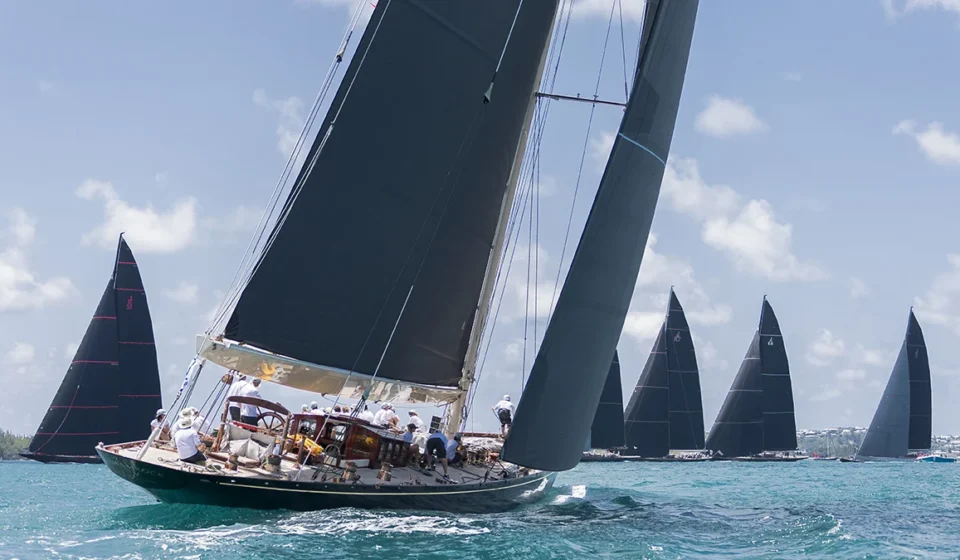

When the J-Class yachts unfurl their sails—deploying up to 7,500 square feet of canvas—the already striking vessels become impossible to ignore. These towering spinnakers, genoas, and mainsails billow majestically above sleek, curved hulls, a design language established nearly a century ago. On deck, a 25-person crew moves with the synchronized, choreographed precision required to pilot these behemoths, turning the open water into a high-stakes theater of maritime tradition and modern engineering.
Today, the Mediterranean is witnessing a profound resurgence of these vessels. A fleet comprising both historic survivors and cutting-edge replicas has gathered, signaling a new era for what many consider the "holy grail" of yachting. For the new generation of owners, these ships are not merely trophies; they are kinetic monuments to a golden age of sailing.
The Anatomy of a Legend: Main Facts and Historical Context
The J-Class yachts, measuring between 119 and 140 feet, emerged in the early 1930s as the ultimate expression of the America’s Cup competition. During that era, these vessels were the playground of the world’s wealthiest titans of industry, such as Harold Vanderbilt and Sir Thomas Lipton. They represented the pinnacle of naval architecture, combining massive, sail-heavy rigs with slender, displacement-heavy hulls.
The defining characteristic of the class is the sheer scale of the experience. "To see four, five, or seven yachts racing is simply so beautiful it takes your breath away," says Louise Morton, class secretary of the J-Class Association. The spectacle is visceral: the sound of wind whipping through carbon-fiber rigging, the rhythmic groan of the hull cutting through heavy swells, and the sight of a 140-foot vessel heeling under the pressure of an immense sail plan.
A Chronological Journey: From Glory Days to Modern Renaissance
The history of the J-Class is a narrative of rise, decline, and miraculous resurrection.
The 1930s: The Zenith of Competition
In the 1930s, ten original J-Class yachts dominated the regatta circuits, primarily fighting for the America’s Cup. They were the fastest, most technologically advanced racing machines of their time. However, the onset of World War II and the prohibitive costs of maintaining such vessels saw most of the fleet reduced to scrap metal to support the war effort.
The Dark Decades and the 1980s Turning Point
For decades, the J-Class nearly vanished from the collective memory of the sailing world. Only three British boats—Shamrock V, Endeavour, and Velsheda—survived the era of destruction. The real catalyst for the modern J-Class revival came in the early 1980s, when American heiress Elizabeth Meyer embarked on the gargantuan task of restoring Shamrock V and Endeavour. Her vision proved that these vessels were not just relics, but viable, competitive yachts.
The Era of the Replica (2000–Present)
The current century has seen a shift toward the creation of "new" J-Class yachts built from original 1930s naval architectural plans. By utilizing modern materials like aluminum hulls and composite rigging, shipyards have been able to build yachts that respect the original design while providing the reliability required for modern global sailing. The launch of Hanuman in 2009, Lionheart in 2010, Rainbow in 2012, and the record-breaking 143-foot Svea in 2017 has solidified this resurgence.
Supporting Data: Engineering the Modern J
The transformation of the J-Class from a historical curiosity to a competitive circuit is fueled by a blend of archival integrity and bleeding-edge technology.
The "Shamrock V" Restoration
The recent four-and-a-half-year restoration of Shamrock V serves as a testament to the dedication of the current class owners. The project demanded 247,000 man-hours, focusing on preserving the soul of the 96-year-old vessel while integrating modern safety and navigation systems. It is the gold standard for how to bridge the gap between 1930 and the present day.
The "Svea" Benchmark
The 143-foot Svea represents the apex of current J-Class development. Based on 1937 designs by a Swedish naval architect, it took eight decades to move from paper to water. Launched in 2017, Svea is currently the longest J ever built. Its performance on the race circuit—notably against Rainbow at the Superyacht Cup Palma—demonstrates that these replicas are not just aesthetic homages; they are formidable competitors designed to win.

Construction and Future Growth
The fleet is currently braced for further expansion. A replica of the 1930 America’s Cup defender Yankee is currently under construction. Once completed, this will bring the active fleet back to a "ten-strong" status, echoing the legendary numbers of the 1930s.
Official Perspectives: The Philosophy of Ownership
The modern owners of these vessels represent a distinct class of steward. Many are not merely passive investors; they are active participants, frequently taking the helm during high-pressure regattas.
"It’s the ultimate yacht to own and race," notes Louise Morton. This sentiment is echoed by those who sail them. The new owner of Shamrock V, a long-time sailor, describes the experience as a form of maritime reverence: "You come off the boat feeling as if you’ve honored the elements and the core of our sport."
From the perspective of the shipyards and architects, the primary goal remains performance. Wick Hillege of Dykstra Naval Architects, who has been involved in the refit or build of six J-Class yachts, emphasizes that the goal is to unlock the maximum potential of the original design. "We focus on making sure their maximum performance potential can be achieved," Hillege says. "That’s the styling that somehow always works—especially that link to the past."
Implications: The Future of the Class
The resurgence of the J-Class has significant implications for the world of luxury sailing.
The Globalization of the Circuit
With upcoming appearances in Greece and the 38th America’s Cup in Naples, the J-Class is transitioning from a niche group of enthusiasts into a global phenomenon. These events are not just races; they are high-profile showcases that attract sponsors, media, and a new generation of sailing fans.
Cruising as a Proof of Concept
Beyond the racecourse, the Js have proven their mettle as legitimate cruising vessels. Velsheda’s historic voyage to New Zealand via the Panama Canal proved that these are not merely "dock queens." They are sea-worthy vessels capable of putting thousands of miles under their hulls, challenging the narrative that large, high-performance racing yachts are limited to short-course competition.
Cultural Heritage and Sustainability
The J-Class represents a unique intersection of heritage conservation and technological advancement. By saving these designs from extinction, the current owners are preserving a critical chapter in maritime history. The transition to aluminum hulls and advanced rigging allows these vessels to remain relevant in a world that demands more efficiency and reliability.
Conclusion: The Eternal Appeal
As the J-Class fleet converges on Les Voiles de Saint-Tropez this September, the sight of these towering vessels will once again serve as a reminder that some designs are truly timeless. Whether it is the historic Shamrock V or the modern giant Svea, the J-Class continues to captivate the imagination.
The revival is more than a trend; it is a profound commitment to the art of sailing. In an age of digital transformation, the tactile, wind-driven power of a 140-foot yacht remains one of the most honest and breathtaking expressions of human ingenuity. As long as there is wind and water, the J-Class will remain the ultimate standard by which all other sailing yachts are measured.