Bridging the Gap: How to Measure True Social Media ROI Using Google Analytics 4

In the modern digital landscape, native social media analytics offer a clear window into how content performs on individual platforms—impressions, shares, likes, and comments are readily available at a marketer’s fingertips. However, these metrics only tell part of the story. The true test of a brand’s social media strategy begins the moment a user stops scrolling, clicks a link, transitions to a website, and ultimately completes a conversion.
Translating social media performance into tangible business outcomes remains one of the industry’s most persistent challenges. According to the 2025 Impact of Social Media Marketing report, a striking 56% of marketing leaders feel their social teams lack status as experts in measuring actual business impact. This disconnect occurs despite social media being a massive driver of digital traffic. Globally, social channels account for roughly 10.12% of all web traffic—a figure that surges to an impressive 15.23% in socially mature markets like the United States.
To capture the holistic picture of how social initiatives drive broader organizational objectives, marketers are increasingly turning to Google Analytics 4 (GA4). By tracking performance once traffic leaves the native platform, businesses can finally bridge the gap between social engagement and top-line growth.
The Chronology of Social Attribution: From Vanity Metrics to Business Outcomes
Understanding how social media evolved from a mere brand awareness tool into a core revenue driver requires looking at how analytics have adapted over the past decade.
- The Era of Vanilla Reach (Early 2010s): In the nascent days of corporate social media, success was largely defined by follower counts and post impressions. Platforms provided basic on-platform metrics, but proving financial return to executive boards was an uphill battle.
- The Rise of Basic Referrals (Mid 2010s): As platforms matured, marketers began embedding links into posts, utilizing Universal Analytics to view basic referral traffic. However, tracking specific campaigns required manual, error-prone URL string construction.
- The GA4 and Multi-Touch Era (Present): With the introduction of Google Analytics 4, tracking has shifted toward user-centric, event-driven data models. Modern attribution allows brands to trace user journeys across multiple devices and touchpoints, identifying precisely how a casual tweet or an Instagram story morphs into a high-value customer conversion.
Supporting Data: Why GA4 Integration is Essential
Analytics dashboards are only as powerful as the decisions they inform. Integrating social media data with GA4 offers invaluable utility through two primary pillars: connecting social to core business goals and understanding granular audience behavior.
Connecting Social to Business Goals
Social metrics cannot exist in a vacuum. To secure budgets and executive buy-in, they must align with organization-wide Key Performance Indicators (KPIs). Data from the 2025 Sprout Social Index™ underscores this reality: 65% of marketing leaders report that tying social performance directly to business goals is the single most effective way to secure social investment.
By linking GA4 with social strategies, marketers can evaluate how visitors from specific platforms interact with site content. Marketers can compare traffic source KPIs to identify which networks drive genuinely engaged visitors rather than fleeting, accidental clicks. Furthermore, GA4 captures funnel metrics—such as goal completions and drop-off points—ensuring top-of-funnel and mid-funnel efforts remain synchronized.

Understanding Your Audience
GA4 tracks audience behavior, interests, and on-site pathways with incredible precision. By observing how social traffic navigates a website, brands gain the qualitative insights needed to craft compelling content strategies that resonate with core buyer personas.
GA4 Traffic Sorting: Organic Social vs. Paid Social
A foundational element of using GA4 for social media analysis is understanding how the platform automatically categorizes incoming traffic. GA4 splits social traffic into two distinct channels based on predefined logic rules:
| Channel | Description | Verbatim Logic Summary | Typical Example Source/Medium |
|---|---|---|---|
| Organic Social | Unpaid visits to your site or app via non-ad links on social networks. | Source matches a regex list of social sites OR Medium equals (social, social-network, social-media, sm, social network, social media). |
instagram / social |
| Paid Social | Visits to your site or app via sponsored ad links on social media networks. | Source matches a regex list of social sites AND Medium matches regex ^(.*cp.*|ppc|retargeting|paid.*)$. |
facebook / paid |
Tagging Social Links with UTM Parameters
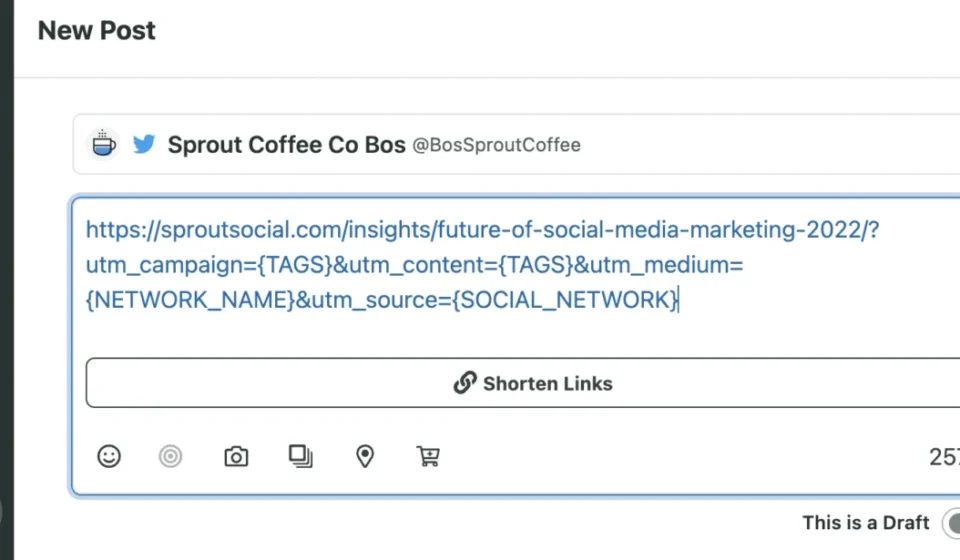
While GA4 automatically catches many referrals, precision requires UTM parameters. UTM tags allow marketers to tie traffic to specific campaigns, posts, and platforms. A typical tagged URL looks like this:
https://www.example.com/spring-collection?utm_source=facebook&utm_medium=social&utm_campaign=spring_launch
Manually tracking and managing UTM links across multiple platforms and campaigns can quickly become overwhelming for time-strapped marketing teams. Tools like Sprout Social streamline this friction by integrating URL shorteners directly into publishing workflows, letting users generate clean UTM links in one click without relying on separate, messy spreadsheets.
Official Perspectives: Key Metrics to Track in GA4
To prove true social media Return on Investment (ROI), data-driven marketers focus on specific metrics within GA4 rather than relying solely on vanity stats.
According to analytics and social marketing experts, the four most critical metrics to monitor include:

- Demographics (Audience): Tracks the location, age, and language of social visitors to confirm if social content is successfully attracting the target buyer persona.
- Session Source/Medium (Acquisition): Identifies the exact social network (e.g.,
facebook/referral) or specific campaign driving the highest volume of visitors. - Sessions and Engaged Sessions (Web Engagement): Filters out accidental clicks by measuring visits that last longer than 10 seconds, result in a conversion, or feature views across two or more pages.
- Average Engagement Time (Web Engagement): Measures the duration a user actively spends on-site, verifying whether website content delivers on the promise made by the initial social post.
Measuring Key Events and Conversions
Whether a brand’s goal is newsletter signups, demo requests, or direct ecommerce purchases, conversions define social ROI. In GA4, these are managed through Key Events (formerly referred to simply as conversions).
- Key Event: Any valuable user action on a website or app tracked natively within GA4.
- Conversion: A key event specifically shared with advertising networks like Google Ads to optimize ad bidding and performance.
Setting Up a Key Event (e.g., sign_up) in GA4:
- Ensure the event is firing: Verify that the recommended
sign_upevent name is successfully flowing into your GA4 property. - Mark the event as a key event: Navigate to the admin panel, select Data display > Events, locate your target event in the recent events table, and toggle the switch to mark it as a Key event.
(Note: If an event is brand new and not yet listed under recent events, marketers can manually navigate to the Key events menu, click + New key event, and type out the event name manually.)
Implications for the Future of Social Marketing
The evolution of digital measurement carries profound implications for organizational structures and marketing budgets. As executive boards demand tighter fiscal accountability, social media teams can no longer afford to operate as isolated silos disconnected from bottom-line revenue.
Implementing robust tracking via GA4 changes the internal conversation. Instead of defending social media based on "likes" and "reach," social strategists can present board-level reports detailing revenue attribution, customer acquisition costs (CAC), and verified lifetime value (LTV).
By adopting integrated tech stacks—such as combining advanced social publishing platforms with comprehensive analytics tools—organizations can achieve a closed-loop view of their customer journeys. This capability transforms social media from an unquantifiable creative expense into a predictable, high-performing revenue engine, ensuring long-term budget security and strategic influence within the modern enterprise.
Related posts: