
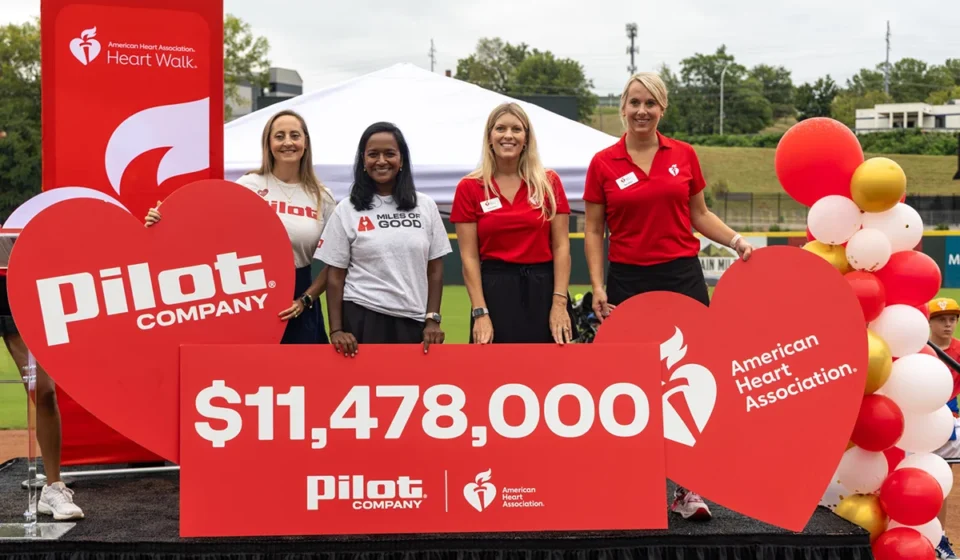
A Decade of Dedication: Pilot Surpasses $11.5 Million Milestone in Landmark Partnership with the American Heart Association

KNOXVILLE, Tenn. – In a profound display of corporate social responsibility and community mobilization, Pilot, the nation’s largest network of travel centers, has officially surpassed a significant philanthropic milestone. Over the past nine years, the company has raised nearly $11.5 million to support the American Heart Association (AHA), fueling life-saving research, education, and community health initiatives across North America.
This achievement, which reached its crescendo during the 2026 Greater Knoxville Heart Walk on September 12, marks a pivotal moment in a multi-year partnership defined by the intersection of roadside accessibility and life-saving medical advocacy. As Pilot continues to serve millions of travelers daily, its commitment to the "Miles of Good" program has transformed the simple act of a fuel purchase into a vehicle for public health.
The Main Facts: Turning Small Change into Massive Impact
The $11.5 million figure represents more than just a corporate donation; it is the culmination of millions of micro-transactions. Since 2017, Pilot has integrated charitable giving into the fabric of its retail experience. By empowering guests to “round up” their purchases to the nearest dollar or purchase commemorative paper hearts during key awareness months, the company has effectively crowdsourced a massive health initiative.
These funds are earmarked for the American Heart Association’s mission to be a relentless force for a world of longer, healthier lives. Specifically, the contributions support:
- Cardiovascular Research: Funding breakthrough studies that address the prevention and treatment of heart disease and stroke.
- Public Education: Expanding the reach of life-saving training, such as Hands-Only CPR.
- Community Health Equity: Ensuring that underserved populations have access to blood pressure screenings and heart-healthy resources.
For Pilot, this is not a peripheral activity but a core component of its brand identity. With over 900 locations across 43 states and five Canadian provinces, the company occupies a unique position in the American landscape, acting as a hub for millions of travelers. By leveraging this massive reach, Pilot has turned its travel centers into nodes of health advocacy.
Chronology: A Nine-Year Journey of Commitment
The trajectory of this partnership reflects a steady escalation in both ambition and community involvement.
- 2017: The Inception. Pilot formalizes its partnership with the American Heart Association, launching in-store campaigns to coincide with American Heart Month (February) and Stroke Awareness Month (May).
- 2019: Scaling Up. As the program gains momentum, Pilot integrates the initiative into its broader corporate social responsibility platform, "Miles of Good."
- 2022: Expanding the Scope. Beyond monetary donations, Pilot begins hosting on-site training sessions at its corporate headquarters and select travel centers, focusing on CPR certification and stroke symptom identification for staff and interested guests.
- 2024: The $10 Million Threshold. Pilot officially crosses the eight-figure mark in total funds raised, a milestone that signaled the company’s transition into one of the AHA’s most consistent and impactful corporate partners.
- 2026: The Milestone Celebration. On September 12, during the Greater Knoxville Heart Walk, Pilot leadership officially announced that the total contribution has climbed to nearly $11.5 million, cementing the partnership’s legacy.
Supporting Data: By the Numbers
To understand the scale of this partnership, one must look at the reach of the infrastructure provided by Pilot and the participation of its stakeholders.
- Financial Impact: Nearly $11.5 million raised since 2017.
- Community Reach: In the greater Knoxville area alone, Pilot’s investment has facilitated Hands-Only CPR education for more than 200,000 individuals.
- The Workforce Engine: Pilot employs approximately 30,000 team members who serve as the frontline ambassadors for these fundraising campaigns.
- Customer Volume: With an average of 1.2 million guests per day, the potential for awareness and donor participation remains one of the largest in the retail sector.
These numbers demonstrate the efficiency of a "distributed" charity model. By asking for small, incremental contributions from a massive volume of customers, Pilot has achieved a fundraising stability that many traditional corporate sponsorships lack.
Official Responses: Voices from the Frontline
The partnership has garnered praise from both corporate executives and health advocates, emphasizing that the success of the initiative lies in the personal connection between the brand and its customers.
The Corporate Vision
Adrienne Ingoldt, Senior Vice President of Communications, Risk, and Procurement at Pilot, and a member of the American Heart Association’s National Life is Why Council of Retailers, frames the initiative as a moral imperative.
"At Pilot, our purpose is to show people they matter at every turn," Ingoldt stated. "Supporting the safety and wellness of our team members, guests, and surrounding communities through heart health and stroke awareness education is one of the most critical and meaningful ways we can live out that purpose. Reaching this milestone reflects the generosity of our more than 30,000 team members and the 1.2 million guests who come through our doors every day. They truly are the heartbeat of this achievement."
The Public Health Perspective
Lisa Hinton, National Senior Vice President of Corporate Relations for the American Heart Association, highlighted the necessity of such partnerships in the modern healthcare landscape.
"Surpassing $11 million raised is a powerful testament to the commitment of Pilot and its guests to advancing heart health in communities nationwide," Hinton remarked. "This support helps drive progress in preventing heart disease and stroke and brings us closer to a future where everyone, everywhere can live longer, healthier lives."
Implications: The Future of Corporate-Health Partnerships
The success of the Pilot and American Heart Association collaboration provides a blueprint for how large-scale retail networks can serve as critical public health infrastructure.
1. Decentralized Public Health Education
One of the most significant implications of this partnership is the shift of health education from clinical settings to the public square. By hosting CPR training at travel centers, Pilot is effectively reaching people who might never attend a traditional community health workshop. This "on-the-go" model of education is vital for reaching a mobile population.
2. The Power of "Micro-Giving"
The success of the "round-up" campaign proves that consumers are willing to participate in philanthropy when the barrier to entry is low and the cause is transparent. In an era where many charitable organizations struggle with donor fatigue, the model used by Pilot and the AHA demonstrates that integrating giving into the daily routine of a consumer is a highly sustainable strategy.
3. A Culture of Safety
For a company like Pilot, which is fundamentally in the business of transportation and logistics, the emphasis on heart health and stroke awareness is a natural extension of its "safety-first" culture. By educating staff on how to identify a stroke or respond to a cardiac event, the company is not only helping the general public but also creating a safer environment for its own employees and patrons.
4. Setting a New Standard for Corporate Social Responsibility (CSR)
As a subsidiary of Berkshire Hathaway, Pilot’s commitment to the AHA sets a standard for other large-scale corporations. It proves that a company can maintain its operational focus while simultaneously acting as a pillar of community wellness. This holistic approach to business—one that values the health of the community as much as the bottom line—is increasingly being viewed as a benchmark for modern corporate excellence.
Conclusion: Sustaining the Momentum
As Pilot moves forward, the lessons learned from this nine-year partnership will likely shape its future philanthropic endeavors. The company has demonstrated that when 30,000 employees and 1.2 million daily guests are aligned behind a common cause, the impact is transformative.
The $11.5 million milestone is not the end of the journey, but rather a reflection of the enduring strength of the bond between the company and its community. As cardiovascular health continues to be a leading concern in North America, the role of corporate partners like Pilot will remain essential in bridging the gap between medical research and public application. By continuing to leverage its unique position on the highways of the nation, Pilot is ensuring that the "Miles of Good" will continue to be traveled for years to come, potentially saving countless lives in the process.
Related posts: