The Tick-Tock of Matrimony: How a Watch Journalist, a Pandemic Romance, and a Squash Shoe Survived the Ultimate Horology Test

Main Facts: A Tale of Passion, Timepieces, and Domestic Chaos
In the rarefied world of horology, where multi-million-dollar auctions and microscopic complications are discussed in hushed, reverent tones, few stories capture the chaotic intersection of marriage and collecting quite like this one. What begins as a lighthearted domestic pursuit can quickly spiral into an all-consuming obsession—especially when a seasoned watch journalist meets a partner who operates life at absolute extremes: zero or 100.
This is the chronicle of a high-stakes relationship with timekeeping, punctuated by lost heirlooms, pandemic-era anxieties, a frantic M.T.A. investigation, and an unceremonious reappearance from the depths of a sweaty squash shoe. It is a cautionary tale for anyone thinking of gifting a luxury mechanical watch to a spouse prone to existential panic, proving that while love may conquer all, it rarely survives a missing vintage Rolex without a few grey hairs.
At the center of this domestic comedy of errors are two opposing forces: a writer whose professional life is entrenched in the niche universe of luxury watches, and a husband whose relationship with timepieces has historically been marked by catastrophe. From a youthful TAG Heuer lost during a college rager at the infamous "Rage Cage" in Boston, to a pandemic-induced Apple Watch sleep-tracking obsession that practically manufactured insomnia, the stage was set for a turbulent journey into serious watch collecting.
Yet, against her better judgment, the author repeatedly tempted fate—gifting first a vintage Patek Philippe Calatrava for their wedding, and later a 1950s Rolex Oyster for their first anniversary. What followed was a 90-day saga of misplaced luxury, municipal transit searches, and a gym bag mystery that defies logic.
Chronology of a Horological Disaster
Phase One: The Pre-Collection Era and Pandemic Paranoia
When the couple first met, the husband found it charming that his partner wrote about fine timepieces, even though he didn’t wear one. His lone horological relic—a high-school graduation gift TAG Heuer—had long since vanished during his college years at the Berklee College of Music. For the early days of their romance, he wore a utilitarian Apple Watch.
Then came March 2020. Hitting the accelerator on their relationship just three months after they began dating, the COVID-19 pandemic thrust them into immediate cohabitation. Thrown off by the global disruption, the husband began complaining of sleep issues. The fatal suggestion was made: wear the Apple Watch to bed to track sleep patterns.
What ensued was a psychological feedback loop. The husband became utterly consumed by the app’s nightly data, his anxiety manufactured entirely by the wrist-bound tracker. Fortunately, during an ill-advised swan dive off a dock into a lake, the Apple Watch was lost to the depths—a moment of pure relief for his partner, who happily bade the digital tracker farewell.
Phase Two: The Wedding Gift and the Patek Philippe Safe-Guard
Fast-forward to 2021, and the couple was preparing for marriage. Defying her own professional instincts, the author sourced a stunning vintage Patek Philippe Calatrava Ref. 5022G from noted dealer Eric Wind of Wind Vintage at an exceptional price.
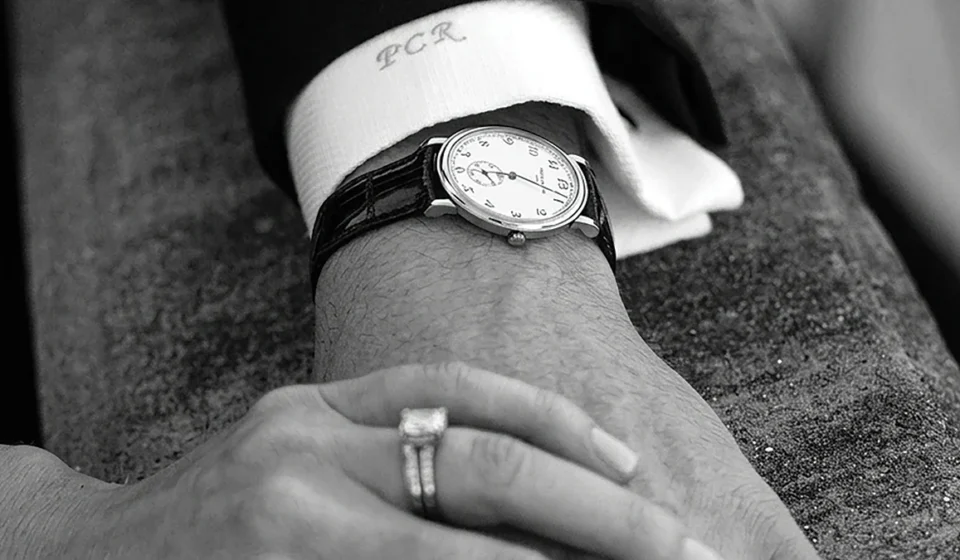
He proudly wore the piece down the aisle, but anticipating the inevitable hazards of his high-velocity lifestyle, the author swiftly banished the Patek Philippe to the safety of a home vault. The watch survived, safely tucked away, but the itch for a wearable timepiece remained.
Phase Three: The Anniversary Rolex and the 24-Hour Disappearance
Approaching their first wedding anniversary, the author attended a watch fair in New York and crossed paths with Eric Wind once again. Showcased among a sea of collectors was a rare, vintage Rolex Oyster Ref. 6424 from the 1950s, fitted on a leather strap and carrying a relatively reasonable price tag. Believing she had found the unicorn—a vintage watch he could actually wear daily without requiring armed security—she purchased it.
The gift was presented that evening at his mother’s home in Connecticut. He was ecstatic—for precisely one day.

Near midnight the following day, the husband walked into the bedroom looking like a man about to confess to a felony. "I’ve lost the watch," he whispered solemnly. "I feel sick."
Phase Four: The Search Party and Municipal Inquiries
What followed was a masterclass in domestic panic. Over the subsequent days, the search effort scaled to absurd heights:
- A formal report was filed with the Metropolitan Transportation Authority (M.T.A.).
- The husband’s mother turned her Connecticut home upside down, systematically ripping apart household trash.
- Every square inch of their apartment was scoured.
- Mortified, the author called Eric Wind to request purchase documentation to support an official police report—marking what is almost certainly Wind Vintage’s first-ever instance of a client losing a watch within 24 hours of acquisition.
Eric Wind’s reaction was one of pure shock. Follow-up communications later that week revealed a shared existential dread: at least four people were now losing sleep over a single 1950s Rolex Oyster.
Phase Five: The Squash Shoe Resurrection
Three agonizing months later, the missing watch made its theatrical return. It did not reappear via a thoughtful detective or a Good Samaritan; it launched itself across a room like a projectile during a medical fitting for orthotics, flying straight out of the husband’s squash shoe.
A joint review of the incident revealed a shared domestic lapse in judgment. To protect the watch from being misplaced at home, the couple had mutually agreed that he would store it inside his sneaker within his gym bag—a location he frequented weekly. Incomprehensibly, both parties forgot about the arrangement, and the husband managed to avoid inspecting the interior of that specific shoe for roughly 90 days.
Phase Six: The Aspen Escalation
Having survived marriage, panic, an M.T.A. investigation, and a three-month stint inside a sports sneaker, the Rolex earned legendary status. One might assume the author’s appetite for gifting watches had been permanently cured.
Not quite. During a winter getaway to Aspen—while the author was actively struggling down the slopes of Ajax Mountain—her phone rang. It was her husband, cheerfully announcing that he had just bypassed a quiet recovery period and picked up not one, but two new watches from Oliver Smith Jeweler at the base of the mountain.
Supporting Data: The Anatomy of Watch Collecting Risks
To understand why this narrative resonates so deeply within the horological community, it is helpful to examine the broader context of luxury watch ownership, loss, and psychological attachment:
- The Insurance Reality: According to specialty luxury insurers, misplaced or lost items account for a significant percentage of claims. However, items lost inside athletic footwear remain statistically rare—likely because most collectors possess a basic instinct to separate high-end Swiss mechanics from sweaty athletic gear.
- The Secondary Market Surge: Sourcing vintage pieces through trusted dealers like Eric Wind (Wind Vintage) provides authentication and value security, but it also raises the emotional stakes. When a buyer acquires a piece of mid-century history—such as a Rolex Oyster Ref. 6424 or a Patek Philippe Calatrava—the cultural and historical weight of the object amplifies the panic of loss.
- The Psychology of the "Zero-to-100" Collector: Behavioral observations in consumer studies suggest that individuals with high-intensity engagement profiles do not dabble; they immerse. When introduced to horology, these collectors quickly transition from casual observers to deep-dive researchers, making them uniquely vulnerable to both the highs of acquisition and the lows of accidental displacement.
Official Responses and Industry Reactions
The cascading events of the lost-and-found Rolex drew wry amusement and disbelief from the professionals involved in its provenance:
- Eric Wind (Wind Vintage): Upon being informed of the watch’s disappearance within 24 hours, Wind expressed genuine distress, noting he was "sick to my stomach about it." Upon hearing of its eventual recovery from a squash shoe three months later, industry insiders agreed it was a first for the secondary market—proving that vintage Rolexes can endure almost anything short of a direct industrial smelting process.
- Oliver Smith Jeweler: While no formal statement was issued regarding the Aspen double-purchase, local retail sources noted that impromptu, multi-watch slope-side acquisitions remain an occupational hazard for visitors encountering high-end inventory at the base of ski resorts.
- Rolex and Patek Philippe (Institutional Context): While neither luxury conglomerate officially condones storing vintage Oysters inside athletic footwear or banishing Calatravas to permanent vault confinement, both brands implicitly understand that the emotional journeys of their collectors often transcend rational consumer behavior.
Implications: What This Means for Collectors and Couples
The intersection of romance and horology is a delicate ecosystem. This story highlights several key takeaways for couples navigating the turbulent waters of luxury collecting:
- Know Your Partner’s Operating Speed: If a partner lives life at "100," introducing high-value, delicate mechanical items into the wild requires stringent risk management—or, at the very least, a strict ban on storing them near athletic equipment.
- The Bond of Shared Trauma: Surviving a joint horological disaster—complete with municipal transit investigations and frantic family trash searches—tests the foundations of a young marriage. If a couple can laugh about a vintage Rolex flying out of a sneaker during an orthotics fitting, they can likely survive anything.
- Incurable Affliction: Ultimately, watch collecting is rarely a temporary phase. As the author discovered in Aspen, attempting to curb a collector’s appetite usually results in accelerated acquisition.
In the end, the moral of the story is simple: marriage, much like watch collecting, requires patience, a sense of humor, and the firm understanding that things will occasionally go entirely off the rails. Whether the Rolex will eventually make its way to future generations having survived marriage, panic, the M.T.A., and a squash shoe remains to be seen—but one thing is certain: both the marriage and the watch collection are here to stay.