Rebuilding the Social Muscle: Why Intentional Networking is the Lifeblood of Modern Events

By the Editorial Desk
Networking muscles atrophy much faster than most professionals care to admit. For three years, a head-down stint at a fast-growing production company can consume an entire career footprint, leaving zero margin for conferences, industry mixers, or community building. When a professional finally steps back onto the conference circuit, event networking often feels less like second nature and more like physical therapy for the socially rusty.
Yet, for the vast majority of conference attendees, mingling and relationship-building remain the primary reason they pack their bags, book flights, and secure hotel rooms. Far from being a secondary perk or an afterthought for the evening cocktail hour, human connection is the core product of the modern live event ecosystem.
Main Facts: The Centrality of Connection in Modern Events
Recent industry insights underscore a hard truth that event organizers can no longer afford to ignore: people do not travel across time zones for slide decks or passive keynote listening. They come to meet peers, trade ideas, challenge assumptions, and build enduring professional relationships.

According to data from the Freeman Trends Report, highlighted by the Professional Convention Management Association (PCMA), networking routinely ranks among the top reasons individuals register for industry events. When surveyed on what matters most to their conference experience:
- 81 percent of attendees prioritize interacting with industry experts.
- 68 percent focus on meeting new professional contacts.
- 64 percent value peer-to-peer exchange above other conference formats.
Despite these overwhelming statistics, event networking is frequently left entirely to chance. Organizers construct magnificent agendas filled with educational tracks while treating the networking hallways as a self-executing mystery.
However, industry veterans who have navigated the post-pandemic or post-burnout "rehab" phase emphasize a critical realization: organic connection is largely a myth. Real networking must be designed with absolute intentionality, removing the friction of initial introductions and giving participants clear, structured permissions to speak.
Chronology: A Professional’s Comeback Story
The journey from social atrophy to conference floor leadership is rarely a straight line. It requires a deliberate, step-by-step physical and mental reset.

Phase 1: Minnesota Meetings & Events Day — The Frictionless Reset
The comeback journey often begins in unexpected places. At Minnesota Meetings & Events Day, one professional stumbled into Nicole Coon’s session, "Five-Star Connections: Networking in Action."
The methodology was deceptively simple: participants rotated from table to table armed with specific, guided prompts focusing on likes, dislikes, and real-world pain points in the events industry. There were no awkward trust falls, nor was there any frantic scrambling for a "fun fact" about oneself. By the third or fourth rotation, standard conversational barriers melted away. Groups quietly abandoned the strict rotation schedules and simply kept talking. The core lesson crystallized quickly: the hardest part of networking is never the conversation itself; it is the opening. By removing initial friction through targeted prompts, relevance naturally takes over.
Phase 2: Smart Meetings Innovation Experience (Boise, Idaho) — Dropping the Ego
If Minnesota served as physical therapy, the Smart Meetings Innovation Experience in Boise, Idaho, felt like the first real game back on the competitive court.
Surrounded by familiar industry faces like Dalia El Gazar and Nick Borelli, the primary rule of effective networking reemerged: stop taking yourself so seriously. Building relationships is impossible from a distance. Within hours, attendees were swept into spontaneous conga lines snaking through the venue and participating in traditional dances in the streets. While such moments inevitably yield lighthearted, slightly embarrassing footage, that vulnerability is precisely what shatters corporate armor and sparks genuine human bonding.

Phase 3: IMEX Frankfurt — Operating at Full Strength
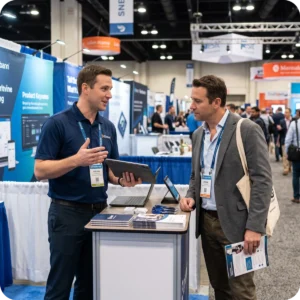
By the time the circuit reached IMEX Frankfurt, the social muscles were fully operational. Pressed into active booth service, an original schedule of six appointments rapidly ballooned into 22 dynamic engagements. The experience transformed from an obligation into a masterclass in joy, yielding scores of high-value connections built on authentic presence rather than transactional card-swapping.
Supporting Data: The Hidden Business Cost of Passive Participation
While extroverts and seasoned veterans dive headfirst into conference activities, a distinct subsegment of attendees chooses to sit on the sidelines. Observers at live events frequently note small clusters of individuals standing at the edge of active engagement zones, heads down and phones out, opting out entirely.
This passive stance carries a steep business toll:
- The Retention Crisis: Attendees who leave an event without forging genuine, memorable connections rarely return for the following year’s iteration. Consequently, attendee engagement transforms from a soft, feel-good metric into a hard core retention problem.
- The Inbox Trap: Participants who spend conference sessions tethered to their email inboxes leave with a slightly less cluttered digital inbox, but an entirely empty relationship pipeline.
- Quality Over Quantity: For reluctant networkers, a handful of profound conversations that evolve into post-event collaborations vastly outperforms a pocket full of unremembered business cards. Staying anchored at a table when a conversation deepens—rather than constantly scanning the room for the next contact—yields the most resilient professional relationships.
Official Responses and Industry Integration: The Role of Event Technology
Recognizing that not every attendee can be spontaneously thrust into a conga line in Boise, forward-thinking event organizers are embedding these psychological lessons directly into event technology infrastructure.

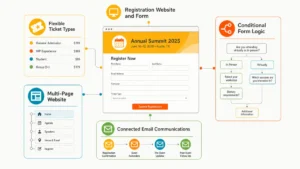
Platforms like EventMobi are leading the charge by turning event networking into a structured, scalable pillar of attendee engagement. Modern event apps now incorporate sophisticated tools designed to lower the barrier to entry:
- Rich Profiles & Smart Matching: Digital profiles act as modern table prompts, highlighting mutual industry challenges and professional interests before attendees ever cross paths in the hallway.
- Streamlined 1:1 Appointment Booking: By facilitating frictionless meeting scheduling directly within the app, organizers hand participants a concrete, low-risk reason to initiate contact.
- Moderated Group Discussions: Pre-event, on-site, and post-event digital channels ensure that conversations initiated during keynote sessions or workshops can continue indefinitely.
By leveraging these technological touchpoints, organizers effectively democratize the networking experience, giving every participant—even the most introverted—a clear, guided pathway into the community.
Implications for Event Planners and Organizations
The overarching takeaway for the events industry is clear: networking muscles atrophy if left unused, but they can be rapidly rebuilt through intentional design.
Leaving attendee engagement to chance guarantees that organizations leave brand loyalty, participant satisfaction, and long-term retention on the table. To secure the future of live events, organizers must adopt a proactive playbook:

- Design for Relevance: Provide attendees with low-pressure conversation starters, industry-specific challenges, and structured discussion prompts rather than relying on forced, awkward icebreakers.
- Assign Ownership: Designate clear ownership within the planning team for networking strategy, ensuring it receives the same logistical attention as audio-visual production and catering.
- Open the Window Early: Launch networking apps and engagement prompts weeks before the event kicks off, allowing attendees to break the ice digitally before stepping onto the physical venue floor.
- Encourage Presence: Remind participants to put away their phones, embrace a little professional vulnerability, and stay anchored in the room where authentic connections happen.
Ultimately, designing event networking on purpose means recognizing that human connection is the heartbeat of the industry. When planners build the framework, the attendees will gladly bring the energy.