Beyond the Ticket: Why Healthcare Organizations Require Specialized Event Registration Infrastructure

WASHINGTON — In the modern healthcare ecosystem, event management sits at the complex intersection of rigorous clinical education, strict regulatory compliance, and continuous professional development. Whether a regional hospital system is orchestrating its annual medical staff conference, a professional medical association is managing Continuing Medical Education (CME)-accredited workshops, or a global pharmaceutical enterprise is coordinating high-stakes investigator meetings, the operational demands extend far beyond the capabilities of basic, off-the-shelf event ticketing software.
As healthcare compliance tightens and the expectations of medical professionals rise, institutional organizers are discovering that generic registration tools introduce severe operational bottlenecks. Managing accreditation credentials, navigating data sensitivity laws, and segregating promotional activities from educational content require purpose-built digital infrastructure.
Main Facts: The Structural Realities of Healthcare Event Registration
Unlike corporate product launches or consumer entertainment events, healthcare event registration serves as the foundational data layer for professional credentialing and legal compliance.
- The Accreditation Chain: Registration is rarely just about confirming headcounts; it is the entry point for data that must ultimately feed into post-event CME and Continuing Education (CE) certification records.
- Diverse Stakeholder Ecosystems: A single medical congress may simultaneously process physicians, nurses, allied health professionals, hospital administrators, pharmaceutical representatives, and commercial exhibitors—each requiring distinct pricing tiers, access controls, and data collection fields.
- Regulatory Rigor: Organizations must operate under strict data governance frameworks, such as the Health Insurance Portability and Accountability Act (HIPAA) in the United States, alongside industry-specific guidelines governing interactions between commercial entities and clinical educators.
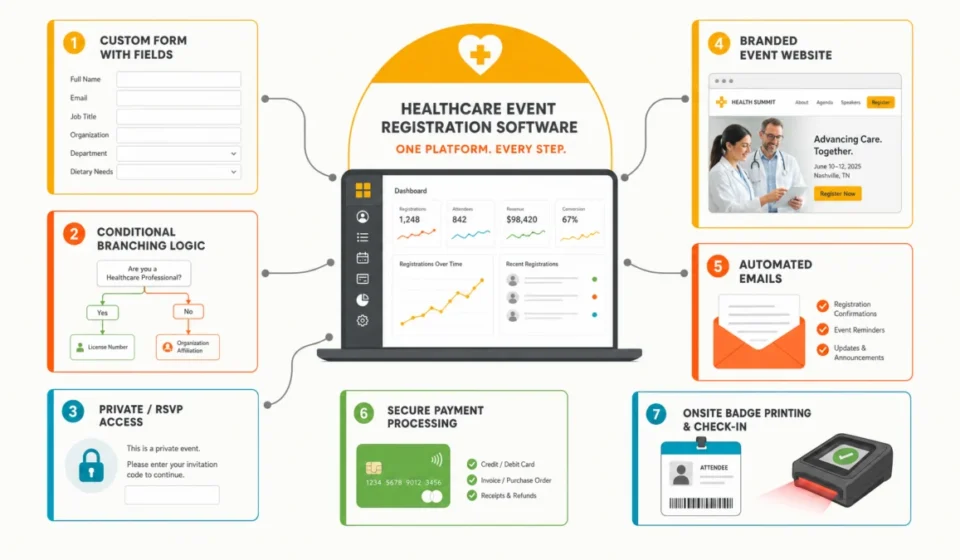
- The Integration Imperative: Modern healthcare event organizers demand unified platforms where registration data flows seamlessly into event websites, email marketing segments, payment gateways, mobile event apps, and onsite badge-printing hardware without manual intervention.
Chronology: The Evolution from Paper Ledgers to Integrated Platforms
Understanding how healthcare event management arrived at its current technological juncture reveals why specialized software has become an operational necessity.
Era 1: Manual Administration and Paper Tracking (Pre-2000s)
Historically, hospital grand rounds and medical association conferences relied on manual sign-in sheets, paper registration forms mailed or faxed to administrative offices, and physical check ledgers. CME credits were calculated by hand, cross-referencing attendance logs against state-issued medical license numbers—a process prone to human error, lost paperwork, and significant administrative delay.

Era 2: The Rise of Generic Ticketing Tools (2000s–2010s)
As the events industry digitized, healthcare organizations adopted general-purpose event registration tools designed for concerts, community fundraisers, and simple corporate seminars. While these platforms streamlined payment processing and basic headcounts, they lacked the architectural flexibility to capture National Provider Identifiers (NPIs), verify professional license jurisdictions, or manage conditional logic for varied medical specialties. Organizers were forced to build cumbersome workarounds, such as external spreadsheets and post-event data matching.
Era 3: The Integrated, Compliance-Driven Era (Present)
Today, healthcare event technology has matured into a specialized ecosystem. Platforms now feature native conditional form logic, secure data segmentation, integrated payment gateways compatible with institutional procurement standards, and real-time synchronization with onsite badging and mobile applications. Furthermore, the integration of artificial intelligence—such as AI-powered registration concierges—has transformed how medical professionals interact with pre-event logistics.
Supporting Data and Operational Challenges
Healthcare event registration faces five distinct hurdles that differentiate it from almost every other commercial sector.
1. Continuing Medical Education (CME) and CE Tracking
For accredited educational events, registration acts as the genesis of an auditable compliance trail. Organizers must systematically capture professional credential numbers, license types, issuing jurisdictions, and precise session selections at the exact moment of sign-up. Relying on post-event surveys or manual follow-ups to collect this data introduces compliance vulnerabilities and administrative drag.
2. Multi-Tiered Attendee Architecture
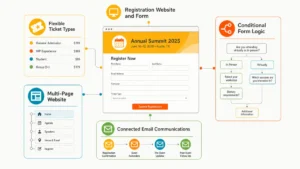
A comprehensive medical conference caters to diverse audiences with conflicting needs. While a physician must input clinical credentials, an exhibitor requires booth staffing details, and a pharmaceutical-sponsored attendee requires specialized compliance disclosures and alternative payment routing. Without advanced conditional form logic—which dynamically alters form fields based on ticket selection—organizers either subject users to endless, irrelevant fields or manage fractured, error-prone workflows.
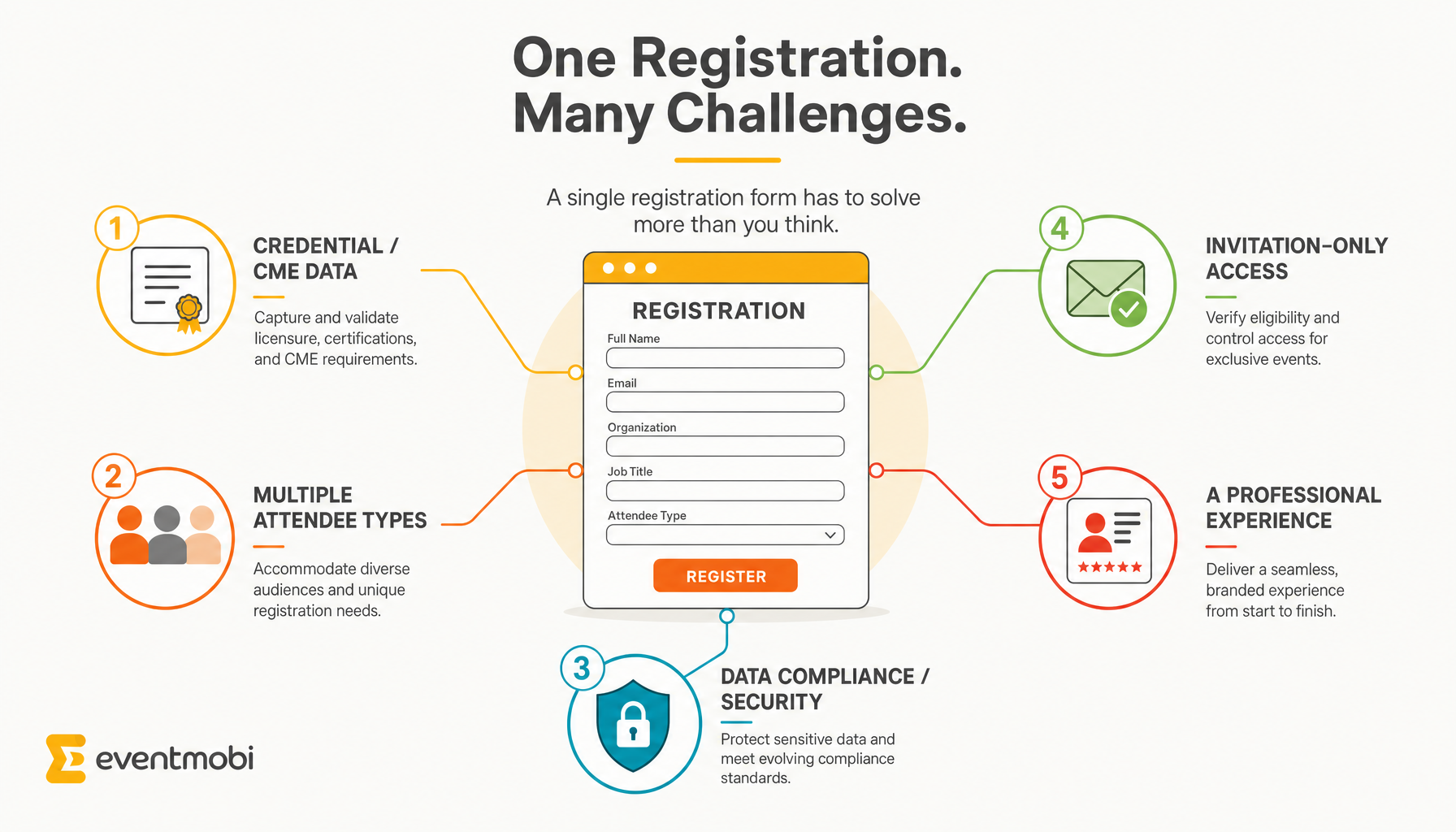
3. Data Sensitivity and Regulatory Compliance
The professional data collected during healthcare event registration is uniquely sensitive. Beyond standard contact details, platforms frequently ingest professional license numbers, institutional affiliations, and compliance disclosures. In the U.S., systems must align with HIPAA guidelines, while events involving life sciences sponsors must strictly adhere to the Accreditation Council for Continuing Medical Education (ACCME) Standards for Integrity and Independence, ensuring a strict firewall between promotional funding and educational content.
4. Gated Access for Private and Invitation-Only Gatherings
A significant portion of clinical collaboration occurs behind closed doors. Investigator meetings, institutional advisory boards, medical staff forums, and internal clinical training sessions require robust invitation-only registration infrastructure. This demands secure RSVP workflows, acceptance tracking, and private access codes that protect sensitive itineraries from public exposure.
5. Elevated Professional Expectations
Healthcare professionals operate in high-stress, precision-driven environments and expect their administrative interactions to match that standard. A poorly branded, generic registration portal hosted on an unsecure third-party URL damages the institutional credibility of a hospital system or medical society. Professional-grade branding, seamless multi-page event websites, and immediate, clear confirmation communications are baseline requirements.
Official Responses and Industry Perspectives
Event technology experts and healthcare compliance officers emphasize that selecting the wrong software infrastructure creates downstream risks that can jeopardize an organization’s accreditation status.
"When you are dealing with CME-accredited programming, data integrity is not optional," notes industry systems integration specialist Marcus Vance. "If an attendee’s license number is mistyped or fails to sync with session attendance logs, that professional may lose credit for hours of continuing education. The software must handle that validation natively at the point of entry."

Procurement officers within major hospital networks also highlight the friction caused by rigid financial systems. "Healthcare procurement is notoriously complex," explains corporate health compliance director Sarah Jenkins. "We cannot adopt tools that force our finance department outside of pre-vetted payment gateways like Authorize.net, Stripe, or Braintree. Registration software must adapt to our enterprise accounting structure, not the other way around."
Furthermore, data security officers stress the importance of robust access controls. With increasing scrutiny on data privacy, institutional buyers are auditing registration vendors for end-to-end encryption, role-based user permissions, and clear data retention policies that protect both institutional integrity and attendee privacy.
Implications for Healthcare Organizations Moving Forward
The maturation of specialized event registration software carries profound implications for the future of clinical education and professional networking.
Streamlined Administrative Overhead
By automating the collection of credential data, conditional form routing, and real-time synchronization with onsite badging systems, healthcare institutions can drastically reduce the man-hours required to launch and execute major conferences. Staff members who previously spent weeks manually reconciling spreadsheets can refocus on educational content delivery and attendee engagement.
Enhanced Audit Readiness
With regulatory bodies imposing stricter oversight on CME credits and industry sponsorships, having an immutable digital audit trail generated automatically at registration protects organizations from compliance infractions. Every disclosure, accreditation selection, and payment status is timestamped and stored securely within a unified database.

Improved Attendee Satisfaction and Retention
In an era where time is a scarce commodity for clinicians, a frictionless, professional registration experience directly correlates with higher event attendance and stronger professional engagement. Features like AI-powered registration concierges—which provide 24/7 answers regarding credit availability, cancellation policies, and accreditation bodies—remove friction before a clinician even steps foot in the venue.
Conclusion: The Bottom Line for Institutional Buyers
Healthcare event registration is undeniably more complex than event ticketing in other sectors, but this complexity is fully manageable with purpose-built infrastructure.
When evaluating software solutions, healthcare organizations must prioritize platforms that offer:
- Out-of-the-box custom fields for license numbers, NPIs, and credit tracking.
- Advanced conditional logic to segment diverse attendee types seamlessly.
- Secure, private access controls for invitation-only medical forums.
- Enterprise-grade payment gateway compatibility aligned with institutional procurement.
- Unified data architecture that eliminates manual data imports between registration, mobile event apps, and onsite check-in hardware.
By investing in specialized event registration technology, healthcare systems, medical associations, and pharmaceutical enterprises can safeguard their compliance standards, elevate their professional brand, and deliver seamless educational experiences for the clinicians who drive modern medicine forward.