The Hidden Revenue Leak on the Expo Floor: How AI Badge Scanners Are Disrupting Trade Show Economics—and How Organizers Can Fight Back

By: Event Industry News Desk
Published: September 2026
Main Facts: The Silent Shift in Trade Show Lead Capture
Picture a high-energy trade show floor. A prospect walks up to a prominent booth, engages in an enthusiastic conversation, and drops a clear buying signal. Instead of opening the official event app, pulling out a proprietary scanner, or using the organizer’s paid QR code solution, the exhibitor simply lifts their smartphone, snaps a quick photo of the attendee’s badge, and taps the screen. Within seconds, a third-party artificial intelligence (AI) tool automatically fills in the missing data fields—generating an email address, verifying the job title, and pulling a company profile.
From the perspective of the event organizer, nothing seems overtly wrong. But a critical shift has occurred: the exhibitor never utilized the official event technology, never scanned the designated QR code, and never paid for the lead-capture add-on that the organizer has relied on for years to pad profit margins.
This scenario is becoming the norm across convention centers globally. Recent industry data highlights a stark disconnect between event organizers and exhibitors: 65% of organizers still attempt to sell lead capture as a standalone, paid add-on, while 15% admit they have no clear visibility into what tools their exhibitors are actually using on the show floor.
The economic implications are severe. When exhibitors bypass official channels to use unverified third-party scraping and AI badge scanning tools, the revenue disappears from the organizer’s budget, valuable engagement data never touches the centralized registration system, and organizers lose the definitive proof of return on investment (ROI) required to secure lucrative sponsor renewals.

Chronology: The Evolution of Lead Retrieval and the Rise of the "Bring Your Own App" Culture
To understand how the trade show industry arrived at this financial crossroads, it is necessary to examine the historical trajectory of lead retrieval technology.
Era 1: The Hardware Monopoly (1990s–2010s)
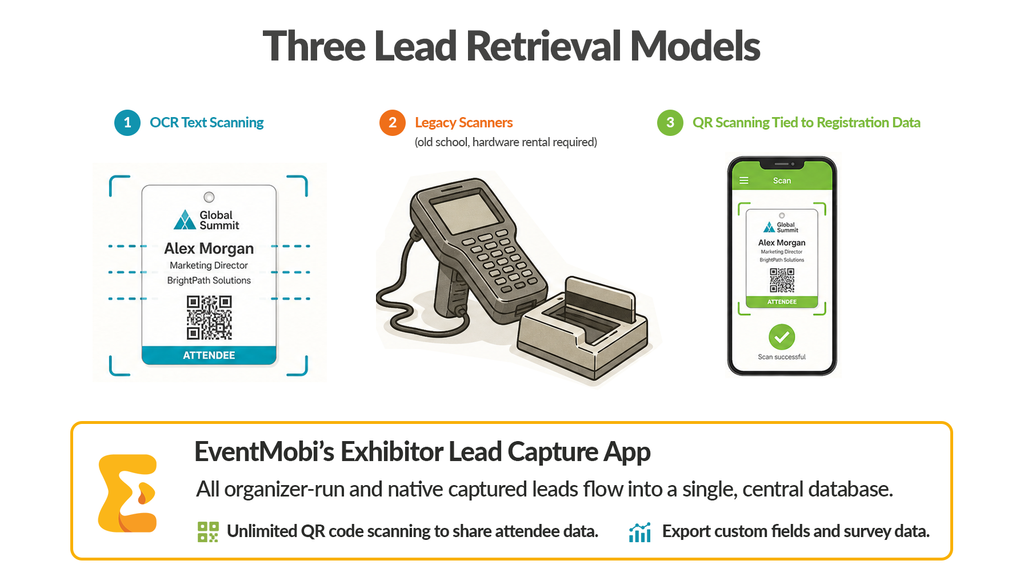
For decades, lead capture was straightforward—and expensive. Exhibitors rented specialized, bulky hardware from exclusive third-party vendors. These included heavy laser barcode scanners and magnetic stripe readers. Because event organizers neither wanted to own nor manage this hardware, they outsourced the function. A vendor supplied the units, and the revenue was split, establishing lead capture as a reliable, highly profitable standalone line of business for organizers.
Era 2: The Mobile App Integration (2010s–Early 2020s)
As smartphones permeated the market, software developers folded lead capture directly into mobile event apps. Badge scanning transitioned from dedicated hardware rentals to in-app camera features tied directly to the event’s central registration database. This promised seamless data synchronization, ensuring that every captured lead was authenticated against verified registration records.
Era 3: The AI and Third-Party Disruption (Present Day)
Today, a convergence of three distinct technological forces has shattered the traditional model:
- Ubiquitous Mobile Cameras: High-resolution smartphone cameras paired with advanced Optical Character Recognition (OCR) mean any device can read text off a badge instantly.
- Accessible AI Data Enrichment: Specialized third-party B2B databases and AI tools allow users to cross-reference a simple name and company with public web data in milliseconds, bypassing the need for a closed-loop event ecosystem.
- Subscription-Based Portability: Exhibitors can now purchase an affordable monthly software subscription to an independent scanning app and reuse it seamlessly across dozens of different trade shows throughout the year.
For a busy corporate marketing team chasing operational consistency across a heavy annual event calendar, the temptation to abandon disparate, show-specific add-on fees in favor of a single, universal tool is exceptionally high.
Supporting Data: The Hidden Flaws of Bring-Your-Own Scanning Apps
While independent AI badge scanners and OCR tools appear sleek and efficient on paper, they harbor severe systemic flaws that ultimately harm both the exhibitor and the event organizer.
1. Data Accuracy Deficits
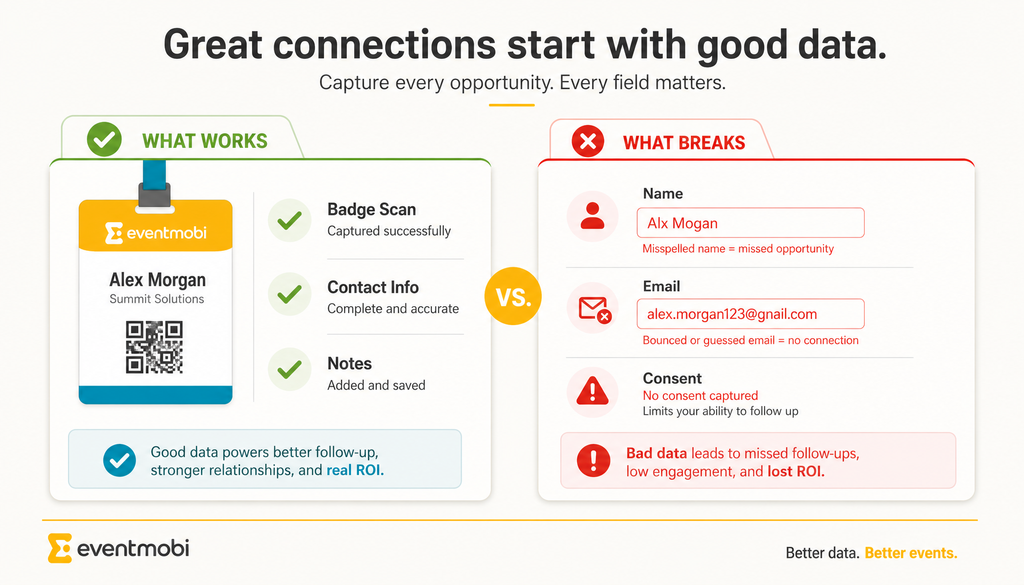
Third-party scrapers rely on probability algorithms rather than direct database validation. Consequently, they frequently fail in two crucial areas: correct legal names and active email addresses. A badge printed with a preferred name or a corporate pseudonym can completely confuse an AI parser, resulting in misspelled client names and bounced emails.
2. The Legal and Compliance Time Bomb
Perhaps the most alarming vulnerability of third-party scanning tools is the consent gap. When an attendee attends a trade show, their data collection consent is bound to the organizer’s privacy policy and the specific event infrastructure. When an exhibitor uses an unvetted scraping app, attendee data is frequently ingested, stored, and enriched outside of compliant data frameworks.
If an attendee is subsequently bombarded with unsolicited sales emails at their personal or direct corporate address post-show, the frustration and regulatory complaints land squarely on the event organizer—not the third-party app vendor.
Regulatory bodies are cracking down heavily on unauthorized data harvesting. A prime example occurred when France’s data protection regulator, the CNIL, fined data enrichment vendor Kaspr €240,000 for scraping contact details without a valid legal basis under the European Union’s General Data Protection Regulation (GDPR).
Official Responses and Expert Insights: Reframing the Business Model
Industry leaders argue that fighting this shift with aggressive sales pitches or restrictive onsite penalties is a losing battle. The standalone "badge scan" is no longer a scarce commodity; therefore, attempting to monetize it as a separate line item is fundamentally flawed.
During a recent masterclass hosted by event technology leader EventMobi, industry experts dissected the crisis and proposed a radical overhaul of expo economics.
Adam Parry, Founder of Event Tech Live, delivered a stark analogy regarding the traditional monetization structure:
"Charging a mandatory lead capture fee feels like walking into a restaurant, ordering a steak, but getting asked to pay for the plate for it to sit on in order for you to eat it."
Parry and other event strategists advocate for a complete reframe: Lead capture must be bundled directly into the foundational booth package, rather than bolted on as an afterthought.
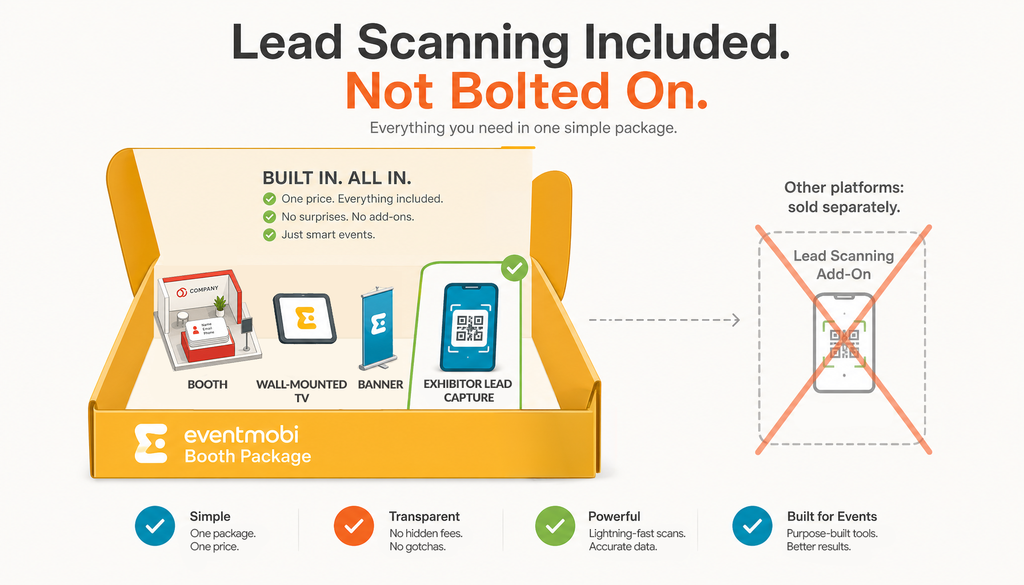
Modern event platforms have made this economically viable. Enterprise-grade lead capture solutions can now be integrated at scale for nominal per-exhibitor costs (such as $50 for multi-license company packs). By folding this fee into the base exhibitor pricing or absorbing it into a slightly adjusted booth rate, organizers completely eliminate the friction that drives exhibitors to seek out unauthorized workarounds.
Furthermore, this model transforms the balance sheet: instead of relying on a disgruntled minority of booths to purchase expensive add-on scans, the modest cost is distributed across the entire exhibitor base, guaranteeing higher adoption rates and cleaner, centralized data pools.
Implications: Monetizing "Event Signals" Beyond the Badge Scan
While bundling basic badge scanning solves the immediate revenue leak, forward-thinking event organizers are realizing that the true competitive advantage lies in selling data that no third-party smartphone app can possibly replicate.
An AI-powered camera can guess a name and scrape a corporate domain from the web, but it is entirely blind to behavior. This behavioral layer consists of event signals—proprietary data points that live exclusively inside the event’s native orchestration platform:
- Session Attendance: Which educational keynotes or technical workshops did the prospect attend?
- In-App Engagement: Did the attendee participate in live session Q&As, poll responses, or gamification challenges?
- Exhibitor Profile Interactions: Did the attendee bookmark the exhibitor’s digital booth profile prior to stepping foot on the physical expo floor?
The Power of Enriched Intent Data
When a third-party scraper hands an exhibitor a list of 200 raw names, the sales team must cold-call blindly. In contrast, an official event lead retrieval app powered by platform telemetry allows the organizer to provide genuine, high-intent intelligence:

"Here are your 200 captured leads. Furthermore, 30 of these individuals attended our morning cybersecurity keynote and actively submitted buying inquiries through our app this morning."
Organizers can package these event signals as premium sponsorship tiers. For instance, post-event targeted email campaigns can be curated and deployed by the organizer on behalf of key sponsors, reaching strictly segmented audiences based on demonstrated, verified on-site intent. This preserves attendee privacy, complies with international data privacy laws, and creates an entirely new, highly lucrative sponsorship inventory.
Actionable Strategy: The Pre-Show Lead Capture Checklist for Organizers
To successfully transition away from outdated add-on models and secure event revenue, organizers should implement the following pre-show checklist:
- Audit Your Exhibitor Technology Usage: Survey past and current exhibitors to understand what percentage are utilizing unauthorized third-party apps versus official tools.
- Redesign Exhibitor Packages: Remove lead capture as an a-la-carte upsell. Bundle multi-license mobile lead capture natively into all baseline booth packages.
- Educate Exhibitors on Compliance: Communicate clearly with sponsors regarding data privacy risks (such as GDPR and CCPA penalties) associated with unvetted third-party scrapers, emphasizing the legal safety of official tools.
- Elevate Data Offerings: Move beyond simple name-and-email capture by integrating behavioral event signals (session tracking, in-app polling, digital bookmarking) into your lead retrieval exports.
- Demonstrate Measurable ROI Early: Utilize centralized reporting dashboards to provide exhibitors with rich, intent-driven analytics immediately following the event, ensuring seamless sponsor renewals for the following year.
The Bottom Line
The rise of AI badge scanners and third-party data enrichment tools is a wake-up call for the trade show industry. Clinging to legacy business models that treat lead capture as an isolated, high-cost add-on is no longer viable in a tech-saturated market.
By eliminating standalone scanning fees, bundling lead retrieval directly into exhibitor packages, and capitalizing on exclusive behavioral event signals, event organizers can successfully plug revenue leaks, protect attendee trust, and transform expo floors into high-integrity, highly renewable revenue engines.
Related posts: