Beyond Basic Ticketing: Why Healthcare Organizations Require Specialized Event Registration Infrastructure

WASHINGTON — In the high-stakes ecosystem of healthcare administration, organizing an event is rarely as straightforward as selling a ticket and printing a nametag. Whether it is a regional hospital system orchestrating its annual medical staff conference, a professional medical association managing continuing medical education (CME)-accredited workshops, or a global pharmaceutical company coordinating investigator meetings, the operational demands extend far beyond the capabilities of standard, out-of-the-box ticketing tools.
Modern healthcare event registration sits squarely at the complex intersection of clinical education, regulatory compliance, data privacy governance, and professional development. For event planners in this sector, utilizing generic registration software often introduces workflow bottlenecks, compliance vulnerabilities, and administrative friction.
This comprehensive guide examines the distinct regulatory and logistical challenges healthcare organizations face, outlines the core technological capabilities required in a modern registration platform, details common operational scenarios, and provides a strategic checklist for evaluation.
The Unique Registration Challenges Facing Healthcare Organizations
Unlike consumer-facing conferences or corporate retreats, healthcare events demand rigorous data collection, strict access management, and adherence to specialized industry standards. Five primary challenges define the complexity of healthcare event registration.

1. Continuing Medical Education (CME) and CE Tracking
For the vast majority of medical and clinical events, the registration process is not merely a mechanism for confirming attendance; it is the foundational first link in a chain of data custody that culminates in official accreditation records.
Organizers of CME- and Continuing Education (CE)-accredited workshops must capture precise professional credential numbers, track granular session attendance, and export structured data sets that integrate directly with post-event certification and licensing databases. Collecting license numbers, state jurisdictions, National Provider Identifier (NPI) numbers, and specific session selections must be executed seamlessly at the point of sign-up. Relying on manual post-event follow-up mechanisms to gather missing credential data introduces unacceptable margins of error into professional development records.
2. Managing Diverse Attendee Ecosystems
A single medical conference often plays host to a diverse cross-section of professionals: physicians, nurses, allied health specialists, hospital administrators, pharmaceutical representatives, and commercial exhibitors. Each demographic registers under unique parameters, requiring distinct ticket tiers, access privileges, and data collection fields.
For example, a practicing physician must submit validation credentials, whereas an exhibitor requires booth assignment protocols, and a sponsored corporate attendee requires specialized billing and disclosure workflows. Managing this web of diversity without overwhelming registrants requires advanced conditional form logic. Without dynamic fields that display only relevant prompts based on prior user selections, organizations are forced to build fragmented, separate registration funnels that complicate back-end data consolidation.
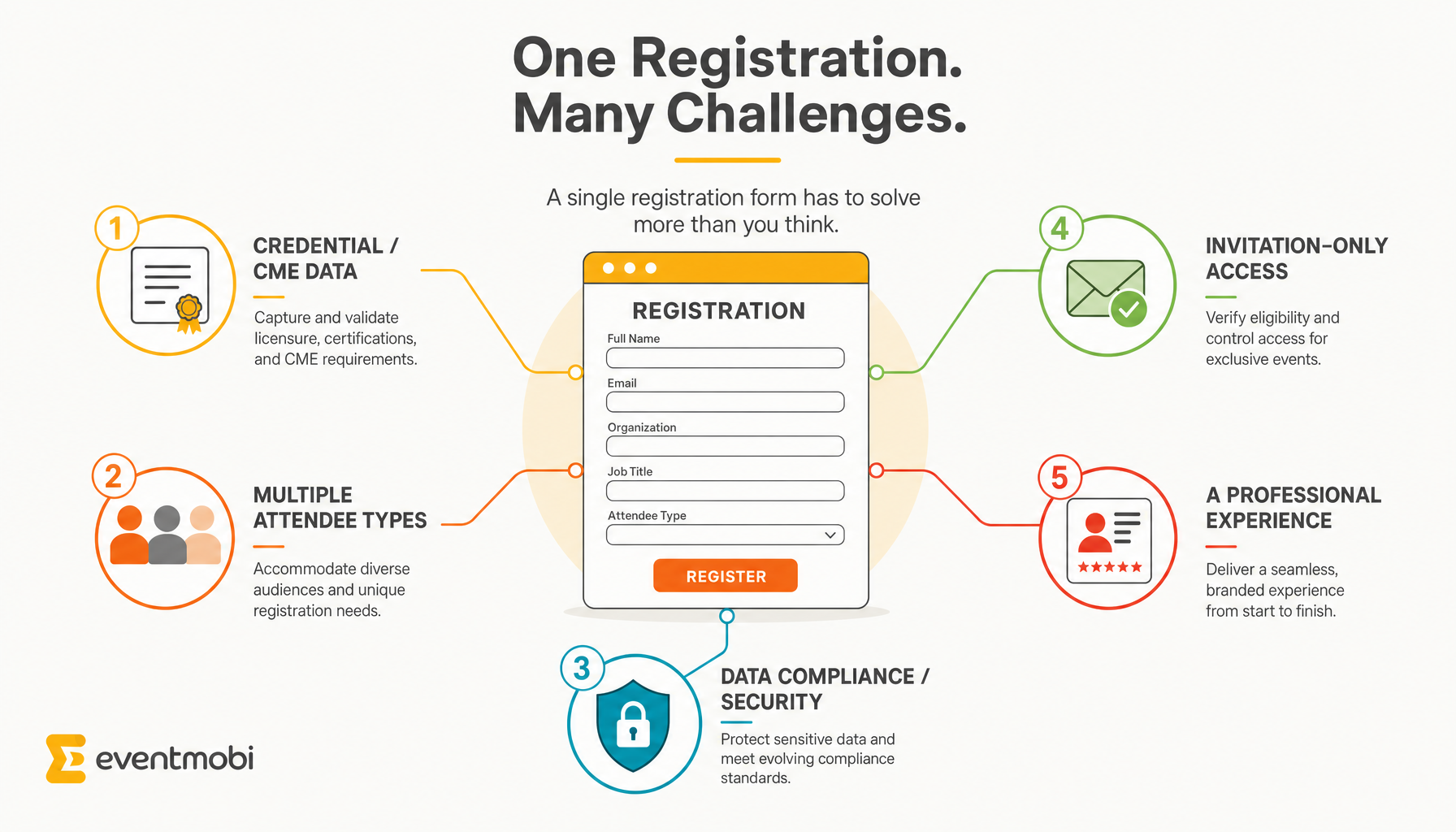
3. Heightened Data Sensitivity and Regulatory Compliance
Healthcare institutions operate under stringent data governance frameworks, most notably the Health Insurance Portability and Accountability Act (HIPAA) in the United States, alongside robust international frameworks like GDPR. Attendee data collected during event registration frequently includes sensitive professional data, institutional affiliations, and licensing credentials.
Furthermore, events involving pharmaceutical or medical device industry sponsors introduce additional layers of compliance. Organizers must navigate strict guidelines—such as the Accreditation Council for Continuing Medical Education (ACCME) Standards for Integrity and Independence—which govern industry sponsorship, financial disclosures, and the absolute separation of promotional activities from accredited educational content. Registration platforms must be engineered to capture, track, and protect these disclosures explicitly.
4. Gated Access and Invitation-Only Workflows
A significant portion of healthcare meetings—including clinical investigator roundtables, advisory board assemblies, medical staff leadership forums, and internal compliance training—are strictly invitation-only.
These events cannot rely on open-access registration portals. Platforms must support private registration gating, curated invitation lists, RSVP acceptance tracking, and secure promotional codes that unlock hidden ticket tiers for vetted participants without exposing administrative workarounds.

5. High Expectations for Professionalism and Polish
Healthcare professionals are discerning consumers accustomed to high standards of digital efficiency and institutional professionalism. A poorly designed, generic third-party registration form can inadvertently undermine the perceived authority and credibility of a hospital system or professional medical society. Cleanly branded, multi-page event websites integrated with frictionless registration flows, immediate confirmation sequences, and responsive support channels are critical for establishing immediate trust.
Essential Capabilities to Look for in Healthcare Event Registration Software
When evaluating software solutions, healthcare administrators must look past surface-level interface designs and interrogate the platform’s structural architecture. The following core capabilities are essential:
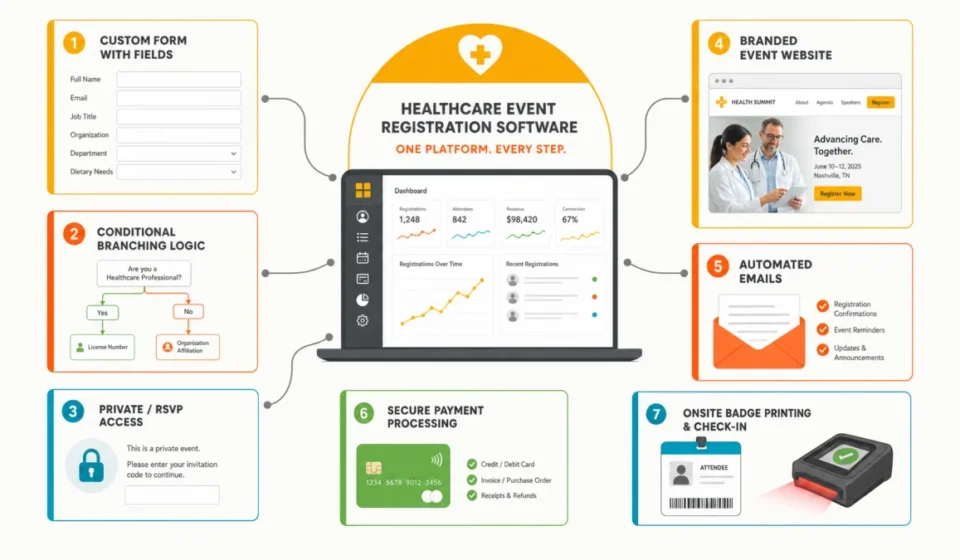
- Advanced Custom Form Fields: The system must natively support fields for license numbers, credential types, licensing states, and NPI numbers without requiring bespoke developer customizations.
- Dynamic Conditional Logic: Form builders must feature robust "if/then" conditional pathways, ensuring that physicians, nurses, and exhibitors see only relevant questions, preserving a streamlined user experience.
- Private Gating and RSVP Management: The platform should seamlessly transition between public-facing conferences and private, invitation-only gatherings via curated invite lists and secure access codes.
- Integrated Branded Websites: Drag-and-drop website builders that natively tie the registration page directly to the event’s informational hubs—displaying agendas, faculty biographies, and venue logistics—eliminate the security risks and disjointed user experiences of embedded third-party widgets.
- Segmented Email Communications: Pre- and post-event messaging tools must integrate directly with registration metadata, enabling precise audience segmentation for logistical updates, CME instructions, and compliance reminders.
- Flexible Payment Gateway Compatibility: Platforms should integrate smoothly with established payment processors (such as Stripe, PayPal Payflow Pro, Authorize.net, and Braintree) to accommodate institutional procurement policies, self-paying clinicians, and complimentary faculty passes.
- Onsite Badging and Check-In Synchronization: Eliminating manual data exports on the morning of an event requires platforms that feed registration data instantly into onsite badge-printing and check-in applications.
- AI-Powered Attendee Support: Modern tools, such as embedded AI concierges, can field high-volume pre-event inquiries regarding CME credit availability, accreditation bodies, and cancellation policies 24/7, significantly reducing administrative burdens on event teams.
Common Healthcare Event Registration Scenarios in Practice
The operational requirements of healthcare registration manifest differently depending on the specific profile of the gathering:
[Annual Medical Staff Conference]  --> High Complexity | Multi-Attendee | CME Tracking
[CME-Accredited Workshop]          --> Credential-Heavy | Structured Data Export
[Investigator Roundtable]          --> Private RSVP    | Invitation-Only Gating
[Association Annual Meeting]       --> Full-Scale Eco  | Exhibitors & Sponsorships
[Internal Clinical Training] --> Domain-Locked | Internal Compliance Focus- Annual Medical Staff Conference: Characterized by moderate-to-high complexity, multi-tiered ticket pricing, comprehensive CME tracking, and a content-rich event website balancing self-paying clinicians and institutional sponsors.
- CME-Accredited Workshops: Focused heavily on credential capture and exact session-to-credit mapping, requiring rigorous post-event data reporting capabilities.
- Investigator Meetings & Advisory Boards: Defined by small, curated guest lists, private RSVP acceptance flows, and strict compliance tracking regarding industry disclosures.
- Medical Association Annual Conferences: Massive flagship gatherings that require the full spectrum of registration capabilities: early-bird pricing tiers, concurrent session selection, exhibitor management, and integrated mobile apps.
- Internal Clinical Training: Streamlined, domain-restricted portals designed to track employee participation in mandatory professional development without exposing registration channels to the public internet.
Strategic Evaluation Checklist: Questions to Ask Vendors
Before committing to a long-term software contract, healthcare procurement and event teams should pose the following vetting questions to prospective technology providers:

- Can the platform natively capture complex credential and CME tracking data without custom coding?
- Does the form builder utilize conditional logic to segment registrants by profession dynamically?
- How are private, invitation-only events secured against unauthorized public registration?
- In what formats can registration data be exported to ensure seamless compatibility with our existing accreditation management systems?
- Does the platform integrate with our organization’s mandated enterprise payment gateways?
Implications for Healthcare Event Organizers
The administrative weight of planning clinical education and medical conferences has reached a point where legacy software tools are no longer viable. For hospital systems, medical associations, and pharmaceutical organizers, adopting specialized event registration infrastructure is an operational necessity.
By prioritizing platforms that blend rigorous credential verification, dynamic form logic, uncompromising data compliance, and native integration with onsite check-in systems, healthcare organizations can mitigate administrative risk, protect sensitive professional data, and deliver a seamless, professional experience for clinicians and administrators alike.