Beyond the "Do More With Less" Trap: A New Paradigm for Data-Driven Marketing

The modern marketing professional is caught in a paradoxical vice. Budgets are tightening, resources are thinning, yet the expectations for pipeline growth and revenue contribution have never been higher. For years, the industry’s knee-jerk reaction to this pressure has been to "do more"—more webinars, more whitepapers, more social posts, and more frantic activity.
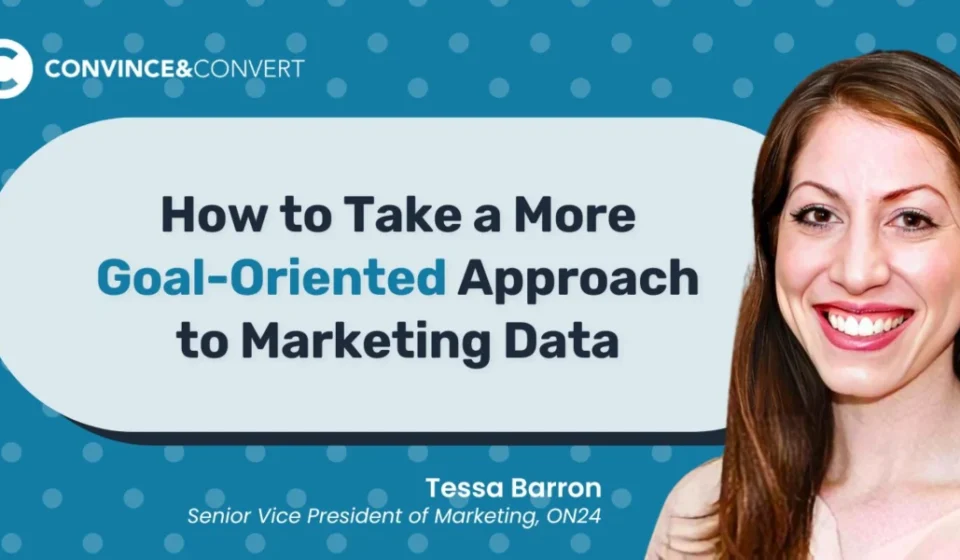
However, Tessa Barron, formerly the Senior Vice President of Marketing at ON24, argues that this quantity-over-quality approach is a relic of a bygone era. In a recent appearance on the Data-Driven Decisions podcast, Barron dismantled the conventional wisdom that links marketing volume to revenue success. Instead, she proposes a fundamental shift: moving from a "tactic-oriented" mindset to a "goal-oriented" framework.
The Evolution of the Marketing Mindset
The disconnect in modern marketing often begins with a refusal to acknowledge that the world has fundamentally shifted. The post-pandemic consumer landscape has evolved, yet many marketing departments are still running the same playbooks they utilized in 2019.
"We as marketers have to check in with ourselves and ask: Are we still doing what we were doing three or four years ago?" Barron notes. "If the answer is yes, that is the first sign that we need to stop expecting that if we execute the same way, we’re going to get more in return."
For seasoned professionals, this is a difficult pill to swallow. It is comfortable to rely on "tried-and-tested" content formats. While webinars, blogs, and videos remain vital tools, they are merely vehicles. The failure occurs when marketers prioritize the vehicle (the tactic) over the destination (the business goal).
Shifting from Tactics to Objectives
The transition requires a change in vernacular and intent. A tactic-driven marketer starts by planning a calendar: "We need four webinars in Q1." A goal-driven marketer starts by identifying a business imperative: "We need to penetrate X number of new accounts or achieve a 10% uplift in pipeline."
By framing the work around a specific outcome—such as increasing the conversion rate of first meetings—the choice of tactic becomes clear. If the goal is a 10% conversion lift, the marketer must ask: What content will educate the prospect effectively enough to drive that meeting? If the answer is a deep-dive technical webinar, the webinar is no longer just "content"; it is a strategic tool designed for a specific conversion milestone.
Uncovering Key Signals: The Data Advantage
In an era of "big data," marketers are often drowning in vanity metrics—page views, clicks, and downloads—that provide little insight into actual buyer intent. Barron suggests that marketers must pivot from collecting "data" to identifying "signals."
A signal is any data point that indicates a buyer is moving closer to a purchase decision. Once these signals are identified, marketing programs should be designed as "traps" or "nets" to capture that intent.
Strategic Data Capture in Practice
ON24 has pioneered this approach by transforming passive content consumption into an active data-gathering exercise. Through polls, surveys, and Q&A sessions within webinars, they move beyond tracking who attended to understanding what the attendee needs.
Barron highlights two successful case studies that illustrate this methodology:
- The Cloud Provider Strategy: A technology company struggling to regain market share identified that prospects using a specific cloud infrastructure were 10 times more likely to convert. Rather than targeting a broad audience, they used webinar polls to ask, "Which cloud provider are you currently using?" This allowed them to filter and prioritize the leads that mattered most to the sales team.
- The Healthcare Risk Assessment: A pharmaceutical firm aimed to connect with doctors treating patients with specific high-risk conditions. By including a question in their educational webinars about the "risk profile" of the doctor’s patient base, they were able to segment the audience. Doctors who identified as having a "high-risk" patient base were immediately identified as high-priority leads for follow-up.
These examples underscore a vital truth: data is only as valuable as the action it triggers.
Bridging the Great Divide: Sales and Marketing Alignment
Perhaps the most significant implication of Barron’s framework is the necessity of radical collaboration between Sales and Marketing. Marketing departments frequently operate in a silo, creating content based on what they assume the customer needs.
"Salespeople sit at the front lines of the prospect’s communication with a company," Barron observes. "They will be able to tell you much more about the prospect’s needs, hesitations, doubts, and expectations than any marketing report."
Redefining the Pipeline Relationship
There is a common misconception that Marketing "creates" the pipeline. Barron offers a sobering correction: Marketing does not create the pipeline; it creates the conditions for the pipeline to exist.
"Marketers are developing a net to catch people who might turn into a pipeline," she explains. "But it is the salespeople who create the pipeline."
This distinction is crucial. If Marketing views its job as "delivering a clear picture" of the prospect to the salesperson before they pick up the phone, the entire strategy changes. Instead of sending raw, unqualified leads, Marketing becomes a provider of intelligence. When Sales and Marketing align on what constitutes a "signal," the friction between the two departments often evaporates, replaced by a shared focus on conversion rates.
The Mechanics of Messaging: A Strategic Framework
To move prospects through the funnel, messaging must be tailored to the specific stage of the buying journey. The "one-size-fits-all" approach to content is often the primary culprit behind low conversion rates.
Barron emphasizes that marketers should rigorously audit the "in-between" steps—the friction points often overlooked during a lead’s journey. These include:
- Lead Capture Forms: Are they asking for too much information, causing abandonment?
- Tailored Messaging: Does the language used in a follow-up email match the intent demonstrated in the initial webinar?
- Interaction Opportunities: Is there a clear path forward for the prospect after they finish consuming a piece of content?
By tightening these small, often ignored steps, marketers can exert control over the conversion process. "It’s focusing there that you can really start to control and understand how to turn dials and add more success," Barron says.
Implications for Corporate Stakeholders
The challenge of "doing more with less" is exacerbated when leadership teams do not understand the nuance of these data strategies. If stakeholders are fixated on vanity metrics, the marketing team is forced into a cycle of producing useless "noise."
To combat this, Barron advocates for a "less is more" approach to reporting. Data should be presented to stakeholders in the simplest, most visually intuitive way possible. The focus must remain on the metrics that reflect health: conversion rates, signal density, and pipeline velocity.
When marketing leaders communicate using this focused data strategy, they build organizational trust. Stakeholders are more likely to support a "less is more" strategy when they can clearly see the correlation between a specific data-driven initiative and the company’s bottom line.
Conclusion: A Call for Intentionality
The pressure to "do more" is unlikely to subside in the current economic climate. However, the path forward for high-performing marketing teams is not found in harder work or longer hours; it is found in the courage to do less, but to do it with greater precision.
By abandoning the "tactic-first" mentality and embracing a "goal-first" framework, marketers can transform their departments from expense centers into revenue engines. This requires moving away from the safety of familiar tactics and leaning into the discomfort of deep, signal-based data analysis.
As Tessa Barron illustrates, when marketers stop trying to be the loudest voice in the room and start being the most informed, they gain the ability to steer the business toward its goals with surgical accuracy. The future of marketing is not about volume—it is about the signal.