Inside F.W. Woolworth’s Former 40th-Floor Skyline Retreat: A $18.5 Million Slice of Gilded Age New York History

Main Facts
Perched high above City Hall Park in Lower Manhattan, a magnificent piece of American retail and architectural history has returned to the luxury real estate market. Residence 40, a sprawling 6,000-square-foot condominium occupying the 40th floor of the iconic Woolworth Building, is currently listed for $18.5 million. Represented by Catherine Juracich of The Corcoran Group, this private home was once the exclusive personal retreat and executive headquarters of retail titan Frank W. Woolworth, the mastermind behind the five-and-dime empire that fundamentally transformed the landscape of American consumerism.
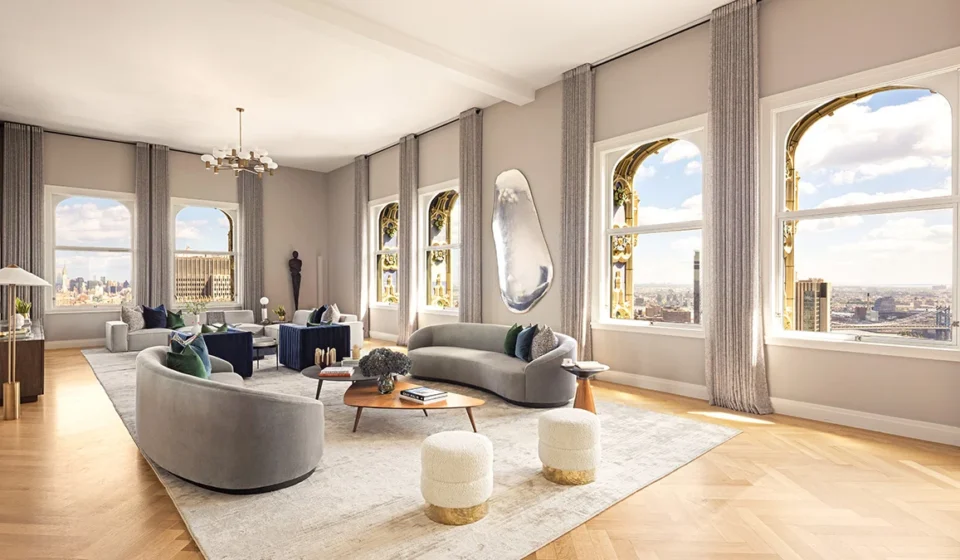
Today, this storied aerie has been meticulously adapted for contemporary luxury living while fiercely preserving its historic DNA. Rising 516 feet above the bustling New York City streets, Residence 40 is distinguished as the only home within the building to combine soaring 15-foot ceilings with authentic, original polychromatic terra-cotta detailing in intricate floral motifs that frame its grand windows.
Accessed via a private elevator, the residence opens into an awe-inspiring 50-foot great room that offers panoramic vistas stretching across Lower Manhattan, framing both the Hudson and East rivers. The layout features four meticulously appointed bedrooms—each with its own en-suite bathroom—a grand dining room capable of seating more than 20 guests, and a chef’s kitchen equipped with custom Dada cabinetry, Calacatta Caldia marble surfaces, and elite Miele appliances.

The building itself, a landmarked neo-Gothic masterpiece commissioned by Woolworth and completed in 1913, remains one of the world’s most recognizable architectural achievements. While the upper tiers of the skyscraper have been successfully reimagined as elite residential spaces by Alchemy Properties—with interiors originally designed by the late, legendary Thierry W. Despont—the address continues to attract elite buyers, high-profile residents, and even Hollywood fame, having previously served as the fictional home of Kendall Roy in HBO’s hit series Succession.
Chronology: The Evolution of a Skyline Icon
To fully understand the gravity of Residence 40, one must trace the timeline of the Woolworth Building from its Gilded Age origins to its modern-day reincarnation as a vertical village for the ultra-wealthy.
- 1913: The Woolworth Building is officially completed. Commissioned by five-and-dime retail magnate Frank W. Woolworth and designed by visionary architect Cass Gilbert, the neo-Gothic skyscraper opens its doors. At a staggering 792 feet, it reigns as the tallest building in the world, serving as a powerful symbol of corporate might and architectural innovation. The 40th floor is established as Woolworth’s private sanctuary and command center.
- Decades of Commerce: Throughout the 20th century, the skyscraper functions primarily as a bustling commercial hub. The Woolworth business empire expands and eventually transitions, ultimately becoming a foundational part of what is known today as Foot Locker, though the original founder’s name remains permanently etched into the New York City skyline.
- The Residential Conversion: Alchemy Properties acquires the upper reaches of the historic tower, embarking on an ambitious and delicate engineering and design feat. They convert the corporate offices above the 30th floor into 33 ultra-luxury condominium residences. Famed designer Thierry W. Despont is brought in to curate the interior aesthetics, balancing modern amenities with the building’s historic Gothic heritage.
- Modern Era & Pop Culture Stardom: The converted tower establishes itself as a magnet for high-profile figures. The building gains modern cultural cachet when it serves as the lavish backdrop for Kendall Roy’s apartment in the critically acclaimed television series Succession. Simultaneously, tech and retail pioneers—such as The RealReal founder Julie Wainwright—buy into the building, cementing its status as a premier residential address.
- Present Day: Residence 40 hits the market with an asking price of $18.5 million, offering a rare opportunity for a buyer to acquire a turnkey modern estate deeply anchored in the architectural annals of New York City history.
Supporting Data and Architectural Specifications
The architectural pedigree and structural specifications of Residence 40 place it in an elite tier of Manhattan real estate offerings. Below is a comprehensive breakdown of the property’s key metrics and features:

- Location: 2 Park Place, Residence 40, Lower Manhattan, New York, NY 10007.
- Asking Price: $18.5 million.
- Interior Square Footage: Approximately 6,000 square feet.
- Elevation: Situated 516 feet above City Hall Park.
- Ceiling Heights: An impressive 15 feet throughout the primary living spaces, maximizing natural light and volumetric grandeur.
- Layout: 4 bedrooms, 4 private en-suite bathrooms, a 50-foot great room, a formal dining salon (seating 20+), and a gourmet kitchen.
- Historic Details: Original polychromatic terra-cotta floral motifs integrated directly into the window framing of the 40th floor—a feature unique to this specific residence within the building.
- Kitchen Finishes: Custom Dada white cabinetry, a sprawling marble island wrapped in Calacatta Caldia marble, and a suite of professional-grade Miele appliances.
- Primary Suite Features: A sprawling corner bedroom layout framing dual city and river views, a generous dedicated dressing room, and a spa-inspired marble bathroom complete with radiant heated floors.
- Building Amenities: Full-time white-glove staff, a state-of-the-art swimming pool, a dedicated fitness studio, a private wine cellar and tasting room, and the exclusive Gilbert Lounge, named in honor of original architect Cass Gilbert.
- Listing Brokerage: Represented exclusively by Catherine Juracich of The Corcoran Group.
Official Responses and Market Perspectives
Real estate professionals and preservationists have long lauded the meticulous balance struck between historical preservation and luxury modernization within the Woolworth Building’s residential conversion.
Catherine Juracich of The Corcoran Group, who holds the $18.5 million listing for Residence 40, emphasizes the rarity of the offering. "There is simply nothing else like it on the market," notes market analysis surrounding the property. "To live within the literal footprint of where F.W. Woolworth once oversaw a global retail empire—while enjoying 15-foot ceilings and authentic, museum-quality terra-cotta details embedded right into your living space—is an unmatched luxury experience."
Architectural historians have similarly praised Alchemy Properties and the late Thierry W. Despont for resisting the urge to strip the upper floors of their historic identity. Instead, the integration of world-class amenities—such as the subterranean pool, wine-tasting rooms, and the Gilbert Lounge—was executed in a manner that respects Cass Gilbert’s original 1913 design intent. The preservation of the building’s exterior terra-cotta cladding and Gothic buttresses ensures that the structure remains an immutable crown jewel of the Lower Manhattan skyline.

Implications for the Luxury Real Estate Market
The listing of Residence 40 at $18.5 million carries broader implications for the trajectory of Lower Manhattan’s ultra-prime residential sector, particularly concerning historic conversions versus newly constructed glass towers.
1. The Premium on Historic Authenticity
As sleek, uniform glass towers continue to proliferate across the Manhattan skyline, properties that offer tangible, irreplaceable historic provenance are seeing sustained demand from high-net-worth buyers. Residence 40 is not merely a collection of luxury finishes; it is a documented historical artifact. Buyers at this price point are increasingly prioritizing narrative, architectural heritage, and character over cookie-cutter modern luxury—a trend that positions landmarked conversions favorably against contemporary new developments.
2. Downtown’s Continued Evolution as a Residential Haven
Historically viewed strictly as a commercial and financial district, Lower Manhattan has undergone a profound structural shift over the past two decades. The successful residential conversion of commercial icons like the Woolworth Building has accelerated this neighborhood evolution. By introducing five-star residential amenities—pools, private lounges, and white-glove concierge services—into historic structures, developers have firmly established Lower Manhattan as a top-tier destination for luxury residential buyers seeking both convenience and culture.

3. Resilience of Trophy Assets
Even amid broader economic fluctuations and shifting interest rate environments, "trophy" assets with unique selling propositions—such as celebrity associations, unparalleled ceiling heights, or direct links to historical figures like F.W. Woolworth—tend to command insulated market interest. Properties that cannot be replicated anywhere else in the world remain shielded from broader market corrections, serving as enduring stores of wealth for global ultra-high-net-worth individuals.
Ultimately, Residence 40 stands as a testament to New York City’s unique ability to reinvent its past, transforming the executive command center of a Gilded Age titan into one of the most coveted modern residential sanctuaries in the world.