Monetizing the Trade Show Floor: Why Event Organizers Are Rethinking Exhibitor Lead Capture

By The Event Industry News Desk
Published: October 2026
Main Facts: The Untapped Revenue Stream on the Trade Show Floor
For decades, event organizers have viewed exhibitor lead capture through a narrow lens: a logistical utility meant merely to cover the baseline costs of printing badges and supplying hardware scanners. According to recent insights from event technology leaders and industry masterclasses—including EventMobi’s Inside Job series and contributions from Event Tech Live co-founder Adam Parry—this traditional approach represents a massive blind spot. Organizers are routinely leaving tens of thousands of dollars in sponsorship revenue on the table simply by treating lead retrieval as an afterthought rather than a high-value core asset.
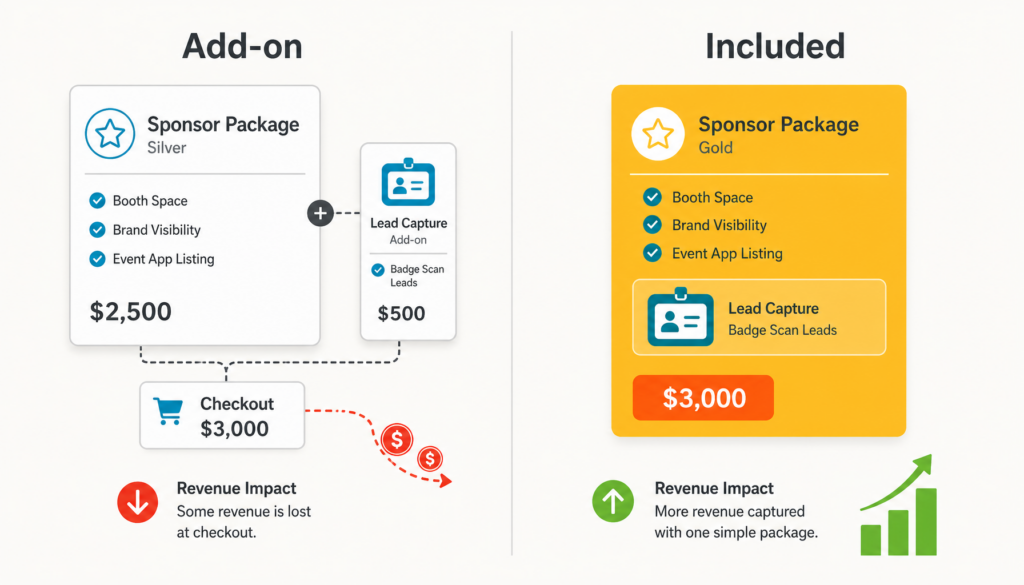
The financial friction is clear. When lead capture is pitched as a separate, optional add-on at checkout, a significant percentage of exhibitors opt out. To bypass the official app, these exhibitors frequently turn to unofficial scanning tools. These third-party workarounds typically capture only a bare-bones name and company from a badge, then rely on external, automated data enrichment software to guess the remaining contact details. The resulting data is frequently inaccurate, incomplete, or entirely uncompliant with privacy regulations.

For event organizers, this unofficial workaround creates a compounding crisis:
- Lost Revenue: Every exhibitor who skips the official app represents a completely uncollected revenue stream.
- Defective Data: Without reliable, verified data, exhibitors cannot effectively follow up with prospective clients.
- Failed ROI and Churn: When exhibitors fail to see a tangible return on investment (ROI) from the show, their future renewals are placed directly at risk.
The solution being adopted by forward-thinking show runners is straightforward: bundle lead capture directly into every exhibitor and sponsor package, baking a healthy profit margin straight into the upfront tier pricing.
Chronology: The Evolution of Trade Show Lead Retrieval and the Rise of Unofficial Apps
To understand how the industry reached this crossroads, it is necessary to examine how lead retrieval has evolved over the past two decades.
- Early 2000s (The Hardware Era): Lead retrieval was dominated by bulky, dedicated laser scanners rented out at exorbitant daily rates. Organizers outsourced these operations to third-party registration giants, splitting modest commissions while exhibitors grumbled about the hardware costs.
- Early 2010s (The App Transition): As smartphones saturated the market, event software companies introduced proprietary mobile apps. However, many organizers continued to treat these apps as standalone add-on products, requiring exhibitors to make a secondary purchasing decision during checkout—a friction point that suppressed adoption rates.
- 2024–2025 (The Rise of Unofficial Scanners): Driven by tighter corporate marketing budgets and a desire to cut costs, a segment of exhibitors began bypassing official event apps entirely. They substituted official infrastructure with general-purpose barcode scanners paired with AI data-enrichment scripts. This trend created widespread data hygiene issues across the exhibition sector.
- Late 2026 (The Bundling Paradigm Shift): Industry platforms like EventMobi began deploying advanced ecosystem tools—such as direct registration-linked CSV exports and enhanced custom qualifier settings—empowering organizers to reclaim control. By late 2026, thought leaders began aggressively advocating for the "bundled package" model, urging organizers to bake lead capture into every tier before the prospectus goes to print.
Supporting Data: The Economics of Lead Retrieval Pricing
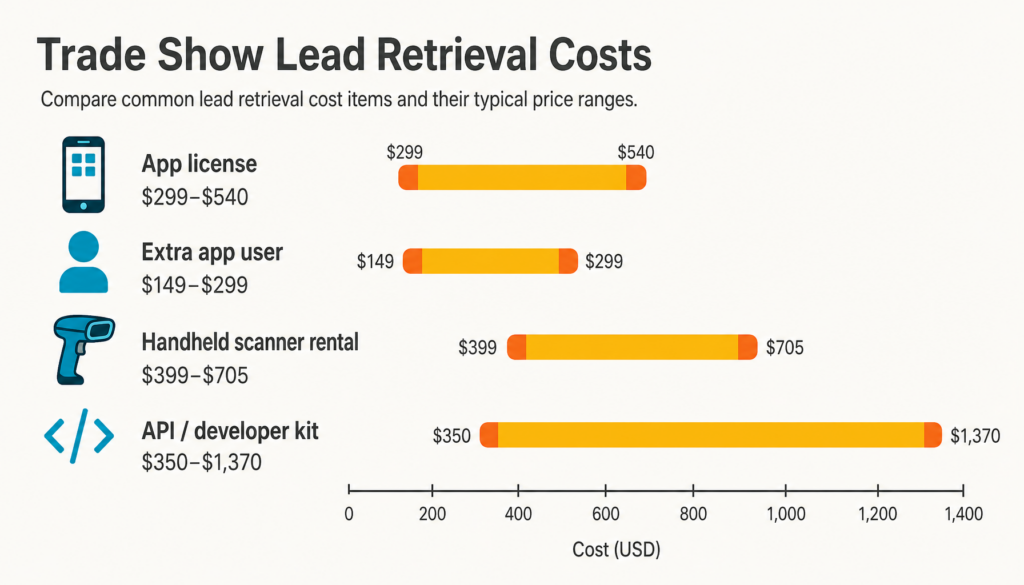
Pricing lead capture effectively requires a firm grasp of current market rates and exhibitor psychology. Many organizers arbitrarily assign a price tag without examining what exhibitors routinely pay at comparable, enterprise-grade industry events.
A comprehensive review of published order forms from major conventions—such as SEMICON West, ASMBS, and AAOS—highlights the wide spectrum of pricing models currently utilized across North American and European exhibitions. License fees for standalone apps, multi-user seat expansions, physical scanner rentals, and API integration kits range drastically from modest $50 software add-ons to enterprise packages costing upwards of $500 to $1,000 per booth.
Comparative Revenue Modeling
To visualize the financial impact of transitioning from an add-on model to an all-inclusive bundled model, consider two hypothetical trade show scenarios based on industry attachment metrics (modeled on data frameworks from providers like Converve):
-
Mid-Sized Association Show (60 Exhibitors):
- Traditional Add-On Model: Assuming a 40% attach rate and a $300 standalone license fee, the organizer generates $7,200 in secondary revenue. However, 60% of exhibitors leave with inferior data and compromised ROI.
- Bundled Model: By rolling a slightly marked-up software cost (e.g., $50 wholesale cost wrapped into a higher package price) across all 60 booths, 100% of exhibitors receive verified, consent-backed lead capture. Sponsor satisfaction rises, and renewal rates stabilize.
-
Large-Scale Enterprise Expo (200 Exhibitors):
- Traditional Add-On Model: At a 35% attach rate and a $400 licensing fee, gross add-on revenue hits $28,000. Yet, 130 exhibiting companies fail to use the official tool, increasing churn risk for the subsequent year’s floor plan.
- Bundled Model: 100% adoption is achieved. The baseline booth and sponsorship packages absorb the nominal software licensing fee, turning a fragmented administrative headache into a seamless, high-margin revenue line.
Furthermore, statistics cited by Cvent and Trade Show Labs place the average cost of generating a single trade show lead at $112. Given this high benchmark, exhibitors who capture even a handful of qualified leads realize an immediate, undeniable return on investment—making the inclusion of a professional lead capture tool an easy sell during package negotiations.

Official Responses and Industry Insights
The debate surrounding lead capture monetization took center stage during EventMobi’s Inside Job masterclass. During a live audience poll conducted during the session, 65% of event organizers admitted they still rely on selling lead capture as a fragmented, paid add-on, highlighting an industry-wide inertia that leaves easy money on the table.
Weighing in on the discussion, Adam Parry, co-founder of Event Tech Live, emphasized the psychological trap of underpricing: "When lead capture is priced solely to cover baseline badge costs, its perceived value in the eyes of the sponsor looks dramatically smaller than it actually is. Organizers must elevate lead capture to its rightful place as a premier sponsorship line item."
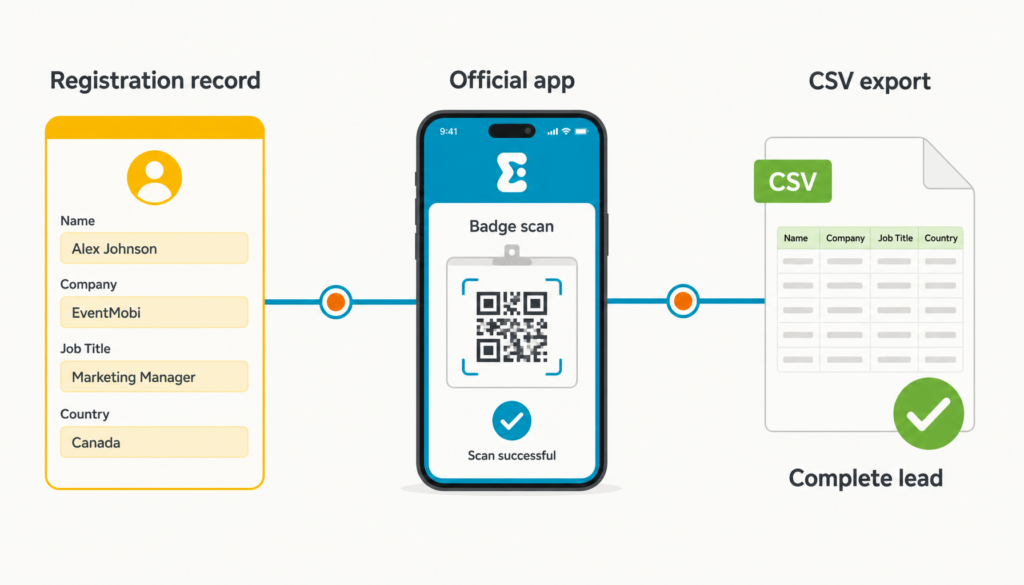
Platform providers have also mobilized to protect event ecosystems. Recent technological rollouts—such as EventMobi’s enhanced CSV export functionalities—allow organizers to embed critical registration data fields directly into exhibitor lead lists (including job titles, company sizes, and geographic locations). This protects both the event organizer’s primary revenue streams and the exhibitor’s data integrity, rendering unofficial scraping tools obsolete.
Implications: How to Implement the Bundled Model Before Your Next Prospectus Goes to Print
For event directors, exhibition managers, and association executives, shifting to an all-inclusive lead capture model requires proactive planning. To ensure smooth execution, organizers should focus on three critical operational pillars:
1. Redesign the Sponsor Prospectus
Eliminate lead capture as a standalone, à la carte checkbox on your order forms. Instead, integrate the cost of the software license (for instance, factoring in wholesale software expenses such as EventMobi’s $50 per-company license) directly into your Platinum, Gold, Silver, and baseline booth packages. Apply a healthy organizational markup so that your profit margin is safely secured within the package fee.
2. Streamline Pre-Show Onboarding
A pricing model only holds up at renewal if the product delivers frictionless value. Prevent on-site confusion by deploying onboarding communications two to four weeks before the event doors open. Ensure that booth staff are provided with clear, step-by-step digital guides for downloading the dedicated Lead Capture app and testing their login credentials ahead of time.

3. Arm Sponsors with Post-Show Evidence for Renewals
Data is your best defense during annual renewal conversations. Because modern platforms allow exhibitors to independently export clean, qualified CSV lead lists directly from their Company Portals, sponsors leave the floor with concrete proof of performance. Given that studies show up to 94% of marketers struggle with post-event lead conversion, providing them with a pristine, verified lead list transforms your event into an indispensable marketing channel.
By recalibrating how lead capture is packaged, priced, and delivered, event organizers can simultaneously eradicate unreliable unofficial scanning apps, elevate exhibitor satisfaction, and permanently unlock a lucrative new pillar of sponsorship revenue.