Navigating the Shift: Why Modern Corporate Event Teams Are Outgrowing Generic Registration Software

NEW YORK — Corporate event management has quietly undergone a structural transformation over the last several years. The professionals tasked with orchestrating executive summits, global sales kickoffs, customer conferences, internal town halls, and partner programs are routinely expected to execute high-stakes calendars with leaner teams than ever before. Yet, despite the growing complexity of these portfolios, many organizations continue to rely on legacy event tools or public consumer-facing ticketing software originally designed for open festivals or concerts rather than enterprise environments.
According to industry analysts, this technology gap has created an invisible operational tax on corporate event planners. Public consumer platforms fundamentally struggle to balance the dual mandate of modern enterprise events: they cannot easily gate an internal town hall to a specific employee base, nor can they cleanly scale to handle a paid, multi-track customer conference requiring corporate single-sign-on (SSO) and complex billing hierarchies.
To address these hurdles, enterprise event strategies must shift. A comprehensive analysis of current corporate needs reveals that successful programs require purpose-built infrastructure capable of navigating distinct internal and external workflows, brand standards, and rigorous security compliance.
The Core Challenges Facing Modern Corporate Event Teams
For decades, event operations suffered from a fragmented software ecosystem. Planners routinely juggled separate platforms for ticketing, email marketing, mobile apps, and onsite check-in, leading to siloed data and chronic administrative friction. Today, corporate event planners face six distinct structural hurdles that generic, consumer-oriented registration software simply cannot resolve.
1. Unifying Internal and External Events
Corporate calendars are rarely monolithic. A single department might manage employee-only training sessions, internal leadership offsites, massive global town halls, and customer-facing user conferences in the exact same quarter.

These events demand opposing configurations. Internal initiatives require strict privacy gating, domain-restricted access, and seamless integration with human resources systems. Conversely, external summits call for highly polished, public-facing brand experiences, robust payment processing, and sophisticated marketing automation. Relying on disconnected platforms for each creates fractured data lakes and inconsistent attendee journeys. Modern solutions must bridge this gap by offering configurable access controls under a single architecture.
2. Enforcing Strict Brand Consistency
Corporate events act as primary touchpoints for an organization’s identity. From the registration landing page and confirmation emails to badges and dedicated event applications, every asset must strictly mirror corporate brand guidelines.
Research from Marq’s State of Brand Consistency report underscores the stakes: 68% of businesses attribute 10% or more of their revenue growth directly to consistent brand presentation. For lean enterprise teams managing dozens of events annually, rebuilding assets from scratch or working within the rigid, unbranded templates of generic software introduces brand risk and wastes valuable hours.
3. Managing Diverse Stakeholder Ecosystems
A standard customer conference rarely caters to a single audience. Registrants frequently include paying customers, VIP executives, guest speakers, strategic sponsors, third-party exhibitors, press representatives, and internal staff.
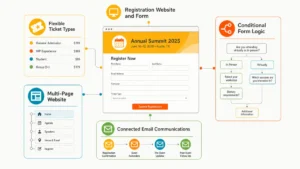
Each stakeholder group demands distinct data fields, unique access tiers, and specialized communication flows. Forcing all participants through a uniform registration path results in data collection errors and frustrated users. Advanced form logic—specifically conditional fields that dynamically adapt based on a registrant’s role—is essential to unifying this intake process.

4. Seamless Integration With the Enterprise Tech Stack
In a modern enterprise, event data cannot exist in a vacuum. Registration platforms must communicate fluidly with Customer Relationship Management (CRM) tools like Salesforce and HubSpot, marketing automation engines, HR databases, and internal messaging suites. When event platforms lack native integrations or robust API connectors, teams are forced into tedious manual data entry and error-prone reconciliation processes.
5. Compliance, Security, and Governance
In regulated sectors such as financial services, healthcare, and government contracting, data collection is bound by stringent legal frameworks. Private gating, invitation-only verification flows, and audit trails are non-negotiable baselines.
Furthermore, many corporate workflows require multi-tier approvals—such as a department manager or budget owner authorizing an employee’s attendance before registration is finalized. Enterprise buyers also look for verifiable security certifications, such as SOC 2 Type II compliance, robust data encryption at rest, and GDPR adherence, ensuring that the corporate entity retains full ownership of its proprietary attendee data.
6. Elevating the Attendee Experience
Corporate audiences—particularly B2B buyers and executives—carry high expectations for digital interactions. A clunky, third-party form signals poor operational maturity. A professional registration journey requires a responsive, multi-page event website, instant confirmation channels, and rapid, friction-free customer support.
Essential Capabilities of Enterprise Event Registration Software
Evaluating platforms against these realities requires looking beyond surface-level feature lists. Industry leaders suggest focusing on seven foundational capabilities when auditing software vendors:

- Branded Event Website Builders: Comprehensive customization controls covering typography, color palettes, imagery, and layout, allowing multi-page depths for agendas, speaker bios, and sponsor showcases.
- Flexible Access Controls: Granular settings that shift effortlessly between public RSVP tracking, domain-restricted employee sign-ins, and exclusive VIP invitation codes.
- Conditional Form Logic: Dynamic form fields that display or hide questions based on prior user inputs, ensuring tailored data collection per stakeholder group.
- Integrated Email Communications: Automated messaging engines linked directly to registration databases, enabling targeted segmentation based on ticket status, custom fields, or attendance history.
- Advanced Payment Processing: Multi-gateway support (such as Stripe, PayPal, Braintree, and Authorize.net) coupled with flexible group registration features. Enterprise software should enable a single invoice and checkout process for multiple attendees without tacking on hidden per-ticket processing fees.
- Ecosystem Interoperability: Native connectors and API availability to synchronize data instantly with core CRM and HR tools.
- Connected Onsite and App Infrastructure: Unified databases that feed registration details directly into badge-printing software, mobile event applications, and check-in kiosks without manual data exports.
Spotlight on Innovation: AI-Powered Attendee Support
As expectations for immediate digital assistance rise, traditional registration workflows often hit a wall during pre-event support. Inbox inquiries can sit unanswered for days, causing prospective attendees to abandon registration entirely.
To solve this, advanced platforms have begun integrating contextual Artificial Intelligence. For instance, solutions featuring built-in registration AI concierges allow organizations to deploy conversational assistants directly onto event websites. Unlike rigid chatbots that require extensive coding or manual script building, these modern tools autonomously ingest event documentation, ticket structures, and agenda details to provide round-the-clock answers to registrants, speakers, and sponsors alike.
For international teams operating across multiple time zones, 24/7 support is no longer a luxury. Furthermore, these AI layers capture organic search data, revealing precisely which questions prospective attendees are asking—thereby highlighting content gaps on the event website itself.
Mapping Common Corporate Event Workflows
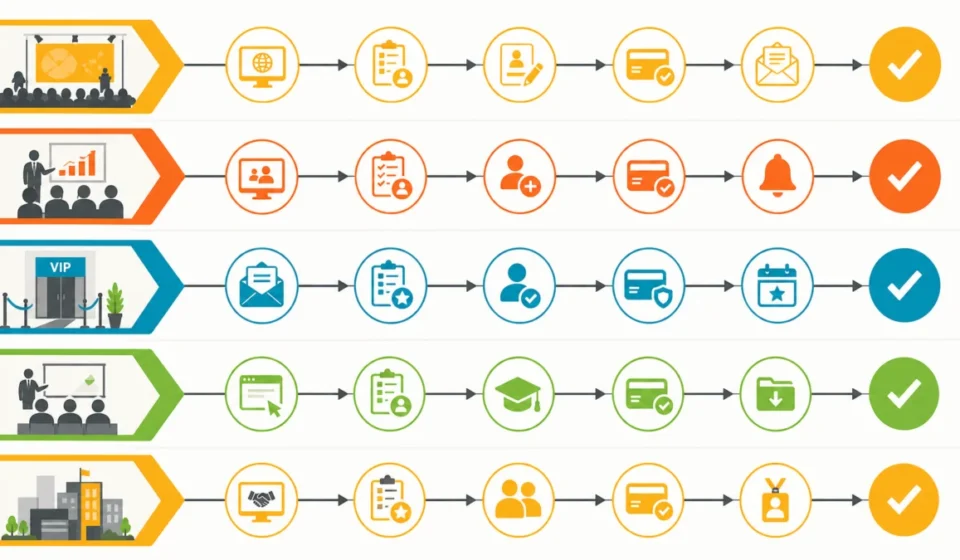
Enterprise software must accommodate diverse operational cadences. Industry workflows generally fall into five distinct archetypes:
- The Customer Conference: The most complex external event type, requiring multi-tier ticket sales, group billing, sponsor management, and deep CRM synchronization.
- Sales Kickoffs and Internal Town Halls: Employee-centric events requiring domain gating (e.g., restricting access to
@company.comemails), simple free ticketing, and logistically focused communications. - Executive Summits: Highly curated, invite-only gatherings driven by RSVP tracking, white-glove communications, and custom data capture for travel and lodging logistics.
- Training and Certification Programs: Structured events requiring prerequisite verification, multi-cohort session selection, and post-event educational data exports.
- Partner and Sponsor Summits: Segmented workflows that grant strategic partners access to specialized tracks, private areas, or exclusive pricing tiers via secure access codes.
Evaluating Vendors: Key Questions to Ask
When sitting down with software vendors, corporate procurement and event teams should use targeted inquiries to stress-test platform capabilities:

- How does the platform handle both internal, domain-gated events and public-facing, paid conferences within the same administrative dashboard?
- Does the system support group registration and unified invoicing for corporate buyers, or does every attendee require an individual checkout?
- What are your exact data security certifications (e.g., SOC 2 Type II), and how do you ensure compliance with regional privacy regulations like GDPR?
- Are there any hidden transaction fees or surcharges added per ticket on top of standard payment gateway rates and software subscription costs?
- How do registration records sync with our existing CRM and marketing automation stack in real time?
- What native mechanisms exist for managing approval workflows, such as manager sign-offs for internal travel and training budgets?
The Bottom Line
Ultimately, the most effective corporate registration software is not defined merely by an exhaustive feature checklist. Rather, it is measured by its ability to unify disparate event formats under a single, cohesive architecture, integrate effortlessly with existing enterprise tech stacks, and grant lean planning teams the operational leverage needed to execute high-volume programs seamlessly. By moving away from rigid consumer tools and investing in purpose-built enterprise platforms, corporate event leaders can future-proof their operations and elevate the strategic value of their entire event portfolio.