Oil Prices Teeter on the Brink of $100 as Gasoline Costs Defy Seasonal Norms

The global energy market is currently caught in a high-stakes tug-of-war between seasonal demand shifts and geopolitical volatility. As crude oil prices hover precariously near the psychologically significant $100-per-barrel threshold, American consumers are finding little relief at the pump. While a recent transition to cheaper winter-blend gasoline has offered a modest reprieve, the structural pressures on the energy sector suggest that the relief may be short-lived.
The State of the Market: A Tenuous Balancing Act
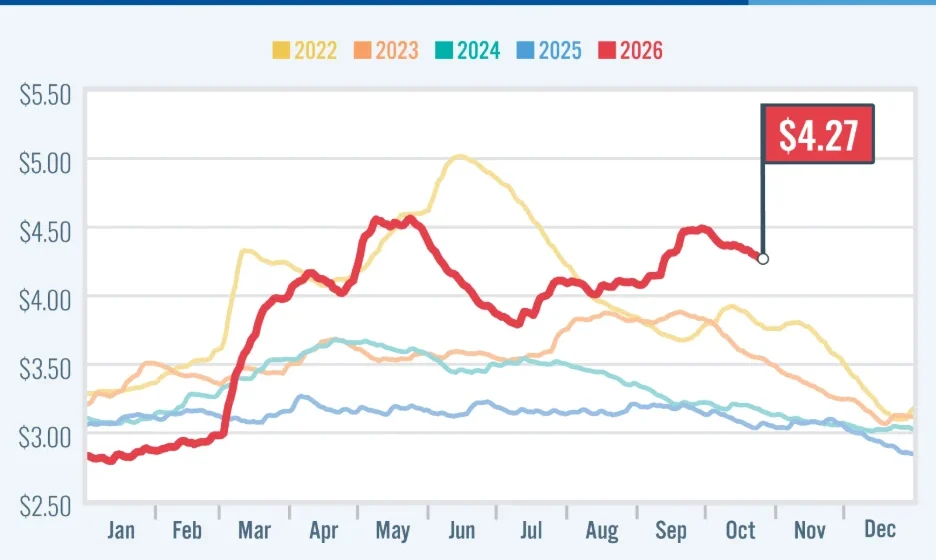
According to the latest reporting from AAA, the national average for a gallon of regular gasoline dipped by six cents this past week, settling at $4.27. While any decrease is welcomed by motorists, the broader trend remains troubling. This October is currently tracking to become the most expensive on record, continuing a grim streak that saw August and September also shatter historical pricing benchmarks.
The primary culprit for this sustained elevation in price is the volatility of crude oil. West Texas Intermediate (WTI)—the U.S. benchmark—has remained stubbornly high, trading near $97.15 per barrel following recent market sessions. The primary driver behind this resilience is instability in the Strait of Hormuz, a critical maritime chokepoint through which a significant portion of the world’s oil supply flows. Any disruption in this region ripples instantly through global markets, placing a "geopolitical premium" on every barrel produced.
Supply and Demand Dynamics
New data from the Energy Information Administration (EIA) paints a complex picture of domestic consumption. Gasoline demand surged last week, climbing from 8.40 million barrels per day to 8.98 million. Simultaneously, domestic gasoline stockpiles tightened, dropping from 208.3 million barrels to 205.3 million.
While domestic refineries have ramped up production—increasing from 9.23 million barrels per day to 9.75 million—the inventory deficit remains a concern. U.S. crude oil inventories fell by 3.1 million barrels to 412.5 million, a figure that sits roughly 3% below the five-year average. When inventories are this low, the market loses its "buffer" against unexpected supply shocks, making prices hypersensitive to even minor fluctuations in geopolitical stability or production output.
Chronology of the Current Price Surge
To understand why prices are so high, one must look at the sequence of events that have defined the latter half of the year:
- Mid-Summer Volatility (August/September): The summer driving season saw record-breaking demand, which, when coupled with maintenance-related refinery slowdowns, pushed prices to their first set of monthly records.
- The Transition Period (Late September/Early October): As refineries switched to the "winter-blend" gasoline—which is cheaper to produce because it lacks the additives required to prevent evaporation in hot weather—analysts anticipated a sharper drop in prices. However, the surge in crude oil prices neutralized much of these savings.
- The October Crunch: Despite the seasonal blend change, the persistence of the $100-per-barrel threat has kept retail prices from plummeting, resulting in an October that is poised to be the costliest in American history.
Regional Disparities: A Tale of Two Economies
The financial burden of current energy prices is not distributed evenly across the United States. Geography plays a massive role in how much a consumer pays for both gasoline and electricity.
The Gasoline Divide
The disparity between the most and least expensive gasoline markets is stark. In California, drivers are currently paying an average of $6.08 per gallon, a reflection of unique state-level taxes, environmental regulations, and regional supply chain logistics. Other Pacific states and parts of the Mountain West follow suit, with Hawaii ($5.64), Washington ($5.34), and Nevada ($5.33) rounding out the top of the cost spectrum.
Conversely, the Southern and Southeastern United States continue to benefit from closer proximity to the Gulf Coast refining hub. States such as North Carolina ($3.55), Georgia ($3.70), and Texas ($3.76) maintain significantly lower averages, highlighting how infrastructure and localized tax policies act as a hedge against global market volatility.

The EV Charging Landscape
The conversation regarding energy costs has increasingly expanded to include the electric vehicle (EV) sector. Currently, the national average for public charging remains stagnant at 41 cents per kilowatt-hour.
Much like gasoline, the cost of "refueling" an EV varies wildly by state. Hawaii leads the nation in charging costs at 54 cents per kilowatt-hour, followed by West Virginia and Louisiana. On the other end of the spectrum, states like Kansas (31 cents) and Missouri (32 cents) offer some of the most affordable public charging rates in the country. This data serves as a reminder that the transition to electrification does not exempt consumers from the volatility of energy markets, as utility rates are often tied to the cost of the natural gas and other fuels used to generate electricity.
Supporting Data: Why $100 Matters
In the world of commodities, $100 per barrel is more than just a number; it is a psychological and economic barrier. When crude oil trades at or above this level, the impact is felt across the entire supply chain.
- Manufacturing Costs: Higher oil prices translate to higher costs for plastics, chemicals, and fertilizers, which eventually trickle down to the grocery store and retail shelves.
- Logistics: The cost of transporting goods via truck or ship is directly correlated with the price of fuel. As diesel and gasoline remain high, the "cost of living" inflation is exacerbated.
- Refinery Margins: While oil companies often see increased profits, the volatility makes long-term planning difficult for smaller independent refineries, potentially leading to supply inconsistencies.
Implications and Future Outlook
The prevailing market conditions present a significant challenge for policymakers. With the U.S. crude inventory sitting 3% below the five-year average, the government has limited tools to mitigate price spikes in the short term. While calls for increased domestic drilling are frequent, the lead time for such projects is measured in years, not weeks.
Geopolitical Fragility
The situation in the Strait of Hormuz serves as a sobering reminder of the global nature of energy dependency. As long as a substantial percentage of the world’s daily oil production passes through such a narrow and volatile channel, the risk of a "price spike" will remain a permanent feature of the energy market.
The Energy Transition
The current situation also provides an unintended stress test for the nation’s transition to renewable energy. While electric vehicles offer a potential insulation from gasoline price fluctuations, the cost of public charging—linked to regional utility costs—shows that there is no "free lunch" in energy consumption. As the grid evolves, the stability of electricity prices will become as critical to the American consumer as the price of a gallon of gasoline.
Consumer Behavior
In the immediate future, economists expect a "demand destruction" phase if prices continue to rise. Historically, when gasoline prices reach these heights, consumers begin to alter their behavior—choosing public transit, carpooling, or postponing non-essential travel. However, with the current record-setting trend, it remains to be seen whether this price elasticity will be enough to force a downward correction in demand, or if the current reliance on fuel is inelastic enough to keep prices elevated throughout the end of the year.
As we move deeper into the fourth quarter, all eyes remain fixed on the global crude market. Whether oil breaches the $100 barrier and stays there, or retreats due to cooling global demand, the impact on the average American household will remain a central economic narrative for the months ahead. The record-setting nature of this October is not merely a statistical anomaly; it is a signal of a market under pressure, reflecting a global energy landscape that is increasingly difficult to predict and expensive to navigate.