Relief at the Pump: National Gas Prices Dip Despite Sustained Seasonal Highs

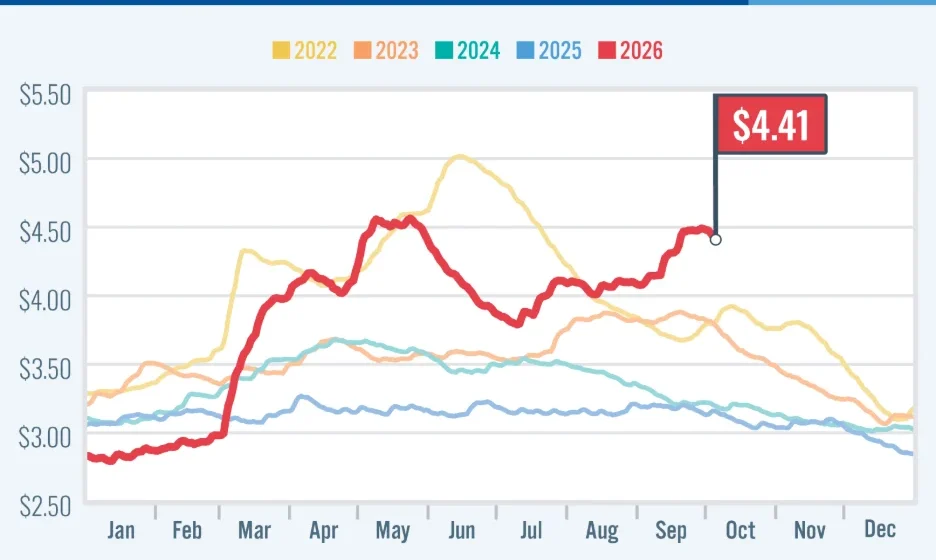
Following a record-shattering September that tested the budgets of American commuters, the national average for a gallon of regular gasoline has finally begun to retreat. According to the latest data from the American Automobile Association (AAA), the national average price dropped by nearly seven cents over the past week, settling at $4.41 per gallon.
While this decline offers a modicum of relief, the current price environment remains historically elevated. September’s monthly average clocked in at $4.33—a staggering 50 cents higher than the previous record for the month, set just last year at $3.83. As the energy market fluctuates, industry analysts are closely monitoring the interplay between crude oil volatility, domestic demand, and the strategic adaptations being forced upon convenience store retailers.
The Chronology of Price Volatility
The path to current pump prices has been characterized by aggressive shifts in global supply and domestic consumption. Throughout September, consumers faced a relentless climb in prices, driven by a combination of tight refining margins and geopolitical uncertainty affecting crude benchmarks.
By the first week of October, the trend shifted. As crude oil prices retreated into the $90-per-barrel range, retail stations began to see the immediate, albeit slow, impact on wholesale costs. While the national average has dipped, the current $4.41 benchmark stands as the highest price ever recorded for this specific time of year, underscoring the persistence of inflationary pressure on the energy sector.
Trading data from the close of Wednesday’s session indicates that West Texas Intermediate (WTI) rose by $1.04 to settle at $90.42 per barrel. Despite this slight uptick, the overall trend remains tempered by increased domestic inventories. According to the Energy Information Administration (EIA), U.S. crude oil stocks climbed by 0.9 million barrels, bringing total reserves to 427.3 million barrels—roughly 2% above the five-year average. This surplus suggests that while price spikes are possible, the market has a buffer that may prevent a return to the extreme volatility seen late last month.
Supporting Data: Supply and Demand Dynamics
The EIA’s weekly report provides the necessary context for the recent price cooling. Gasoline demand experienced a contraction last week, falling from 8.84 million barrels per day (bpd) to 8.68 million bpd. This reduction in demand, coupled with a decrease in domestic gasoline supply—down from 206 million barrels to 204.4 million—and a dip in production from 9.59 million bpd to 9.46 million bpd, paints a picture of a tightening but stabilizing market.
Regional Disparities: A Tale of Two Coasts
The geographic divide in fuel pricing remains stark, often dictated by state-level taxes, refining capacity, and proximity to pipelines.
The Top 10 Most Expensive Gasoline Markets:
- California: $6.40
- Hawaii: $5.62
- Washington: $5.49
- Nevada: $5.49
- Oregon: $5.05
- Alaska: $5.03
- Utah: $4.97
- Idaho: $4.97
- Arizona: $4.77
- Illinois: $4.71
Conversely, drivers in the Southern and Midwestern states continue to enjoy more competitive pricing.
The Top 10 Least Expensive Gasoline Markets:
- Indiana: $3.81
- Texas: $3.94
- Georgia: $3.96
- Mississippi: $3.96
- Louisiana: $3.97
- Tennessee: $3.97
- South Carolina: $3.99
- Arkansas: $3.99
- Alabama: $4.02
- Kentucky: $4.04
The EV Landscape: Charging Costs Remain Static
While gasoline prices capture the headlines, the cost of powering electric vehicles (EVs) at public charging stations has remained notably stable. The national average per kilowatt-hour (kWh) remained unchanged this week at 42 cents.
Much like gas prices, the cost of public charging varies significantly by state, often reflecting regional electricity generation mixes and local utility regulations.

Most Expensive States for Public Charging (per kWh):
Hawaii (54 cents) leads the list, followed by West Virginia (52 cents), Louisiana (49 cents), Alaska (48 cents), and California (48 cents).
Least Expensive States for Public Charging (per kWh):
Kansas (31 cents) offers the lowest rates, followed by Missouri (32 cents), Iowa (33 cents), Nebraska (34 cents), and Maryland (35 cents).
Implications for Retailers: Strategic Navigation
The sustained high cost of fuel is not merely a challenge for the consumer; it is a fundamental disruption for the convenience store industry. Elie Y. Katz, CEO and president of National Retail Solutions (NRS), recently addressed these challenges in CStore Decisions, providing a roadmap for retailers attempting to maintain foot traffic amidst "price pain at the pump."
Rebuilding the Value Tier
Katz emphasizes that retailers must protect the "psychological anchors" of their business. Price-sensitive shoppers rely on specific items—such as a dollar fountain drink, a breakfast combo, or a low-cost snack—to gauge the affordability of a store.
"Protect those anchors even if it means thinner margins," Katz advises. By highlighting these value items through endcap signage and pump-top advertisements, retailers can communicate to the consumer that they understand the current economic environment. When a customer is already agitated by the cost of filling their tank, they are actively looking for a store that makes them feel like their budget is being respected.
The Shift from Discounting to Bundling
One of the most common mistakes retailers make during inflationary periods is aggressive, across-the-board discounting. Katz argues that this erodes margins without fostering long-term loyalty.
Instead, he advocates for "bundling." By pairing a high-margin item with a lower-margin essential, retailers can create a perceived "win" for the customer while protecting their bottom line. A "fill up and fuel up" promotion—tying a car wash or a food item to a fuel purchase—is a proven method to nudge a driver from the pump into the store. This strategy requires tight integration between a store’s foodservice department and its general merchandise managers, ensuring that the bundle is perceived as a value-add rather than a cheapened product.
Leveraging Loyalty Platforms
Perhaps the most significant tool at a retailer’s disposal is the loyalty app. In an environment where every price increase leads to potential customer churn, a loyalty program serves as a critical bridge between the consumer and the brand.
Katz notes that a customer who feels every price increase individually is a customer likely to shop elsewhere. However, a customer who earns points, receives personalized offers, or unlocks rewards via an app experiences the store’s value proposition differently. "Retailers sitting on loyalty platforms they aren’t fully using are leaving real retention on the table," Katz notes. By using data-driven insights, retailers can target their most price-sensitive shoppers with specific, personalized offers, avoiding the need to cut prices for their entire customer base.
Conclusion: Looking Ahead
While the national average of $4.41 suggests that the worst of the September surge may be in the rearview mirror, the market remains fragile. The interplay between crude oil inventory levels and seasonal demand will continue to dictate pump prices through the end of the year.
For the average American driver, the recent dip is a welcome reprieve, but it is unlikely to return to the lower levels seen in previous years. For retailers, the path forward is clear: success in this high-cost environment will depend on the ability to demonstrate value, foster loyalty, and bundle products in ways that keep the customer engaged even when the cost of fuel remains a source of frustration.