The Hidden Revenue Drain on the Expo Floor: Why AI Badge Scanners Are Costing Trade Show Organizers Millions—And How to Fight Back

By the Industry Insights Desk
Published: September 2026
Picture this: A prospective buyer walks up to an exhibitor’s booth at a major industry trade show. The conversation sparks genuine interest, and a clear buying signal is established. Instead of pulling out the official event app, scanning a Quick Response (QR) code, or utilizing a paid lead-retrieval add-on, the exhibitor simply lifts a smartphone, points it at the attendee’s badge, and taps once.
Within seconds, an independent, third-party software tool captures the attendee’s name, company, and title, while automatically enriching the profile with a scraped email address from public directories.
Notice what did not happen in that interaction: The exhibitor never opened the official event app, never engaged with the organizer’s proprietary infrastructure, and certainly never purchased the event’s dedicated lead-capture add-on. From the organizer’s perspective, that booth has quietly stopped contributing to the revenue stream that has historically funded event tech ecosystems.
This scenario was the focal point of a recent EventMobi Masterclass titled Inside Job: What AI Badge Scanners Are Costing You in Trade Show Revenue (And How to Fight Back). The session peeled back the curtain on the hidden economics of exhibitor lead capture, revealing a phenomenon far more widespread than most event organizers realize. During a live poll conducted during the webinar, 65% of organizers admitted they still attempt to sell lead capture as a rigid, paid add-on, while 15% confessed they had no idea what tools their exhibitors were actually using on the expo floor.

The stakes for the events industry could not be higher. When booths bring their own unauthorized badge-scanning workarounds, vital revenue disappears from organizer budgets, critical registration data remains siloed outside official systems, and organizers lose the definitive proof of return on investment (ROI) required to secure lucrative sponsor renewals. Worse yet, the exhibitors rarely win either, as the data harvested through these makeshift tools is frequently inaccurate, non-compliant, and ultimately ineffective.
Main Facts: The Anatomy of the Lead Capture Shift
For decades, the model of trade show lead capture remained largely unchanged. To understand why the modern expo floor is experiencing a mass migration away from official apps, it is necessary to examine how the ecosystem evolved.
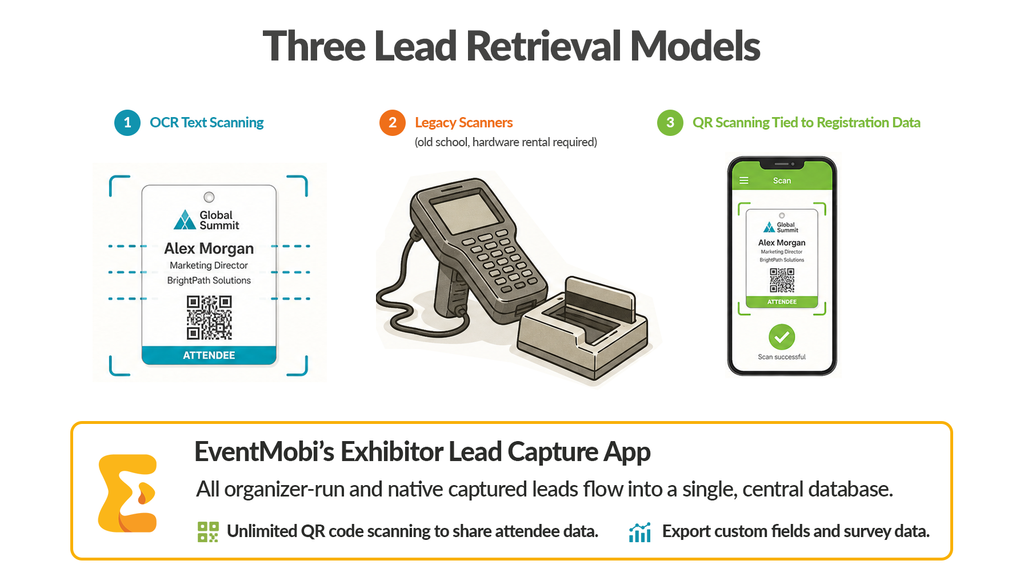
Thirty years ago, lead retrieval meant renting specialized, bulky hardware—heavy laser barcode scanners and magnetic stripe readers. Because event organizers neither wanted to own nor manage this hardware logistics nightmare, specialized third-party vendors supplied the devices and split the rental revenue with the venue or organizer. This revenue-share model firmly established lead capture as a distinct, standalone line of business.
As mobile technology advanced, organizers folded badge scanning into their broader event apps, binding lead data directly to central registration databases. However, three modern forces are colliding to shatter this integrated model:
- The Rise of Computer Vision and OCR: Advanced Optical Character Recognition (OCR) and machine learning allow any standard smartphone camera to instantly "read" a badge and parse its text without relying on backend event databases.
- Third-Party Data Enrichment Platforms: Standalone software vendors now offer horizontal, subscription-based mobile apps that let sales reps scan badges at any event, aggregating leads into a single external CRM regardless of who organized the trade show.
- Subscription Fatigue Among Exhibitors: Exhibitors attending multiple events annually balk at paying $200 to $500 per show for isolated lead-retrieval licenses when they can purchase a flat-rate monthly SaaS subscription that works across all events.
When these factors combine, the result is predictable. Exhibitors bypass the organizer’s app entirely, opting for multi-use scanning apps that offer cross-event continuity.
Chronology of an Industry Disruption: From Hardware Rentals to Bring-Your-Own Software
To fully grasp the current crisis, one must trace the timeline of trade show technology adoption over the past three decades:
- The 1990s to Early 2000s (The Hardware Era): Lead capture was hardware-centric. Exhibitors rented chunky scanners by the day. Revenue was lucrative, shared between specialized hardware providers and event organizers.
- The 2010s (The Mobile App Transition): Smartphones entered the mainstream. Event tech providers introduced event apps featuring QR code scanning. While this lowered hardware costs, organizers still treated lead retrieval as an expensive, premium add-on to maximize ancillary revenue.
- The Early 2020s (The Rise of SaaS and Point Solutions): Cloud-based CRM extensions and independent sales enablement apps emerged. Exhibitors began utilizing tools designed for general sales prospecting rather than event-specific data collection.
- 2024–2026 (The AI-Powered Scraping Wave): The integration of generative AI and automated data enrichment tools allowed third-party apps to instantly populate missing contact data (such as emails and direct dials) via web scraping. This effectively decoupled the exhibitor’s lead-gathering process from the organizer’s registration database entirely.
Supporting Data and Regulatory Realities: Where Third-Party Scanners Fall Short
On paper, bring-your-own scanning apps look remarkably competitive on a feature checklist: badge scanning, basic contact information fields, and rudimentary note-taking capabilities. However, a closer look reveals severe vulnerabilities—specifically in the two fields exhibitors value most: verified names and current email addresses.
The Data Accuracy and Compliance Gap
Independent scanning tools rely on OCR to read printed badge text and often supplement this with automated web scraping to unearth professional email addresses. This process introduces significant friction:
- Misread Data: If a badge layout varies or uses an unconventional font, OCR software frequently misspells names or misinterprets company titles.
- Bounced Emails: Scraped email addresses are often generic catch-alls or outdated personal addresses, leading to high bounce rates during post-show email campaigns.
- The Compliance Landmine: Most critically, independent scrapers operate without the attendee’s explicit, contextual consent.
The consent gap represents an existential risk for event organizers. When an attendee receives unsolicited marketing blasts at a personal email address following a trade show, the resulting privacy complaint is directed at the event organizer, not the third-party app vendor.
This risk is far from theoretical. In December 2024, France’s data protection regulator, the CNIL, slapped data enrichment vendor Kaspr with a €240,000 fine for scraping and processing professional contact details without a valid legal basis under the European Union’s General Data Protection Regulation (GDPR).
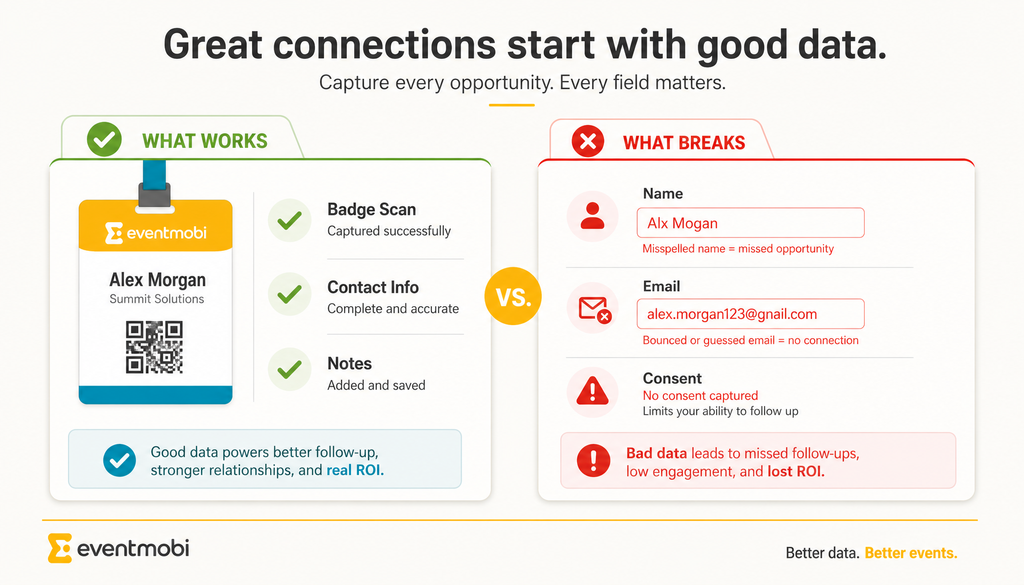
When exhibitors use unauthorized scraping apps, both parties lose: the exhibitor saves a marginal amount of money on unverified data, while the organizer sacrifices both ancillary revenue and regulatory compliance. Official event apps resolve scans directly against secure, permissioned registration databases, ensuring clean and legal data audits.
Official Responses and Expert Perspectives: Re-Engineering the Revenue Model
Industry leaders argue that attempting to combat this shift with aggressive policing or higher paywalls is a losing battle. The scan itself is no longer a scarce commodity; therefore, defending it as an isolated, high-priced line item is unsustainable.
Adam Parry, founder of Event Tech Live, addressed this exact dynamic during the EventMobi masterclass:
"Charging a mandatory lead capture fee feels like walking into a restaurant, ordering a steak, but getting asked to pay for the plate for it to sit on in order for you to eat it."
— Adam Parry, Founder, Event Tech Live
According to Parry and other event tech strategists, the solution requires a fundamental reframe of how lead capture is monetized. Instead of treating badge scanning as a bolt-on luxury, organizers should bundle it directly into base exhibitor packages.
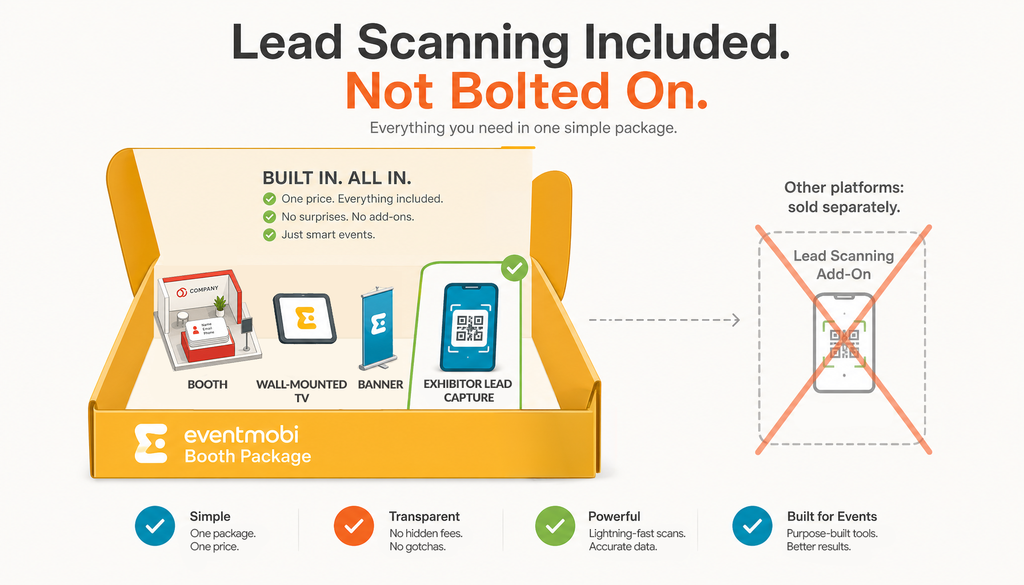
For instance, modern platforms like EventMobi offer scalable licensing models (such as packages priced at $50 per block of ten company licenses). This price point is low enough to be absorbed into standard booth fees or marked up imperceptibly, effectively eliminating the incentive for exhibitors to seek out risky third-party workarounds. By spreading the modest cost across the entire exhibitor base, organizers can maintain—or even grow—their net revenue while entirely removing friction from the expo floor.
Implications: Turning Event Signals Into Unreplicable Value
Bundling basic badge scanning solves the immediate revenue leak, but forward-thinking organizers are recognizing an even larger opportunity: selling insights that no external, third-party app can possibly replicate.
While a phone camera utilizing OCR can guess a name and scrape a corporate URL, it remains blind to what an attendee actually did inside the event. This behavioral data—referred to as event signals—lives exclusively within the organizer’s digital ecosystem:
- Educational Session Attendance: Knowing which workshops or keynotes an attendee sat through.
- In-App Engagement: Tracking interaction with specific digital sponsor profiles, resource downloads, and virtual booth visits.
- Interactive Polling and Q&A: Capturing direct statements of intent shared during live sessions.
The Competitive Advantage of Event Signals
Consider the disparity in value delivered to a sponsor:
- The Scraper Approach: An independent scraping app hands an exhibitor a raw list of 200 scanned names.
- The Event-Signal Approach: An official lead retrieval platform provides the same 200 names, but highlights that 30 of those individuals attended a specialized cybersecurity workshop and explicitly stated via in-app polling that they are actively sourcing new enterprise vendors this quarter.
Organizers can surface these behavioral metrics as enriched data columns within exhibitor export files or package them as high-value sponsorship upsells. For example, organizers can segment attendees by demonstrated intent and execute targeted post-event email campaigns on behalf of premium sponsors—reaching only genuinely interested prospects with verified consent.

Pre-Show Checklist for Organizers
To safeguard revenue, protect data integrity, and deliver undeniable ROI to sponsors, organizers should implement the following pre-show checklist:
- [ ] Audit Current Add-On Models: Evaluate whether charging separately for lead capture is driving exhibitors toward unauthorized, non-compliant third-party apps.
- [ ] Explore Inclusive Bundling: Work with your event technology provider to integrate lead capture licenses directly into baseline booth or sponsorship packages.
- [ ] Enhance Data Transparency: Clearly communicate to attendees and exhibitors how official lead scanning guarantees GDPR/CCPA compliance and protects against bounced data.
- [ ] Leverage Behavioral Event Signals: Configure your event platform to capture session attendance, poll responses, and in-app interactions to enrich lead profiles beyond basic badge text.
- [ ] Educate Exhibitors Early: Provide pre-show webinars and guides demonstrating why official retrieval apps yield higher-conversion sales leads compared to generic OCR scanners.
The Bottom Line
Ultimately, choosing how to manage and monetize a lead retrieval app is about safeguarding three foundational pillars of the exhibition business: exhibitor follow-up efficacy, attendee data trust, and long-term sponsor renewals.
The traditional playbook of treating badge scans as an isolated profit center is broken. To survive and thrive in an era dominated by ubiquitous AI tools and data scraping, trade show organizers must adapt their strategies:
- Stop selling the scan as an isolated line item, as cheap external alternatives make it too easy for exhibitors to bypass.
- Bundle lead capture into every exhibitor package, distributing the cost evenly and removing the temptation for exhibitors to seek out risky workarounds.
- Monetize the unique value only organizers own: the deep behavioral event signals that transform a cold contact into a qualified, in-market sales lead.
By aligning event technology with modern exhibitor expectations, organizers can turn the threat of AI badge scanners into an engine for renewable, long-term trade show revenue.