
Published on July 23, 2026
California-based boutique automotive manufacturer Rezvani has long held a reputation for pushing the boundaries of automotive design, often blurring the lines between military-grade utility and high-performance luxury. Today, the company is pivoting toward a new, radical frontier: the ultra-high-performance off-road supercar. With the unveiling of its latest creation, the "Dune," Rezvani has effectively signaled that the limits of what a street-legal, track-bred machine can achieve on loose gravel and sand have yet to be reached.
The Dune is not merely a modification; it is a profound reimagining of the Lamborghini Huracán Sterrato. While the Sterrato was initially hailed as a daring, wedge-shaped experiment—an attempt to bridge the gap between tarmac-shredding precision and rally-inspired grit—Rezvani has taken that concept to its logical, if not slightly absurd, extreme. By injecting the platform with massive horsepower gains and a suspension setup that makes the standard Sterrato look tame, Rezvani is positioning the Dune as the ultimate vehicle for the world’s most adventurous collectors.
Main Facts: The Anatomy of the Dune
At its core, the Rezvani Dune is a bespoke, limited-production machine that centers on the foundational brilliance of the Lamborghini V-10 platform while completely overhauling the vehicle’s geometry, power output, and off-road capability.

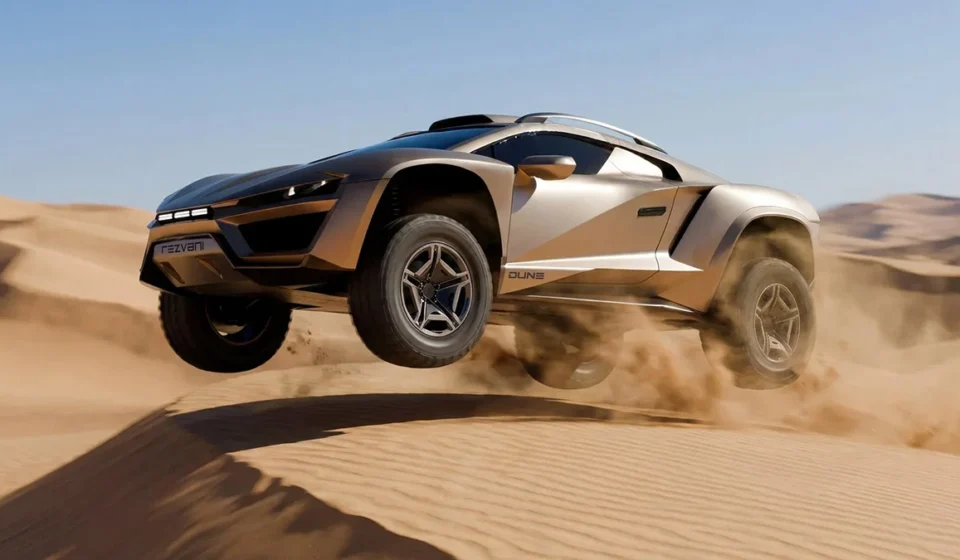
The most striking visual element of the Dune is its aggressive, fully sculpted carbon fiber bodywork. Unlike the factory Sterrato, which keeps its design cues largely aligned with the standard Huracán, the Dune sports widened, reinforced fenders, a redesigned roof structure featuring a high-intake scoop for optimal cooling, and a stance that demands attention.
The vehicle has been lifted 4.5 inches over the standard Huracán architecture—a full 2.8 inches higher than the factory Sterrato. When paired with its bespoke custom wheels and 31-inch all-terrain tires, the Dune boasts a total ride height of 11 inches. This configuration fundamentally changes the vehicle’s center of gravity and approach angles, transforming it from a "supercar that can handle dirt" into a genuine, high-speed desert runner. To ensure the chassis remains intact during high-speed off-road traversal, Rezvani has integrated comprehensive underbody armor, specialized auxiliary lighting arrays for nocturnal excursions, and a roof-mounted snorkel to protect the engine during deep-water or heavy-dust crossings.
Chronology: From Concept to Extreme Reality
The development of the Dune follows a deliberate progression in Rezvani’s portfolio, which has historically leaned toward armored SUVs like the Tank and the Hercules. However, the move toward the supercar segment represents a strategic shift.
- Late 2024: Internal discussions at Rezvani begin regarding the "off-road supercar" trend, spurred by the market reception of the Lamborghini Huracán Sterrato and the Porsche 911 Dakar.
- Early 2025: Collaboration with VF Engineering is initiated to explore the limits of the Lamborghini 5.2-liter V-10 platform. The goal is to move beyond the natural aspiration of the stock engine.
- Mid-2025: Prototypes of the carbon fiber body kit are stress-tested in the California desert. Engineering focus shifts to suspension articulation and heat management for the supercharger system.
- Q1 2026: Final calibration of the 800-hp powertrain is completed. Testing moves to high-speed stability runs on loose surfaces.
- July 23, 2026: Official public unveiling of the Rezvani Dune. The company announces a strictly limited production run of just seven units, underscoring the "ultra-exclusive" nature of the project.
Supporting Data: Engineering the Beast
The heart of the Rezvani Dune is its powerplant. While the Huracán Sterrato’s naturally aspirated 5.2-liter V-10 is a masterpiece of linear power delivery, Rezvani felt it lacked the sheer grunt required for true desert conquest. Through a partnership with the renowned VF Engineering, the engine has been equipped with a bespoke supercharger system.

Performance Specifications
- Power Output: 800 horsepower (an increase of approximately 190 hp over the factory 610 hp).
- Drivetrain: Retains the advanced all-wheel-drive system of the Huracán, recalibrated for high-torque delivery at low speeds.
- Ground Clearance: 11 inches total.
- Tires: 31-inch custom-compound all-terrain tires.
- Chassis: Reinforced with lightweight carbon fiber to offset the added weight of off-road armor and the forced-induction hardware.
While official acceleration and top-speed figures are currently under wraps, the industry expectation is that the Dune will improve upon the Sterrato’s 2.5-second 0–60 mph sprint, provided the tires can find sufficient traction. The mechanical marriage of the supercharged V-10 and the high-travel suspension suggests that the Dune is not just a showpiece, but a legitimate rival to professional rally-raid machinery in terms of raw output.
Official Responses and Strategic Vision
Rezvani has remained relatively tight-lipped regarding the granular engineering details, preferring to focus on the "experience" of the vehicle. A company spokesperson noted that the Dune was designed for a "very specific type of owner—one who views a multi-million-dollar desert landscape as a personal playground rather than a barrier."
The collaboration with VF Engineering is particularly significant. By leaning on an established name in forced induction, Rezvani has provided a level of confidence in the engine’s reliability that custom builders often struggle to achieve.
From the Lamborghini side, the reaction has been one of professional detachment, though internal rumors suggest that the Italian automaker is closely monitoring the success of these modified Sterratos. Lamborghini’s own interest in expanding the Sterrato line indicates that there is a viable, high-margin market for these "lifestyle-supercars."

Implications: The Future of the High-Performance Niche
The existence of the Rezvani Dune raises important questions about the trajectory of the supercar industry. For decades, the supercar was defined by low ride heights, aerodynamics optimized for downforce at high speed, and a strictly paved-surface mission statement.
The "Go-Anywhere" Shift
The emergence of the Dune, alongside factory efforts like the Porsche 911 Dakar and the Lamborghini Sterrato, signals a definitive shift in consumer taste. The modern hyper-wealthy collector is increasingly interested in "adventure luxury." It is no longer enough to have the fastest car on the Nürburgring; the prestige now lies in having the fastest car that can also traverse a sand dune or a gravel mountain pass.
Exclusivity and Value
With only seven units slated for production, the Dune is essentially a modern collector’s artifact. While a price has not been confirmed, industry analysts estimate the vehicle will command a significant premium over the $300,000 base price of a stock Huracán Sterrato. When factoring in the R&D costs of the custom bodywork, the VF Engineering supercharger, and the specialized suspension geometry, a price tag north of $600,000 would not be surprising.
The Sustainability of the V-10
Perhaps the most poignant aspect of the Dune is that it is being built at the "tail end of the V-10’s lifestyle." As the automotive world rapidly transitions to electrification, machines like the Dune represent a final, glorious hurrah for the naturally aspirated (or in this case, supercharged) internal combustion engine. It is a loud, visceral, and unashamedly excessive final chapter for one of the most iconic engine architectures in history.

Conclusion: A New Benchmark for Excess
The Rezvani Dune is an outlier in every sense of the word. It is a vehicle that defies conventional automotive categorization, blending the precision of an Italian supercar with the rugged durability of a Baja racer. By taking the Sterrato platform—a car already considered "ridiculous" by many traditionalists—and pushing it even further, Rezvani has secured its place as a provocateur in the automotive world.
For the seven lucky individuals who secure a build slot, the Dune offers something that few other vehicles can: the ability to conquer the world’s most punishing terrains with the soul of a supercar screaming behind their ears. It is, in every sense, a testament to the idea that when it comes to automotive performance, too much is never enough.
For those interested in witnessing the visual transformation of the platform, a full gallery of the Rezvani Dune in its various desert-ready configurations is available via the official Rezvani media portal.