The Death of the Dashboard: Why Modern Brand Strategy Requires Autonomous Monitoring

The traditional news cycle—once governed by the morning paper and the evening broadcast—has been irrevocably dismantled. In its place lies a chaotic, high-velocity ecosystem where real-time updates break on social media, often bypassing legacy gatekeepers entirely. According to the Q1 2026 Pulse Survey, social media has officially ascended to become the primary source for news, ranging from viral TikTok explainers to high-stakes investigative threads on X, professional discourse on LinkedIn, and deep-dive community analysis on Reddit.
For modern enterprises, this shift represents an existential challenge. Conversations about your brand, your leadership, and your products are occurring across dozens of platforms simultaneously. These narratives do not exist in isolation; they feed into each other, spiraling from a niche subreddit into a mainstream PR crisis in a matter of minutes. In this environment, relying on manual monitoring or traditional press clipping services is akin to trying to catch a flood with a thimble.
The Fragmented Reality: Why Legacy Monitoring Fails
In the current digital landscape, public perception can pivot in the time it takes to brew a cup of coffee. When a brand’s reputation is subject to the whims of viral algorithms, checking direct mentions—or worse, waiting for a weekly report—is no longer just inefficient; it is a liability.
Without a comprehensive, proactive cross-network monitoring strategy, organizations suffer from two primary risks: the loss of actionable customer feedback and the "snowball effect" of unmanaged crises. By the time a communications team realizes a negative narrative is gaining traction, the conversation has already moved from the fringes to the front page. To navigate this, companies must transition from passive observation to proactive, cross-network intelligence.
What is Cross-Network Brand Monitoring?
Cross-network brand monitoring is the practice of aggregating, tracking, and analyzing mentions of your brand, products, and executives across the entire digital spectrum. It is not merely about counting mentions; it is about synthesizing fragmented data from social networks, discussion forums, review sites, blogs, and digital news into a single, cohesive view.
Modern monitoring software acts as a digital nervous system, scanning the internet for targeted keywords, phrases, and hashtags. By unifying this data, organizations can transform "internet noise" into concrete data points. This intelligence is the foundation for everything from responsive customer care and agile product development to the orchestration of complex crisis management strategies.
The Anatomy of an Information Crisis: A Chronology
To understand why speed is the only metric that matters, consider the standard lifecycle of a modern digital narrative:
- The Spark (0–15 minutes): A user on Reddit or a niche industry forum identifies a perceived flaw in a product or a questionable statement by an executive.
- The Amplification (15–60 minutes): Influencers or power-users on X and TikTok pick up the narrative. The story gains its first layer of social proof, often fueled by short-form video content.
- The Cross-Pollination (1–4 hours): The story migrates to Substack newsletters and aggregator sites. Journalists covering the beat begin to notice the spike in volume.
- The Mainstream Inflection (4–24 hours): The narrative reaches traditional media outlets. By this point, the "brand narrative" is often already set in stone, making reactive PR statements feel like damage control rather than proactive transparency.
"Today, narratives—both opportunities and threats—can kick off anywhere," explains Paul Quigley, GM of Listening at Sprout Social. "From a news story, a discussion on Reddit, a TikTok, or a Substack post. Brands risk exposure and missed opportunities if their listening focuses too heavily on just a couple of sources. They need nothing less than the full media landscape at their fingertips."

Establishing a Unified Foundation
Building a cross-network monitoring program is not a "set it and forget it" task. It requires a rigorous, two-phase architectural approach: mapping channels and categorizing objectives.
1. Centralizing the Network Map
The first step is a comprehensive audit of where your audience resides. This is not a one-size-fits-all list; it must be tailored to your industry. A B2B enterprise might prioritize LinkedIn and niche industry forums, while a B2C fashion brand must maintain a constant watch on TikTok and Instagram. Once these channels are identified, the data must be piped into a centralized dashboard to eliminate departmental silos. When customer care, PR, and marketing share the same source of truth, the entire organization benefits from a unified view of the consumer.
2. Setting Strategic Objectives
Data without a goal is merely clutter. Organizations must set clear, trackable objectives for their monitoring efforts, such as:
- Share of Voice: Tracking brand visibility relative to key competitors.
- Sentiment Velocity: Monitoring the speed and direction of sentiment shifts.
- Issue Resolution Time: Measuring how quickly customer service can move a complaint from a public social mention to a private, resolved ticket.
The Shift to Agentic Monitoring
Perhaps the most significant evolution in this field is the move from reactive, dashboard-based monitoring to agentic monitoring.
Traditionally, marketing teams have relied on manual checks—logging into platforms and reviewing retrospective graphs. This process is inherently flawed because it requires a human to "catch" the fire after it has started. Agentic monitoring, powered by advanced AI, changes the paradigm. Instead of waiting for a human to interpret a chart, autonomous AI agents—like Sprout Social’s Trellis—scan the web 24/7.
"The era of logging into dashboards to check things is over," notes Quigley. "Now, 94% of NewsWhip data is consumed off-platform—pushed to teams by monitoring agents, predictive alerts, and other formats, landing directly in the right inboxes, Teams channels, and Slack groups."
These AI agents are integrated with your strategic goals. When a predefined threshold is hit—such as a 20% spike in negative sentiment on a specific keyword—the agent triggers an instant alert. This removes the "human middleman," allowing teams to shift their energy from data triage to high-level strategic response.
Extracting Business Answers with AI
The power of tools like Trellis lies in their ability to act as a conversational interface. Rather than scrolling through lists of posts, analysts can query their data using natural language. A manager can ask: "What are the primary drivers behind yesterday’s sentiment drop on Reddit?" or "Summarize our competitors’ product flaws based on this week’s reviews."
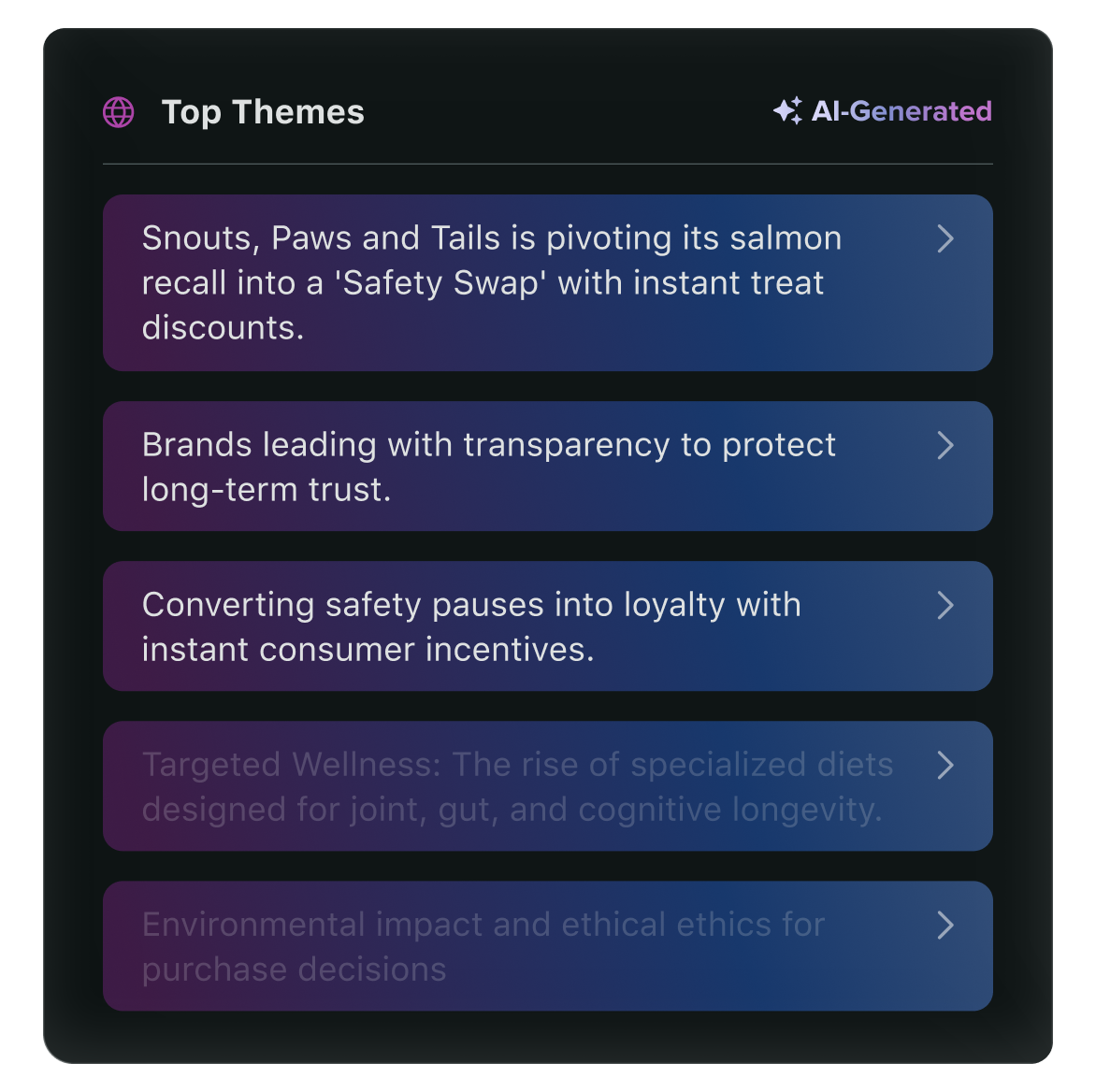
This capability bridges the gap between raw data and executive-ready strategy. By converting fragmented digital signals into coherent, actionable insights, AI allows organizations to make decisions at the speed of the internet.
Building Internal Pathways for Escalation
Data is useless if it stays trapped in the marketing department. For monitoring to be truly effective, it must be supported by "escalation pathways."
- Product Teams: Receive automated feeds of recurring feature requests or software bugs.
- Customer Care: Receive high-priority, sentiment-flagged complaints for immediate resolution.
- Communications: Receive instant alerts on potential PR crises, allowing for the rapid drafting of accurate, nuanced responses.
By formalizing these pathways, organizations can scale their monitoring efforts without the risk of brand misalignment or information overload.
Conclusion: Turning Noise into Advantage
The transition to a proactive, cross-network monitoring strategy is not just a technological upgrade—it is a cultural shift. By moving away from the reactive, dashboard-centric model of the past and embracing autonomous, agentic systems, companies can turn the chaotic noise of the internet into a competitive advantage.
In an age where silence can be interpreted as indifference and speed is the hallmark of leadership, your brand’s ability to "listen" at scale is the single most important factor in your long-term survival. As the digital landscape continues to evolve, those who integrate AI-driven intelligence into their core operations will be the ones who define the narrative, rather than being defined by it.
Frequently Asked Questions (FAQs)
Q: What are the best tools for cross-network brand monitoring?
A: The most effective tools are those that unify web, forum, review, and social media data into a single, AI-enabled interface. Solutions like Sprout Social Listening and NewsWhip by Sprout Social are designed specifically to handle this level of complexity.
Q: How does brand monitoring differ from social listening?
A: While often confused, the two serve different functions. Brand monitoring is tactical: it focuses on direct tracking of your specific brand, products, and executives to handle immediate needs like customer support and crisis management. Social listening is strategic: it takes a macro view of industry trends, competitor movements, and cultural shifts to inform long-term business goals.
Q: What keywords should I track for my brand?
A: A robust monitoring strategy requires a categorized approach. You should track:
- Core Brand: Company names, handles, and common misspellings.
- Products/Services: Specific product names, feature sets, and model numbers.
- Leadership: Names of key executives and public-facing figures.
- Competitive Landscape: Direct competitor names and their primary product lines.
- Industry Context: Key phrases or hashtags that define your sector’s current discourse.