A Midsummer Night’s Dream Meets Midsommar: Inside a Radical, Theatre-Driven Wedding in Spain

When Júlia and Marc began planning their wedding, they didn’t reach for a bridal magazine or a Pinterest board of conventional trends. Instead, they approached their nuptials as if they were mounting a new production. As professional directors, they saw the ceremony not just as a legal formality, but as a blank stage—a space to assemble a cast, build a set, and curate a narrative that would ultimately invite a little bit of magic to unfold.
“We never actually set out to have an ‘alternative’ or ‘untraditional’ wedding,” Júlia reflects. “We just kept asking ourselves, over and over again: ‘What feels most like us?’”

The result was a breathtaking, surrealist, and deeply personal celebration in the countryside near Girona, Spain. It was a day where Shakespearean fantasy collided with the folk-horror aesthetics of Midsommar, resulting in an event that blurred the lines between performer and guest, reality and theater.

The Concept: A Play in Two Acts
The thematic backbone of the day was A Midsummer Night’s Dream, the very first play the couple directed together. For Júlia and Marc, the play’s unique alchemy of romance, comedy, performance, and absurdity provided the perfect framework for their own union.

They selected June 20th as their date, anchoring the celebration as close to the summer solstice as possible. This was no coincidence; the timing allowed them to lean into the long, golden light of midsummer, turning their wedding into a pagan-inflected, theatrical gala. To maintain their creative vision, they eschewed traditional wedding terminology. Guests were referred to as “the audience,” while the carefully curated decor was dubbed “the set.”

A Chronology of the Day: From Forest Rituals to Theatrical Revelry
The Ceremony: A Subversive Start
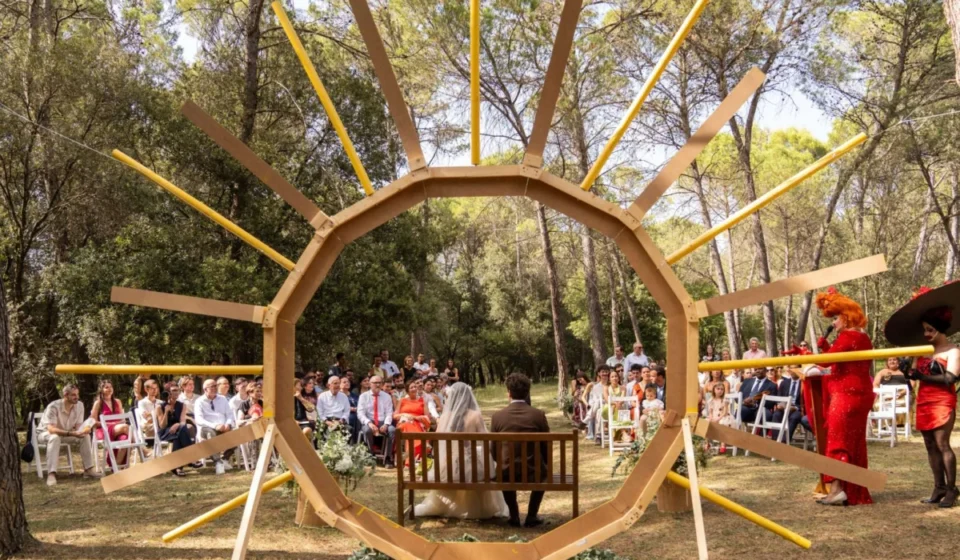
The wedding took place in a lush, verdant Mediterranean forest. The altar was a masterpiece of DIY engineering: a giant, handmade wooden sun, heavily inspired by the visual language of Ari Aster’s Midsommar. It loomed over the couple, casting a warm, rustic glow on the proceedings.

The ceremony began with a deliberate disruption of tradition. Kika Superputa, a drag queen and one of the couple’s closest friends, took the stage to announce that the wedding had been unceremoniously cancelled because the groom, Marc, had “run away.” In a display of physical comedy, Marc was then led out, tied up and gagged, as Kika regaled the audience with a dramatic, tongue-in-cheek tale of her scheme to destroy the wedding and abscond with all the gifts.

The tension—and the hilarity—was broken when Tita Mari, another drag queen and dear friend, emerged from the audience to challenge Kika’s plot. The two performers then joined forces to officiate the ceremony, blending high-camp performance art with genuine, heartfelt vows.

“From there, things got a little more traditional,” Júlia notes with a laugh. Marc walked down the aisle with his mother to the upbeat rhythm of Fatboy Slim’s Praise You, while Júlia entered with her brother and nephews to the ethereal sounds of Taylor Swift’s Wildest Dreams. The couple exchanged deeply personal vows—Marc’s were penned months in advance, while Júlia’s were finalized just hours before the ceremony, capturing the raw, immediate energy of the morning.

The Reception: A People-Made Production
The reception abandoned the standard wedding banquet format. In lieu of a traditional multi-tiered cake, ten couples brought their own favorite homemade cakes, creating a communal dessert table that celebrated their guests’ own talents and tastes. The dinner was entirely vegetarian, reinforcing the couple’s commitment to community and sustainable, conscious consumption.

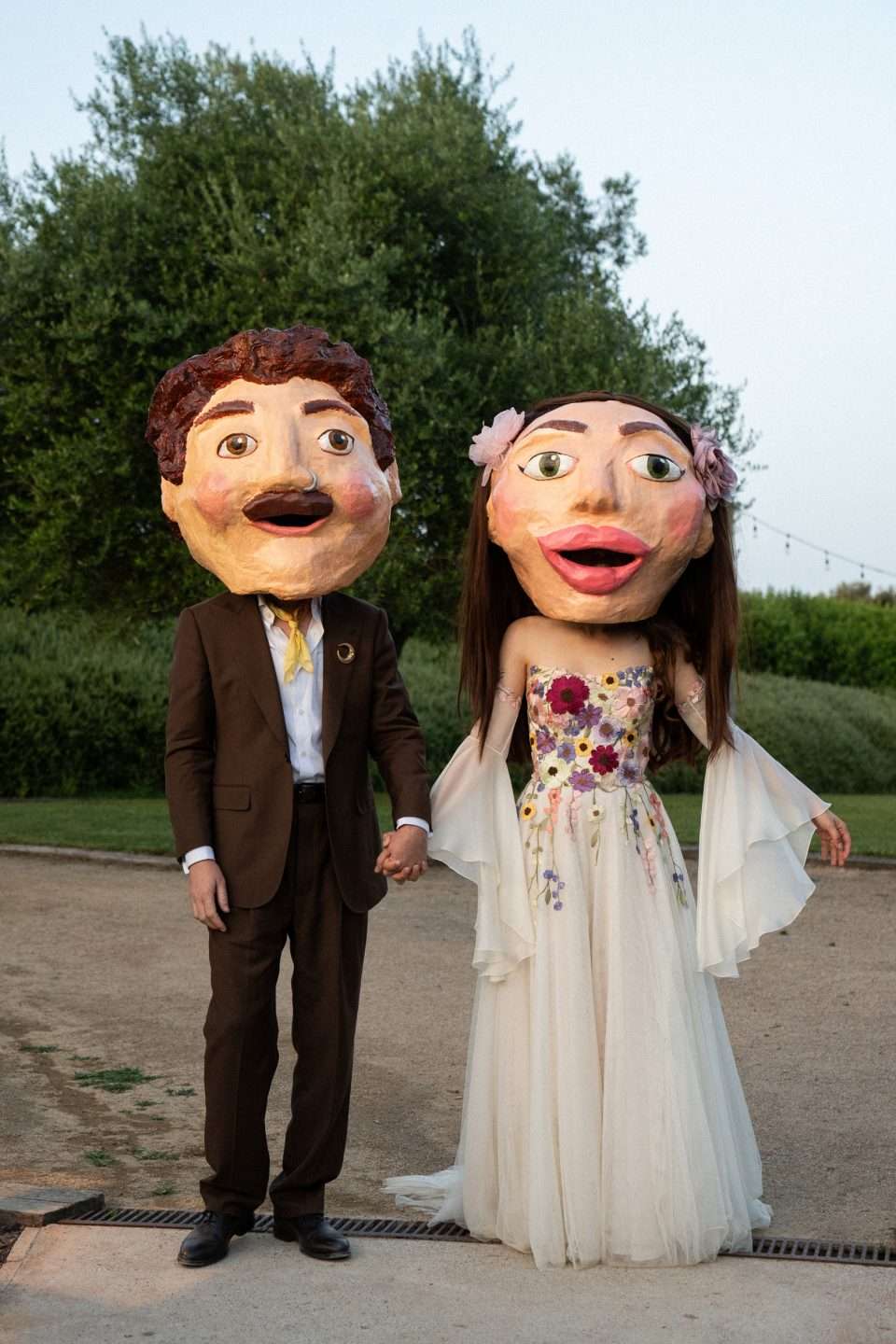
As the sun dipped lower, the "theatrical" nature of the event shifted into high gear. During their entrance, the couple donned giant, papier-mâché versions of their own heads—an homage to the capgrossos (big-heads) found in traditional Catalan festivals. The parade-like entrance set a surreal, festive tone for the evening.

Later, their friends from the theater community staged an original, shortened adaptation of A Midsummer Night’s Dream specifically for the newlyweds. The night reached its zenith with a final, shocking flourish: the bride literally jumping out of a giant cake, a nod to classic vaudevillian showmanship.

Supporting Data: The Power of Community-Led Craft
The wedding was defined not by its budget, but by the sheer volume of collaborative labor invested in it. The couple leaned heavily on their creative network to build every element of the day:

- Ceramics: A friend who is a professional ceramicist produced every single pot used for the ikebana floral arrangements.
- Florals: The day before the wedding, over 25 friends gathered for an informal workshop. With no prior experience, they crafted the baskets for the ceremony and the table arrangements. Júlia describes this as the "soul" of the event—an excuse to get hands dirty and build something together.
- The Dress: The bride’s wedding attire was a family affair, designed by her sister-in-law and sewn by one of her closest friends.
The success of these projects proves that high-concept events do not require high-end, anonymous vendors. Instead, by utilizing the existing skills within their inner circle, Júlia and Marc ensured that every object, every flower, and every decoration had a story—a tangible link to the people they love.

Official Responses and Reflections
When asked about the "alternative" label often attached to their wedding, the couple remains modest. They insist that their decisions were not made for the sake of being different, but for the sake of being authentic.

“By the end, it felt less like we’d hosted a wedding and more like we’d created a piece of theatre together,” Júlia says. “It was handmade, but above all, it was people-made.”

Their perspective on the wedding industry is clear: the modern wedding has become too detached from the people it intends to celebrate. By treating the wedding as a performance, they regained agency over the narrative. They didn’t just walk down an aisle; they directed their own life-changing scene.

Implications: The Future of "Theatrical" Weddings
The success of Júlia and Marc’s wedding offers a roadmap for couples looking to escape the "industrial" wedding complex. Their approach implies several shifts in how weddings might be planned in the coming years:

- From Consumption to Creation: The shift toward DIY, community-led production reduces the carbon footprint and financial burden of weddings while increasing the emotional ROI.
- Theatricality as Authenticity: By adopting a "theatrical" lens, couples can justify the inclusion of humor, performance, and absurdity, which often feel sidelined in favor of rigid tradition.
- The Death of the "Vendor" Model: As seen here, relying on friends and family to provide creative services—from ceramics to dressmaking—fosters a deeper sense of community and investment in the marriage itself.
- Inclusive Officiation: The use of drag queens as officiants highlights a growing trend toward choosing leaders who represent the couple’s values and social circles rather than traditional religious or legal figures.
Advice for Future Couples
For those looking to replicate this spirit, the couple’s advice is straightforward: "Trust yourselves, your taste, your ideas, and the kind of wedding you actually want to have. Enjoy making things happen and enjoy each other along the way."

They emphasize that the process of "getting your hands a little dirty" is not a chore—it is a bonding exercise. When a couple spends months building a giant wooden sun or learning how to arrange ikebana, they aren’t just creating decor; they are building a shared history.

In a world where weddings are increasingly optimized for social media performance, Júlia and Marc’s day stands as a reminder that the most memorable events are those that invite the audience to participate, play, and witness a story that belongs entirely to the people on the stage. Their wedding was not just a start to their marriage; it was a testament to the fact that when you build your own world, you get to decide exactly how the magic happens.