
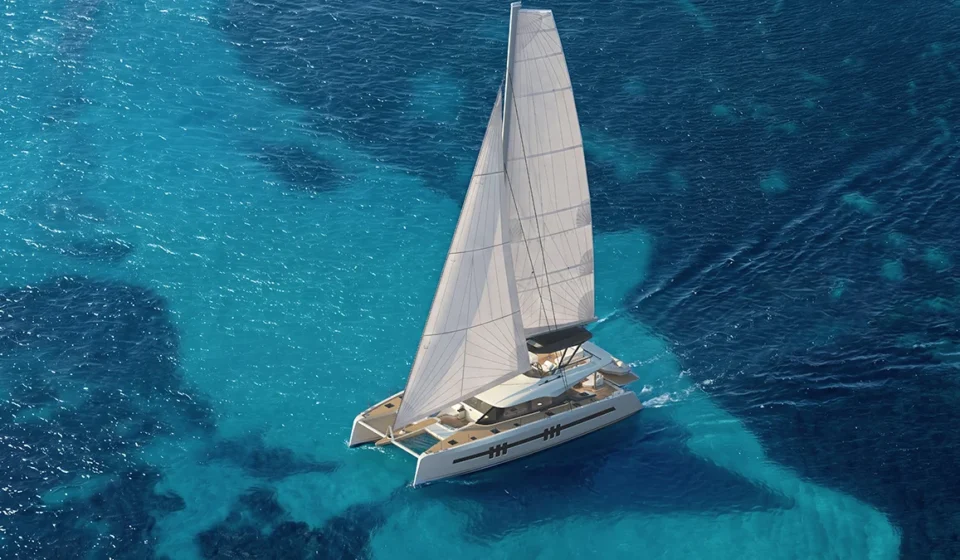
Charting a New Course: Oyster Yachts Unveils Its First-Ever Sailing Catamaran, the C60

Main Facts
After 53 years of defining the benchmark for elite bluewater monohull sailing yachts, British luxury shipbuilder Oyster Yachts is officially charting a revolutionary course into uncharted waters. The legendary custom builder has unveiled the Oyster C60, the very first sailing catamaran in the company’s storied history. Developed in strategic partnership with renowned French naval architecture and design firm Berret-Racoupeau, the 64-foot multihull represents a profound evolution for a brand traditionally associated with world-cruising monohulls.
The Oyster C60 is engineered to bridge the gap between multiple worlds of luxury marine architecture. It successfully synthesizes the inherent open-deck stability and sprawling interior volume of a high-end multihull, the opulent amenity suite of a modern motor yacht, and the responsive performance dynamics of a bluewater sailing vessel. Designed meticulously for extended, long-range offshore cruising, the preliminary layout boasts nearly 1,200 square feet of combined interior and exterior living space.
Key structural and design highlights of the new Oyster C60 include:
- The Scale: A compact yet voluminous 64-foot footprint optimized for shorthanded sailing and effortless harbor maneuvering.
- Indoor-Outdoor Integration: Wide, flush-threshold opening doors that seamlessly fuse the main salon with the aft deck, complemented by a central serving bar and fold-out swim and waterside terraces.
- Social Zones: A sunken foredeck lounging cockpit and an elevated flybridge command station designed for panoramic alfresco entertaining.
- Accommodations: An isolated, highly private owner’s suite outfitted with Oyster’s signature triple Seascape windows, alongside three additional guest cabins, each featuring a private en-suite bathroom.
- Offshore Architecture: Approximately three feet of bridgedeck clearance to mitigate wave-slamming in heavy seas, supported by twin 110-horsepower engines and an expansive 1,300-square-foot mainsail configuration.
Chronology of an Evolution: 53 Years in the Making
To understand the magnitude of the Oyster C60’s launch, one must look back at the trajectory of Oyster Yachts. Founded in the United Kingdom in 1973, the company carved out an enviable, near-mythic reputation among global circumnavigators. For over half a century, the name Oyster became synonymous with ultra-sturdy, exceptionally seaworthy, deck-saloon monohulls built to weather the harshest conditions of the world’s oceans. Generations of adventurous sailors trusted Oyster’s robust hand-laid fiberglass hulls to carry them across the Atlantic, around Cape Horn, and into remote archipelagos.
However, the global luxury marine market has undergone a dramatic psychological and structural shift over the last decade. While monohulls remain beloved by traditionalists, modern yacht owners increasingly prioritize expansive deck spaces, level living areas that reduce fatigue during long passages, and the shallow draft required to anchor in secluded, crystal-clear lagoons inaccessible to deep-keel sailboats.

Recognizing this market tide, Oyster’s leadership spent years evaluating how to enter the multihull sector without diluting the core DNA that made the brand famous. The development of the C60 was not a reactionary pivot, but the culmination of rigorous market research, naval architecture trials, and direct consultations with clients whose cruising lifestyles were evolving. By partnering with Berret-Racoupeau—a firm celebrated for its mastery of both comfort-driven cruising cats and high-performance sailing hulls—Oyster ensured that its maiden catamaran would adhere to the same uncompromising structural standards as its legendary monohull fleet.
Supporting Data and Technical Specifications
While the Oyster C60 is currently in its design and engineering maturation phase, preliminary specifications released by the yard point to a vessel engineered for serious, self-sufficient bluewater passages.
Dimensions and Capacity
- Length Overall (LOA): 64 feet (approx. 19.5 meters)
- Total Living Space: Just under 1,200 square feet across interior cabins and exterior deck lounges.
- Bridgedeck Clearance: Approximately 3 feet (0.9 meters), providing critical safety margins and structural integrity when punching through steep, confused offshore seas.
Rigging and Propulsion
- Mainsail Area: ~1,300 square feet, optimized for a balanced sail plan that provides swift passage-making times without requiring an oversized professional crew.
- Auxiliary Power: Twin 110-horsepower inboard engines, designed to provide reliable maneuverability in tight marinas, calms, and motoring environments.
- Tankage and Range: Though specific fuel and water capacities are subject to final engineering adjustments, Oyster has confirmed that substantial onboard storage infrastructure is being baked into the design to facilitate extended, off-the-grid cruising periods far away from shore-based marinas and refueling stations.
Accommodation Layout
The interior arrangement has been meticulously designed to balance communal lifestyle spaces with absolute privacy. The forward sections of the hulls are dedicated to guest comfort, housing three well-appointed guest cabins, each equipped with its own private en-suite bathroom. Meanwhile, the owner’s suite is physically isolated from the high-traffic guest and crew zones. Flooded with natural light via Oyster’s signature triple Seascape windows, the owner’s stateroom functions as a private sanctuary on the water, offering peace, quiet, and panoramic sea views.
Official Responses and Leadership Vision
The decision to break a half-century tradition of building strictly monohulls was not taken lightly by Oyster’s executive team. Speaking on the strategic rationale behind the new vessel, Oyster Yachts CEO Stefan Zimmermann Zschocke emphasized that the company’s longevity has always relied on listening closely to its clientele.
"We have always evolved by listening to our owners," Zimmermann Zschocke stated in an official company release. "Over recent years, we have seen some of our loyal clients move towards multihulls as their lives, families, and cruising ambitions have changed. Simultaneously, we have also heard from prospective owners who are traditionally drawn to the Oyster brand values and build quality, but see a catamaran as the precise yacht configuration that fits their lifestyle."

Zimmermann Zschocke’s remarks underscore a broader philosophical shift within the upper echelons of the marine industry. Luxury yacht buyers today view their vessels not merely as instruments for sailing from point A to point B, but as floating primary residences, entertainment venues, and exploration platforms. By introducing the C60, Oyster is positioning itself to capture a lucrative demographic of affluent buyers who might have otherwise defected to dedicated French or South African catamaran builders.
Design partners Jean-Michel Berret and Olivier Racoupeau echoed the CEO’s sentiments, noting that the primary engineering challenge of the C60 was marrying the dynamic performance expected of an Oyster with the volumetric luxury inherent to a catamaran.
"Our goal was never to build just another floating apartment," a representative for Berret-Racoupeau noted during early briefings. "The C60 had to sail like a true blue-water yacht. It needed to point well into the wind, respond crisply to the helm, and offer the kind of predictable, confidence-inspiring handling that allows a couple to manage the boat safely in variable offshore conditions."
Industry Implications and Future Outlook
The launch of the Oyster C60 is far more than the introduction of a single new model; it represents a watershed moment for the luxury sailing yacht sector. For decades, the boundaries between monohull purists and multihull enthusiasts were sharply drawn. Monohull builders argued for sea-keeping and traditional sailing feedback; catamaran manufacturers championed interior volume, level living, and shallow drafts.
By stepping into the catamaran arena, Oyster Yachts is effectively signaling that the future of bluewater cruising belongs to hybrid design philosophies. The C60 proves that elite yacht owners no longer have to compromise between the aesthetic elegance and heel-and-toe performance of a traditional sailboat and the sprawling, penthouse-style social spaces of a modern multihull.

Furthermore, the introduction of the C60 is expected to send ripples across the competitive landscape of 50-to-70-foot luxury catamarans. Competitors who previously dominated the high-end multihull market—such as Sunreef, Bali, and Outremer—now face a formidable new contender backed by Oyster’s legendary reputation for bespoke British craftsmanship, world-class customer support, and an intensely loyal global community of owners known as the Oyster World Rally family.
As engineering and construction progress on the initial hulls, anticipation within the maritime community is reaching a fever pitch. If the Oyster C60 successfully delivers on its ambitious promise of combining the stability of a catamaran, the luxury of a motor yacht, and the performance of an Oyster sailing vessel, it may well redefine what owners expect from a modern bluewater cruiser. For Oyster Yachts, a brand rooted in maritime history, the C60 proves that the boldest way to respect the past is to bravely sail into the future.
Related posts: