Rolex Breaks Its Own Rule: The Blockbuster Debut of the Perpetual Padellone Annual Calendar

Main Facts: The Return of a Mid-Century Giant
In the meticulous world of high horology, few announcements command the immediate, industry-shaking gravity of a new Rolex release. While the broader watchmaking landscape has spent the past decade obsessively mining its back catalogs for vintage-inspired reissues and retro revivals, Rolex has remained famously austere. The Crown rarely looks backward, and it introduces entirely new collections or complications with glacial deliberation.
However, when Rolex finally decides to break its self-imposed silence, the result is nothing short of a blockbuster.
Unveiled today in Milan—a deliberate nod to the Italian vintage collector community that birthed its moniker—the new Rolex Perpetual Padellone marks a monumental shift. Inspired by the legendary and ultra-rare reference 8171 triple calendar from the late 1940s and early 1950s, the modern Padellone bridges a historical chasm in the brand’s catalog.

Yet, this is far past a mere nostalgia play. Powered by the newly developed, patent-dense Caliber 7190, the watch brings a high-frequency annual calendar complication wrapped in a 39mm, dress-focused architecture to the contemporary market. Offered initially in three distinct configurations—two in Everose gold and one in platinum with an ice-blue dial—the Perpetual Padellone arrives not as a limited edition, but as a strictly allocated masterwork destined to test the patience of collectors worldwide. Pricing starts at $59,000 for the Everose gold variant on a leather strap, scaling to $62,200 for the platinum edition, and peaking at $72,000 for the Everose model outfitted on Rolex’s proprietary seven-link Settimo bracelet.
Chronology: From the Auction Darling Reference 8171 to the Milan Launch
To fully understand the seismic nature of the Perpetual Padellone, one must trace the timeline of the horological ghost that inspired it.
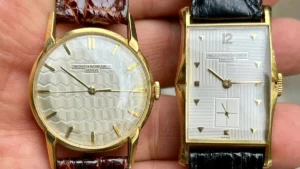
- The Post-War Era (Late 1940s – Early 1950s): Rolex produces the reference 8171, a rare, complex timepiece featuring a triple calendar (day, date, and month) alongside a moon-phase display. Made in exceedingly small numbers—predominantly in yellow gold, pink gold, and stainless steel—it stands alongside the reference 6062 as one of the very few complicated calendar wristwatches Rolex ever manufactured during that era.
- The Rise of the "Padellone" Moniker: Astute Italian collectors look at the reference 8171’s daringly wide 38mm case, flat profile, and gently domed dial, dubbing it the Padellone—Italian for "large frying pan."
- The Modern Auction Phenomenon: Over the subsequent decades, surviving examples of the reference 8171 ascend to mythical status in the secondary market. At elite international auctions, pristine models regularly command mid-six-figure sums, with exceptionally rare case materials and conditions pushing valuations past the $1-million threshold.
- January 2023: Rolex disrupts its traditional playbook by discontinuing the long-running Cellini line and introducing the Perpetual 1908 collection. This move lays the structural groundwork for a dedicated, dress-oriented family of watches driven by classic aesthetics and transparent casebacks.
- 2025: Rolex debuts the high-frequency Caliber 7135 within the Land-Dweller, laying the technical foundation for a new generation of sophisticated complications.
- Today (September 2026): Rolex officially pulls back the curtain on the Perpetual Padellone in Milan, merging the historical soul of the reference 8171 with state-of-the-art twenty-first-century mechanical engineering.
Supporting Data: Engineering the Caliber 7190 and the Haplos System
While the vintage reference 8171 was a complete calendar requiring manual intervention at the close of every month with fewer than 31 days, the modern Perpetual Padellone enters the arena as a true annual calendar. It automatically distinguishes between 30- and 31-day months, demanding a manual correction precisely once a year—at the transition from February to March.

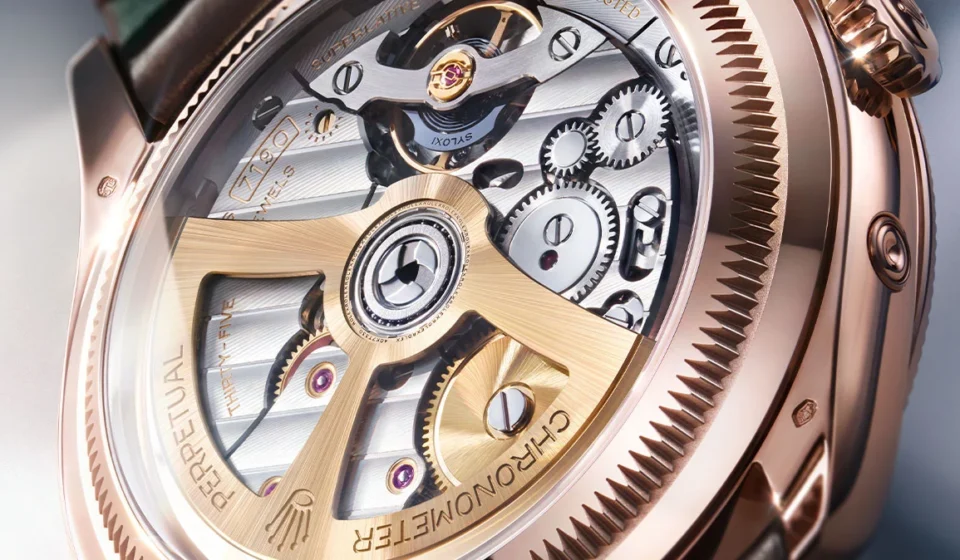
At the heart of this functionality is the brand-new Caliber 7190, an evolution of the architecture seen in the 2025 Land-Dweller. Protected by an astounding 30 patent applications (two of which are entirely exclusive to this movement), the caliber showcases the absolute pinnacle of Rolex’s industrial and intellectual research capabilities.
Technical Specifications Matrix
| Feature | Specification |
|---|---|
| Model Name | Rolex Perpetual Padellone |
| Reference Type | Annual Calendar with Moon Phase |
| Movement | In-House Caliber 7190 (High-Frequency Automatic) |
| Frequency | 5 Hz (36,000 vibrations per hour) |
| Power Reserve | Approximately 66 hours |
| Patent Innovations | 30 patent applications, featuring the Haplos system |
| Case Dimensions | 39 mm diameter, 12.2 mm thickness |
| Water Resistance | 50 meters (165 feet) |
| Case Materials | Everose Gold or Platinum |
| Dial Variations | Grain-finished white (Everose) / Ice Blue (Platinum) |
| Pricing | $59,000 (Everose / Leather) $72,000 (Everose / Settimo Bracelet) $66,200 (Platinum / Leather) |
The crown jewel of the Caliber 7190 is the newly developed Haplos system. This patent-pending mechanism accomplishes the complex math of tracking variable month lengths using a mere two additional components, keeping the movement reliable, slim, and mechanically elegant.
Furthermore, the movement beats at a blistering 5Hz (36,000 vph). This high frequency significantly enhances chronometric stability and shock resistance, earning the entire assembly Rolex’s stringent Superlative Chronometer certification. Through the sapphire display caseback—a feature once anathema to traditional Rolex purists—enthusiasts can admire the meticulous Côtes de Genève finishing on the bridges and the striking, skeletonized yellow-gold oscillating weight.

Official Responses and Design Philosophy
In exclusive briefings surrounding the launch, Rolex design executives emphasized that the Perpetual Padellone was not conceived to chase market trends, but to offer a definitive modern interpretation of an overlooked chapter in the brand’s heritage.
"We did not set out to build a replica of the past," noted a senior product development lead during the Milan unveiling. "The reference 8171 gave us a magnificent canvas—a masterclass in calendar layout and proportional balance. However, the expectations of the modern wearer demand mechanical autonomy, superior chronometry, and a level of finishing that honors the legacy of the original while pushing the boundaries of contemporary manufacturing."
Aesthetic Evolution
The visual language of the Padellone honors its historical muse while firmly aligning with the modern design codes established by the Perpetual 1908 collection:

- The Case: Measuring 39mm in diameter and a slender 12.2mm in thickness, the case is only a fraction larger than the vintage 8171. It swaps the original’s smooth bezel for a finely fluted bezel, yet retains the four discrete case-band correctors required to adjust the day, date, month, and moon phase.
- Hands and Numerals: Abandoning the Dauphine hands of the 1940s original, the Padellone adopts Breguet-style hands—characterized by a slender, elegant stem and a hollow circular ring near the tip—directly echoing the 1908. The dial typography features applied Arabic numerals at 3 and 9 o’clock, replacing the stick indexes of the historical reference.
- The Calendar Display: The day of the week and the month are cleanly displayed through dual apertures situated just below 12 o’clock. The date is indicated via a sweeping, crescent-tipped blue hand that tracks along an outer railway index.
- The Moon Phase Innovation: Moving away from the traditional half-aperture display of the 8171, the Padellone features a fully visible enamel disk at 6 o’clock. Both the full moon and new moon are rendered in authentic meteorite, with the new moon treated with a dark PVD coating. Rather than being artificially obscured by a mask, the moon phase tracks the continuous, natural passage of time between lunar phases, aligning with a fixed triangular indicator.
Implications: The Retail Landscape and Collector Dynamics
The arrival of the Perpetual Padellone sends immediate shockwaves across the upper echelons of the watch collecting ecosystem. By entering the annual calendar complication space—traditionally dominated by high-end independent houses and historic Swiss Maisons like Patek Philippe and Vacheron Constantin—Rolex has raised the stakes considerably.
1. The Death of the "Rolex Doesn’t Do Vintage" Narrative
For years, pundits argued that Rolex’s aversion to direct vintage reissues was a strict policy designed to protect the secondary market values of vintage icons like the Submariner, GMT-Master, and Daytona. The introduction of the Padellone—and its predecessor, the 1908—proves that Rolex is willing to explore its heritage, provided it can be executed through a lens of absolute mechanical innovation rather than superficial nostalgia.
2. Upward Pressure on Vintage Reference 8171 Values
Counterintuitively, the launch of a modern homage often acts as a rising tide for the original vintage pieces. Auction houses should anticipate renewed interest, heightened institutional competition, and potentially record-shattering bids the next time a pristine reference 8171 crosses the auction block.

3. Allocation Realities and Dealer Dynamics
Rolex has explicitly stated that the Perpetual Padellone is not a limited edition. However, much like the 1908 collection, production capacity for a high-frequency, patent-heavy annual calendar featuring meteorite and hand-finished enamel elements will be severely constrained.
For collectors hoping to secure one of the three launch references, the strategy is clear. As industry insiders have noted, the announcement serves as an immediate reminder for clients to nurture and deepen their relationships with authorized dealers. With retail prices stretching from $59,000 to $72,000, the Padellone is positioned firmly in the upper tier of luxury watchmaking—where availability, pedigree, and mechanical mastery converge into the ultimate status symbol of modern horology.
Related posts: