
The Regulatory Reckoning: How Global Social Media Bans and Youth Safety Laws Are Transforming Digital Marketing

The digital landscape is undergoing a monumental shift. For over two decades, social media platforms operated largely as the "Wild West" of global communications—a sprawling ecosystem fueled by algorithms designed to maximize screen time, engagement, and algorithmic feeds. Today, however, that era is rapidly drawing to a close. Driven by mounting public concern over mental health, doom-scrolling, and the pressures of influencer culture, lawmakers and regulatory bodies worldwide are enacting sweeping restrictions on how minors access digital platforms.
According to Sprout Social’s Q1 2026 Pulse Survey, an overwhelming 68% of consumers support social media bans for children, with parents of young children forming the vanguard of this movement. As countries across Europe, Asia, and the Americas implement or debate strict age-verification and access laws, the corporate world is forced to adapt. For global brands and social media marketers, this regulatory pivot demands a fundamental rewrite of how campaigns are structured, how audiences are targeted, and how success is measured.
Main Facts: The Global Shift Toward Youth Digital Protection
The global crackdown on youth social media usage is no longer a fringe policy discussion; it is rapidly becoming international law. Governments are no longer asking if platforms should be regulated, but how quickly restrictive frameworks can be implemented.
- Public Backing: Nearly seven in ten consumers (68%) support legislative bans or strict age-gating to protect children from the harms of unmitigated social media exposure.
- The Burden of Compliance: In almost every jurisdiction, the legal duty to enforce age limits, parental controls, and verification protocols falls directly on the tech platforms—such as Meta, TikTok, YouTube, and Snapchat—rather than individual users.
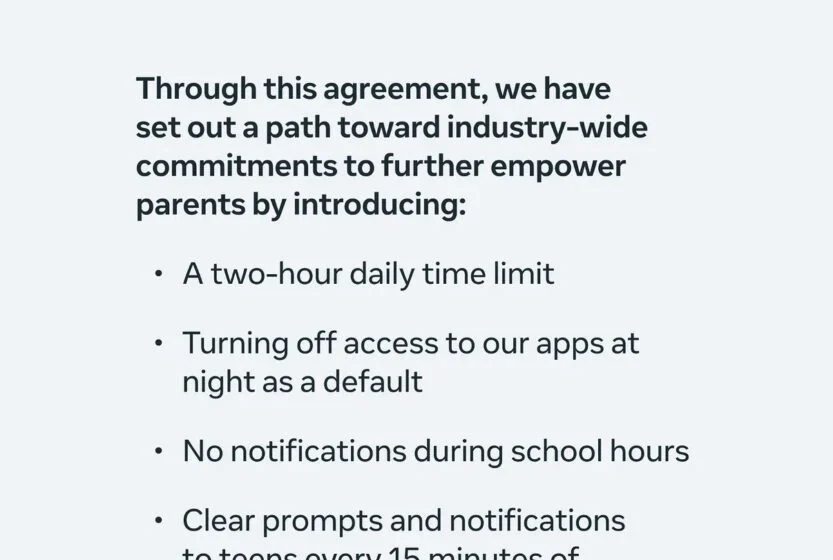
- The Meta Settlement Catalyst: A landmark youth safety settlement involving Meta has accelerated sweeping design changes across Instagram and Facebook. These changes serve as a de facto blueprint for the entire industry, establishing new standards for parental supervision, notification limits, and algorithmic feeds.
- A Shift in Strategy: Brands can no longer rely on "blanket posting" and passive reliance on recommendation algorithms. Marketers are moving toward age-targeted messaging, rigorous compliance frameworks, and hybrid digital-physical (IRL) marketing strategies.
Chronology of Reform: From Legislative Proposals to Landmark Settlements
The current wave of regulation represents a rapid acceleration of policy changes that have evolved over recent years. While initial safety measures focused primarily on voluntary privacy settings, lawmakers have shifted toward mandatory structural interventions.
2024–2025: The Groundwork for Restrictions
State-level legislation in the United States and early parliamentary discussions in Europe and the Asia-Pacific (APAC) region began challenging the foundational architecture of social media. Lawmakers introduced bills focused on age-assurance technology, app-store gating, and parental consent models.
Late 2025–Early 2026: Legislative Tipping Point
A series of rapid policy enactments transformed the global arena:
- April 2026: Turkey passed comprehensive legislation prohibiting personal social media accounts for children under 15, introducing strict parental controls for teenagers aged 15 to 17.
- June 2026: The United Arab Emirates (UAE) formally established a minimum age requirement of 15 for independent social media accounts, placing stringent controls on users aged 15 and 16.
- August 2026: France’s highest court ruled on expression-related constraints regarding a youth ban, prompting immediate expectations for revised, legally sound restrictions. Simultaneously, countries like Australia, Indonesia, and Malaysia advanced or enforced active bans restricting children under 16 from accessing high-risk networks.
The Meta Settlement Wave (Mid-2026)
Rather than waiting for slow-moving legislative bodies, judicial settlements—most notably Meta’s landmark youth safety agreement—forced immediate operational changes. Under the terms of this settlement, major networks were compelled to fast-track restrictions on algorithmic delivery, direct messaging features for minors, and nighttime app access. Crucially, the settlement set a precedent: restrictions on reaching youth demographics are arriving faster through legal settlements than through traditional parliamentary bills.
Supporting Data: Regional Breakdowns of Social Media Legislation
Global responses to youth access vary significantly by region. Below is an overview of how different geopolitical blocks are structuring their oversight.
EMEA (Europe, Middle East, and Africa)
| Country | Minimum Age & Effect on Audience | Duty to Regulate | Current Status |
|---|---|---|---|
| UAE | Under 15s barred from personal accounts; ages 15–16 face feature restrictions. | Networks | Active / In Action |
| Turkey | Under 15s prohibited from registering; ages 15–17 require strict parental oversight. | Networks | Passed / Pending Enforcement |
| United Kingdom | Under 16s lose algorithmic feed access; 16–17-year-olds face overnight curfews. | Networks | Proposed / Under Review |
| Greece | Under 15s restricted from opening personal accounts. | Networks | Proposed |
| Denmark | Under 15s face potential platform bans (terms under negotiation). | Networks | Proposed / Negotiating |
| France | Under 15s restricted from personal accounts. | Networks | Struck down by high court; revision expected |
Note: The European Commission has also floated a bloc-wide framework aimed at standardizing protections for all users aged 16 and under across European Union member states.
APAC (Asia-Pacific)
| Country | Minimum Age & Effect on Audience | Duty to Regulate | Current Status |
|---|---|---|---|
| Australia | Minors under 16 prohibited from holding independent personal accounts. | Networks | Active / In Action |
| Indonesia | Under 13s limited to child-safe products; ages 13–16 require parental consent; high-risk platforms restricted to 16+. | Networks | Active / In Action |
| Malaysia | Children under 16 barred from registering new platform profiles. | Networks | Active / In Action |
| New Zealand | Under 16s barred from accessing networks designated as "high risk." | Networks | Proposed |
United States Regulatory Models
While federal legislation remains complex and state-level battles play out in American courts, US states are predominantly experimenting with four core regulatory models:
- Age Restrictions + Parental Consent: Establishes minimum age floors with mandatory parental verification gates for older teens.
- Feed and Design Restrictions: Bans personalized recommendation algorithms and night-time notifications for minors while keeping platforms technically accessible.
- Usage and Time Limits: Imposes daily platform-use caps for minor accounts.
- App-Store Verification: Shifts the verification burden away from social networks entirely, placing the responsibility on app marketplace operators like Apple and Google.
Official Responses and Industry Insights
As platforms scramble to comply with international edicts, marketing executives and agency leaders are publicly reassessing the future of digital engagement. Rather than viewing these regulations as an existential threat to marketing, industry veterans frame this as a necessary maturation of the medium.

Sam Morgan-Smith, Head of Social at UK-based PR agency The Romans, characterizes the transition bluntly:
"The days of blanket posting (or ‘throwing confetti’ as I refer to it) and trusting the algorithm are over. Brands will need to get far more strategic. Content needs to be age-aware and legally defensible."
Echoing this sentiment, Tiffany Sayers, co-founder of Australian agency Loft Social, emphasizes the need for operational rigor:
"If underage users are legislatively restricted or platforms are penalized for blurred lines, we’ll need more rigour in how brands brief talent, capture first-party data and define success."
Rather than signaling the death of digital advertising, industry leaders view the environment shifting from an unregulated "Wild West" to a structured, accountable media landscape—comparable to the evolution of broadcast television decades ago.
Implications for Global Brands and Marketers
For social media marketers accustomed to chasing viral vanity metrics, the rise of youth safety laws requires a profound operational realignment. Navigating this new normal demands strategic adaptation across three distinct pillars:
1. Precision Targeting and Age-Aligned Content
With blanket algorithmic distribution facing headwinds, brands can no longer rely on casting a wide net. Marketing teams must develop hyper-targeted content strategies rooted in first-party data. Campaigns must be carefully curated to ensure messaging strictly aligns with adult demographics or legally permissible age brackets, removing ambiguity from creator briefs and paid media buys.
2. Sophisticated Brand Safety and Governance
Compliance can no longer be treated as an afterthought or a superficial add-on. Modern social media governance requires internal playbooks that dictate permissible messaging by age, region, and platform. Furthermore, training must extend beyond dedicated social media teams to include all digital-facing departments, ensuring adherence to complex international frameworks such as the US Children’s Online Privacy Protection Act (COPPA), the UK Online Safety Act, and Australia’s strict age-assurance mandates.
3. The Pivot to Hybrid and Real-World (IRL) Immersion
As digital reach becomes more restricted by age-gating and algorithm limits, brands are rediscovering the power of real-world experiences. Industry experts advise a strategic pivot toward hybrid ecosystems. Online, brands are exploring safe alternative spaces such as gaming integrations and instant messaging channels. In the physical world, there is a creative resurgence of micro-events, university activations, experiential retail theater, and peer-to-peer word-of-mouth storytelling.
Conclusion: A Maturing Digital Ecosystem
The global push for social media bans and stricter platform governance is fundamentally reshaping the relationship between consumers, tech giants, and brands. While compliance introduces new administrative hurdles and brand safety risks, it also clears away the noise of unverified metrics.
As Tiffany Sayers notes, social media continues to deliver robust return on investment (ROI) throughout the consumer funnel, provided brands are willing to adopt smarter systems and more intentional messaging. By shifting executive focus away from superficial "likes" and toward genuine human connection, compliant digital marketing is poised to enter a more responsible, sustainable era.
Related posts: