Setting Sail on the Bay: A Rare Floating Home in San Francisco’s Mission Creek Harbor Lists for $1.7 Million

Published: September 28, 2026
Author: Real Estate Desk
Main Facts
In a real estate market traditionally dominated by Victorian painted ladies, luxury high-rises, and mid-century architectural marvels, a truly unique piece of San Francisco history has surfaced on the open market. Located at 300 Channel Street, a spacious, three-bedroom, three-bathroom floating home within the historic Mission Creek Harbor community is currently listed for $1.7 million.
Represented by Erik Throm of City Real Estate, the 1,780-square-foot marine residence offers an exceptionally rare opportunity. Unlike houseboats in other regions that frequently rotate through public listings, the residences nestled within Mission Creek Harbor—San Francisco’s only permitted floating home community—rarely change hands publicly. Transactions are typically conducted discreetly behind the scenes, passing quietly between family members or long-standing members of the local nautical enclave.
Compounding the allure of this floating architectural gem is its inclusion package: the purchase price not only secures the multi-level floating home itself, but also comes bundled with a private pleasure boat and a coveted 40-foot boat berth. Balancing maritime charm with high-end, contemporary interior design, 300 Channel Street represents an idiosyncratic slice of Bay Area counterculture, perfectly adapted for the 21st-century luxury buyer.
Chronology of a Waterfront Haven: From Industrial Outpost to Modern Enclave
To truly understand the significance of 300 Channel Street, one must look back at the evolutionary timeline of San Francisco’s southeastern waterfront.

The Countercultural Roots (1950s–1960s)
Long before the tech boom transformed the city’s skyline, demographics, and economic fabric, San Francisco served as a crucible for America’s countercultural movements. In the 1950s and 1960s, a free-spirited, bohemian ethos took root along the fringes of the city’s industrial zones. Artists, musicians, and free-thinkers began anchoring unorthodox floating dwellings in the city’s hidden waterways.
Mission Creek Harbor emerged as a primary canvas for this aquatic lifestyle. At the time of its inception, the harbor was a far cry from the manicured urban destination it is today. It was situated squarely within a gritty, heavy-industrial district defined by roaring railroad yards, sprawling brick warehouses, and a heavily polluted, working shipping channel. Life on the water meant embracing a raw, off-the-grid existence that prioritized community, self-sufficiency, and an intimate connection to the San Francisco Bay tides over modern urban conveniences.
The Urban Transformation (Late 20th to Early 21st Century)
As decades passed, the industrial footprint of the neighborhood began to fade, paving the way for one of the most dramatic urban redevelopments in the United States. The gritty rail yards and dilapidated warehouses gave way to gleaming biotech campuses, luxury apartment towers, and premier sports and entertainment destinations.
The arrival of Oracle Park—home to the San Francisco Giants—in 2000 fundamentally shifted the cultural and economic gravity of the neighborhood. Nearly two decades later, the opening of the Chase Center, home of the Golden State Warriors, cemented the district as a bustling epicenter of commerce, entertainment, and recreation. Today, the floating community at Mission Creek Harbor floats in stark, poetic contrast to its hyper-modern surroundings: a preserved vestige of bohemian history anchored amid the gleaming architecture of the modern tech and entertainment era.
The Next Chapter: 2026 and Beyond
The neighborhood’s evolution is far from finished. City planners have slated a massive new municipal park to break ground just footsteps from the harbor later this year, further elevating the neighborhood’s livability and blending urban green space with aquatic living. It is against this backdrop of dynamic urban renewal that 300 Channel Street makes its rare public market debut.

Supporting Data & Architectural Anatomy
Spanning 1,780 square feet of thoughtfully curated living space, 300 Channel Street defies expectations of what a floating home can be. Eschewing the cramped quarters often associated with marine life, this residence offers a sprawling, multi-level layout that rivals traditional dry-land luxury condominiums.
Interior Layout and Split-Level Design
The home’s entertaining spaces are organized across a dynamic split-level architectural plan. On the upper level, a sophisticated, modern living room acts as the social heart of the home. It is dramatically framed by a floor-to-ceiling, steel-trimmed interior window that looks down into the dining area and kitchen below, creating an open-concept feel while maintaining distinct functional zones.
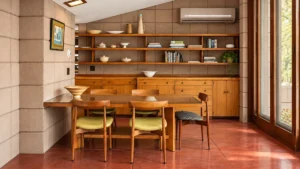
The galley kitchen is a masterclass in custom craftsmanship. It features bespoke wood countertops that seamlessly wrap around the space, culminating in a striking, curving breakfast bar designed for casual dining and morning coffee while watching the harbor traffic glide by.
The Nautical Primary Suite & Accommodations
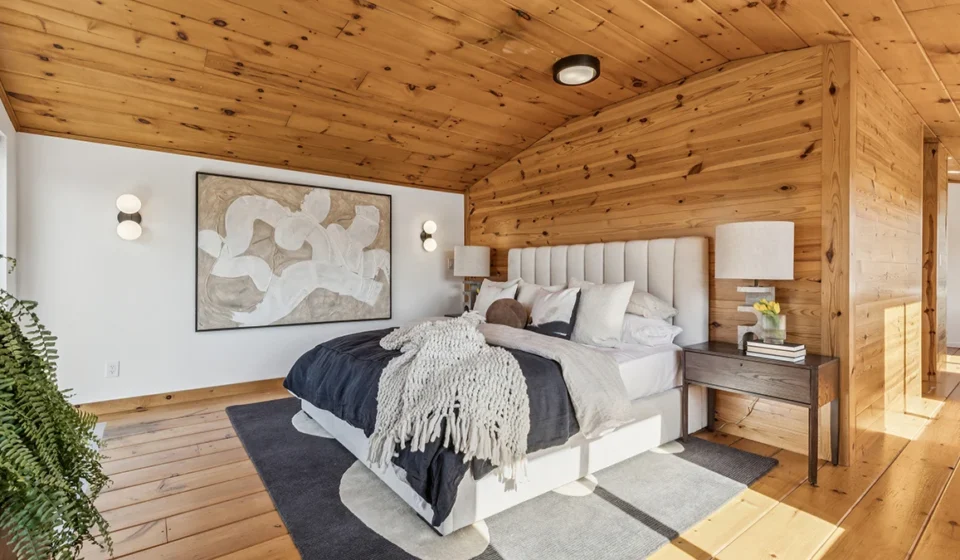
The primary suite leans heavily into its maritime setting. Lined completely from floor to ceiling in rich, wide-plank wood paneling, the bedroom evokes the cabin of a luxury yacht. It opens directly onto a private balcony, offering uninterrupted views of the water. Additional features of the primary retreat include a dedicated water-facing sitting room, a generous walk-in closet, and a spa-like, sleekly appointed bathroom.
The home’s remaining two bedrooms embrace a more minimalist, contemporary aesthetic. One of these secondary bedrooms enjoys the added luxury of a private en-suite bathroom. For remote professionals or creatives, a dedicated small office space is tucked away, accessible via a sculptural winding steel staircase. Outside, a compact waterside deck provides the ideal spot for open-air lounging, reading, or evening cocktails as the sun sets over the San Francisco skyline.

Asset Breakdown
- Property Type: Permitted Floating Home
- Location: Mission Creek Harbor, San Francisco, CA
- List Price: $1,700,000
- Square Footage: 1,780 sq. ft.
- Layout: 3 bedrooms, 3 bathrooms, split-level living areas, home office
- Included Assets: Private pleasure boat and a 40-foot boat berth
- Listing Agent: Erik Throm, City Real Estate
Official Responses and Market Perspectives
The listing of 300 Channel Street has generated significant buzz among local real estate experts, urban historians, and prospective buyers looking for alternatives to traditional housing stock in the Bay Area.
"Floating homes of this caliber—and within this specific harbor—simply do not pop up on the open market every day," notes listing agent Erik Throm of City Real Estate. "For decades, the community at Mission Creek Harbor has operated like a closely guarded secret. Homes are passed down through generations or sold strictly via word-of-mouth networks. Giving the general public an invitation to purchase a turnkey, architecturally striking home here—complete with a 40-foot berth and a pleasure boat—is an unprecedented opportunity."
Urban planning advocates have also weighed in on the significance of preserving San Francisco’s floating communities. Dr. Elena Vance, a local architectural historian specializing in Bay Area waterfronts, emphasizes the cultural weight of Mission Creek Harbor:
"San Francisco has lost an immense amount of its quirky, countercultural character to hyper-gentrification and corporate development. Mission Creek Harbor is one of the last living testaments to the independent, seafaring spirit that defined the city’s mid-century identity. When properties like 300 Channel Street become available, they aren’t just selling square footage; they are selling stewardship over a rare cultural ecosystem."
Market analysts point out that while $1.7 million commands a steep price per square foot relative to national averages, it occupies a competitive sweet spot within San Francisco’s luxury market. For comparison, traditional single-family homes or luxury condominiums in nearby South Beach or Mission Bay routinely eclipse the $2.5 million to $4 million threshold, often without the distinct lifestyle perks of water frontage, private boat berths, and unobstructed bay views.

Implications for the San Francisco Real Estate Market
The public listing of 300 Channel Street carries broader implications for how buyers view alternative housing in high-density urban environments.
1. The Rise of Experiential Real Estate
As remote and hybrid work models persist among affluent buyers—particularly within the tech and professional services sectors—the definition of luxury has shifted. Buyers are increasingly prioritizing lifestyle, mental well-being, and unique spatial experiences over traditional suburban square footage or standard high-rise living. A floating home that doubles as a marine sanctuary offers a psychological and physical detachment from the urban grind, all while remaining minutes away from downtown San Francisco.
2. Scarcity and Regulatory Protections
San Francisco’s stringent maritime and environmental regulations mean that the creation of new floating home communities is virtually impossible under current municipal codes. The 20 permitted homes at Mission Creek Harbor represent a finite, irreplaceable asset class. As long as the city continues to densify around the waterfront—highlighted by the impending construction of the massive new neighborhood park—the relative value and prestige of these protected floating enclaves are expected to appreciate steadily.
3. Bridging Past and Future
Ultimately, 300 Channel Street serves as a physical bridge connecting San Francisco’s bohemian past with its high-tech, ultra-modern present. It demonstrates that luxury real estate in the Bay Area does not have to conform to glass-and-steel uniformity. By blending custom architectural craftsmanship with raw nautical freedom, this listing challenges the status quo of urban living, proving that the most desirable address in the city might just be the one that floats.