
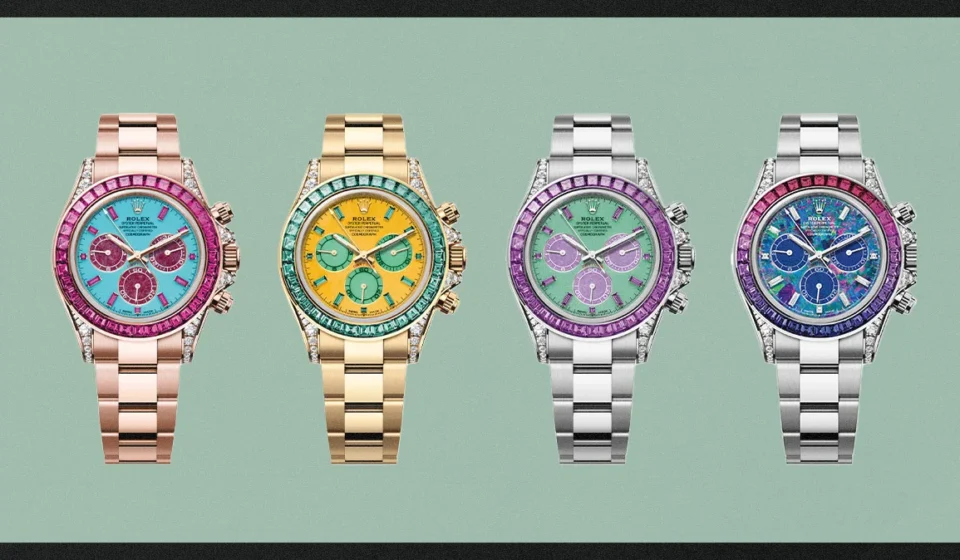
A Historic Night in London: Rolex’s "Four Seasons" Daytonas Smash Records with a $49.5 Million Charity Sweep

LONDON — In what horological historians are already calling a watershed moment for the watchmaking industry, Rolex has shattered expectations during a high-profile charity auction in London. A specially curated quartet of one-of-a-kind gem-set Cosmograph Daytonas—collectively dubbed the "Four Seasons" collection—sold for a staggering total of $49.5 million.
Conducted by industry titan Aurel Bacs under the auspices of Phillips auction house, the Monday evening event drew international collectors, ultra-high-net-worth individuals, and industry insiders. More remarkably, every single cent of the astronomical proceeds has been earmarked for philanthropic initiatives spearheaded by two of the world’s most recognizable cultural figures and longtime Rolex Testimonees: tennis legend Roger Federer and Academy Award-winning actor and environmentalist Leonardo DiCaprio.
The auction not only underscores the unyielding, almost gravitational pull of the Rolex Daytona in the upper echelons of the secondary and vintage markets, but it also establishes a new benchmark for brand-backed charity sales in the modern era of luxury goods.
1. Main Facts: The $49.5 Million Quartet
The focal point of the evening was an unprecedented offering: four unique, gem-set Rolex Cosmograph Daytonas, each conceptually bound to a different season of the year. Rolex, a brand notoriously guarded about producing officially designated "unique pieces," officially confirmed the singular nature of these four timepieces, sending shockwaves through the global collecting community.
Led by auctioneer Aurel Bacs, the bidding war culminated in the sale of all four lots for a combined $49.5 million. The breakdown of the individual sales highlights the intense demand for rare precious metal configurations, exotic hardstone dials, and meticulously graded precious stones:

- The Summer Daytona ($13.65 million): Commanding the highest individual price of the evening, the summer iteration features a warm Everose gold case, a vibrant turquoise dial contrasted by ruby counters, and a bezel fully encrusted with brilliant-pink sapphires.
- The Autumn Daytona ($13.5 million): Following closely behind, the fall model pairs a rich yellow-gold architecture with an earthy mookaite dial, striking chrysoprase sub-dial counters, and a lush bezel set with green tourmalines.
- The Winter Daytona ($13.2 million): Representing the colder months, this variant pairs a heavy platinum case and bracelet with a mesmerizing blue opal dial, deep blue lapis lazuli counters, and an icy border of blue sapphires.
- The Spring Daytona ($9 million): Rounding out the quartet, the spring model utilizes a refined white-gold architecture, a soft green chrysoprase dial, contrasting lepidolite counters, and a delicate gradient bezel of purple sapphires.
2. Chronology of the Evening: A Masterclass in High-Stakes Bidding
The atmosphere inside the London sale room on Monday night was electric. Weeks of speculation within private collector circles had primed the market, but few anticipated the ferocity with which the opening bids would escalate.
As the lights dimmed and Aurel Bacs stepped up to the rostrum, the room fell into a tense hush. Bacs, renowned for his theatrical and commanding auction style, opened the night by emphasizing the gravity of the occasion—not merely as a commercial transaction, but as an intersection of elite craftsmanship and global philanthropy.
- The Opening Salvo (Spring): The auction commenced with the Spring Daytona. Estimated conservatively ahead of the night, white-glove enthusiasm immediately drove the bidding past traditional retail ceilings. After a brisk volley between room and telephone bidders, the hammer fell at $9 million, setting a high-water mark for the evening that would quickly be eclipsed.
- The Climactic Middle (Winter and Autumn): Momentum accelerated dramatically as the Winter Daytona took the block. The rare combination of platinum and blue opal sparked a prolonged duel between two anonymous phone bidders, ultimately closing at $13.2 million. Immediately following, the Autumn Daytona—with its autumnal mookaite and green tourmalines—ignited a similar frenzy, pushing past its sister watch to realize $13.5 million.
- The Grand Finale (Summer): The evening reached its dramatic climax with the presentation of the Summer Daytona. Boasting the striking Everose gold and turquoise combination, the watch captured the imagination of the room. Following a rapid series of escalating bids, the hammer dropped to rapturous applause at $13.65 million, securing its place as the top lot of the night and sealing the $49.5 million grand total.
3. Supporting Data & Context: The Anatomy of Daytona Supremacy
To understand the astronomical figures fetched by the "Four Seasons" collection, one must examine the unique economic and cultural ecosystem surrounding the Rolex Daytona.
First introduced in 1963 as a tool watch for endurance race car drivers, the Cosmograph Daytona has evolved over six decades into the undisputed holy grail of watch collecting. While standard-production stainless steel and precious metal Daytonas command significant waitlists and secondary market premiums, historically exceptional or unique pieces occupy an entirely different financial stratosphere.
The most famous precedent in modern horological history occurred in October 2017, when Paul Newman’s personal, stainless-steel Rolex Daytona (Ref. 6239) was sold by Phillips in New York for nearly $18 million. While that sale proved the historical and sentimental value of a celebrity-owned vintage piece, the London charity auction established a new paradigm: factory-fresh, modern complications engineered explicitly as unique art objects can command comparable figures.

Furthermore, the rarity factor cannot be overstated. Rolex rarely sanctions or confirms "unique pieces" (pièces uniques) coming directly from its Geneva workshops. By breaking protocol for this charitable endeavor, The Crown effectively guaranteed that these four Daytonas would instantly enter the pantheon of museum-grade horology.
4. Official Responses and Philanthropic Impact
Beyond the jaw-dropping financial metrics, the core narrative of the evening remains deeply rooted in philanthropy. The entire $49.5 million proceeds will directly benefit two major charitable organizations established by Rolex Testimonees: The Federer Foundation and Re:wild.
Aurel Bacs, Phillips
Reflecting on the historic sale, Aurel Bacs shared his awe in an official statement:
"This is a historic moment for the world of watchmaking. We are deeply honoured to have played a role in this first-ever charity auction with Rolex and to support the important work of the Federer Foundation and Re:wild. It was a privilege to stand on the rostrum and witness the energy and passion in the room, united by shared values of excellence, craftsmanship, and, above all, a commitment to making a positive difference."
The Beneficiaries
- The Federer Foundation: Established in 2003 by tennis icon Roger Federer, the organization focuses on systemic educational reform. It champions early and foundational learning initiatives for vulnerable children across several countries in Southern Africa as well as in Federer’s native Switzerland. The infusion of funds from the auction will allow the foundation to scale its educational infrastructure significantly.
- Re:wild: Co-founded by Academy Award-winning actor and environmental activist Leonardo DiCaprio alongside a group of renowned conservation scientists, Re:wild is dedicated to protecting and restoring the earth’s most vulnerable wild ecosystems. The organization works globally to halt species extinction, safeguard indigenous lands, and reverse climate degradation.
Bacs emphasized the broader legacy of the night, noting, "The extraordinary amount raised will make a meaningful contribution to future generations and to the protection of our natural world."

5. Industry Implications: What This Means for the Watch Market
The resounding success of the Rolex "Four Seasons" auction leaves deep ripples across the luxury watch landscape, signaling several key shifts in how ultra-high-end timepieces are perceived, collected, and utilized:
1. The Blurring Lines Between Horology and Fine Art
For decades, high-end watches were judged primarily by their mechanical complications, historical provenance, or utility. The integration of rare hardstones (turquoise, mookaite, blue opal, chrysoprase) and high-jewelry gem-setting in these four Daytonas repositions them away from pure tool watches and squarely into the realm of fine art objects—akin to unique canvases by master painters.
2. The Rise of "Philanthropic Luxury"
Luxury brands are increasingly under pressure to demonstrate social responsibility. By leveraging its most coveted asset—the Daytona—in direct partnership with global cultural icons like Federer and DiCaprio, Rolex has set a new gold standard for corporate philanthropy. This event proves that the world’s wealthiest collectors are willing to open their wallets wider when a purchase serves a dual purpose of high-status acquisition and global betterment.
3. Strengthening the Primary-to-Secondary Continuum
By participating in a transparent, high-profile public auction rather than private, closed-door sales, Rolex has injected immense confidence into the broader watch market. At a time when secondary market values for certain luxury brands have experienced corrections, the $49.5 million total proves that the pinnacle of ultra-exclusive collecting remains entirely insulated from broader economic headwinds.
As the dust settles in London, the four unique Daytonas—Summer, Autumn, Winter, and Spring—disappear into the private vaults of their victorious bidders. Yet, their legacy is already cemented: a masterclass in design, a triumph of auctioneering, and a monumental financial victory for global education and environmental conservation.