Preserving Organic Modernism: The Samuel Eppstein Residence Hits the Market in Michigan

GALESBURG, Mich. — Frank Lloyd Wright’s indelible footprint on American residential architecture continues to command the attention of high-end real estate connoisseurs, preservationists, and architectural historians alike. Few architects have so profoundly altered the national vernacular, shifting the paradigm from European-derived compartmentalization toward fluid, human-scaled spaces that honor their natural surroundings.
Now, a pristine example of Wright’s mid-career genius has surfaced on the open market. The Samuel Eppstein Residence, located in the pastoral suburb of Galesburg just outside Kalamazoo, Michigan, is currently listed for $2.1 million with Signature Sotheby’s International Realty. Completed in 1953, the three-bedroom, two-bathroom architectural jewel stands as a remarkably intact testament to Wright’s Usonian philosophy—a democratic vision for modern, middle-class American living that remains as captivating today as it was over seven decades ago.
Main Facts: The Eppstein Residence at a Glance
Nestled within a private, two-acre parcel, the Samuel Eppstein Residence exemplifies the core tenets of Wright’s organic architecture. The structure marries a low-slung, sturdy concrete-block facade with rich wood trim, framing expansive windows designed to dissolve the boundary between the interior living spaces and the surrounding landscape.
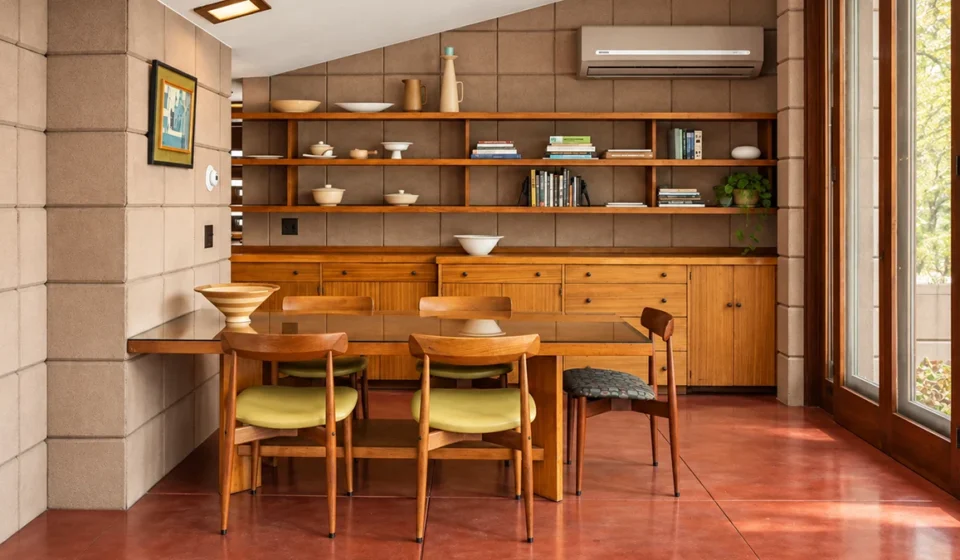
Inside, the residence showcases signature Wrightian details at every turn. The home is anchored by iconic red-stained concrete floors, which run continuously throughout the footprint, providing a warm, earthy foundation. The main living area features a classic, open-concept wood-burning fireplace designed to draw families together, flanked by floor-to-ceiling glass that bathes the interior in natural daylight.

Built-in cabinetry, warm wood paneling in the private quarters, and a cozy dining nook adjacent to the kitchen preserve the home’s historic integrity. Additionally, a flexible multi-purpose room provides modern adaptability, functioning seamlessly as a secondary lounge, home office, or private wellness studio. Outdoors, the property offers generous terrace space, a charming outdoor dining patio, and a covered carport, all surrounded by a master-planned cooperative community defined by meadows, mature timber, and rolling hills.
Chronology: From Conception to Architectural Landmark
The history of the Samuel Eppstein Residence is inextricably tied to "The Acres," a visionary cooperative residential project in southwest Michigan. To understand the timeline of the home is to trace the twilight years of Wright’s legendary career and the enduring camaraderie of the families who commissioned him.
- 1947–1948: A group of Michigan-based scientists and professionals—including Samuel and Dorothy Eppstein—form a cooperative with the dream of creating an intentional community centered around modern architecture. They pool their resources to purchase a 70-acre tract of rolling farmland and woods in Galesburg.
- 1948: The group approaches Frank Lloyd Wright, successfully commissioning the master architect to design a master plan for the property, along with individual Usonian homes for the participating families.
- 1953: Construction of the Samuel Eppstein Residence is officially completed. Working in close collaboration with Wright himself just a few years before his death in 1959, the Eppsteins realize their vision of an organic, integrated modern home.
- 2004: Recognizing the profound historical and architectural significance of the collective development, The Acres is officially added to the National Register of Historic Places, cementing its status as a sacred site for midcentury modern preservation.
- Summer 2024: Another architectural marvel within the same cooperative—the curving, Wright-designed Winn House—hits the market, commanding attention and setting a high benchmark for regional historic values at $1.9 million.
- Early 2025: The momentum within The Acres continues as the Weisblat House, yet another Wright-designed gem in the community, lists for nearly $2.3 million.
- Current Day: The Samuel Eppstein Residence lists for $2.1 million, offering a new custodian the rare opportunity to acquire a meticulously maintained piece of American design history.
Supporting Data: The Economics and Anatomy of Usonian Living
To fully appreciate the listing price of $2.1 million, one must contextualize the valuation within the broader niche market of Frank Lloyd Wright properties and the specific ecosystem of The Acres.
Architectural Specifications
- Property Type: Single-Family Usonian Residence
- Location: 11090 Hawthorne Drive, Galesburg, Michigan (Kalamazoo metropolitan area)
- Bedrooms: 3
- Bathrooms: 2
- Acreage: 2 private acres (within a shared 70-acre cooperative nature preserve)
- Listing Price: $2.1 million
- Represented By: Signature Sotheby’s International Realty
- Historic Status: Contributing property to The Acres Historic District, listed on the National Register of Historic Places (2004)
The Usonian Economic Landscape
Wright’s Usonian houses were originally conceived during the Great Depression as an affordable, elegant solution for the American middle class. Ironically, these modest homes—originally built for modest budgets—now command seven-figure sums due to their extreme scarcity, historical import, and the tireless stewardship required to maintain them.

Compared to contemporary listings in The Acres—such as the Winn House ($1.9 million) and the Weisblat House ($2.3 million)—the Eppstein Residence sits squarely in line with current market valuations for authenticated Wright properties in the Midwest. While coastal Wright homes often fetch multi-millions or tens of millions of dollars, the Michigan enclave offers exceptional value for buyers seeking an authentic, undisturbed spatial experience without urban density.
Official Responses and Preservationist Perspectives
The stewardship of a Frank Lloyd Wright home is rarely a passive endeavor; it is widely viewed by owners and preservationists as a cultural trusteeship. Representatives from Signature Sotheby’s International Realty emphasize that properties of this caliber attract a very specific buyer profile: individuals who view themselves as caretakers of architectural art rather than traditional homeowners.
Local architectural historians and representatives from the Frank Lloyd Wright Building Conservancy frequently monitor the lifecycle of homes within The Acres. Because four of the five homes in the enclave were designed by Wright, the community operates as a living museum.
In past statements regarding the preservation of The Acres, architectural advocates have noted that the mutual agreement among homeowners to protect the shared 70-acre landscape has successfully prevented the suburban sprawl that so often swallows midcentury developments. The Eppstein family’s meticulous care over decades, followed by subsequent owners, has ensured that original elements—from the custom built-ins to the clerestory windows—remain pristine, drawing praise from preservation organizations nationwide.

Implications: What the Sale Means for the Midcentury Real Estate Market
The listing of the Samuel Eppstein Residence carries several broader implications for the high-end real estate market, architectural conservation, and regional development in the American Midwest.
1. The Resilience of Rural Architectural Tourism and Investment
For decades, high-end architectural real estate was concentrated primarily in major metropolitan hubs like Los Angeles, Chicago, and New York. However, the consistent performance of properties in Galesburg—culminating in the sequential listings of the Winn, Weisblat, and Eppstein houses—proves that destination architecture can thrive in secondary and tertiary markets. Discerning buyers are increasingly willing to relocate or maintain secondary residences in pastoral settings if the architectural provenance is absolute.
2. The Growing Value of Cooperative Stewardship
The success of The Acres highlights a replicable model for historic preservation. By pooling land into a shared trust, the original owners created a buffer against incompatible development. As modern buyers increasingly prioritize privacy, nature, and sustainability, master-planned cooperative communities like The Acres offer a blueprint for future residential design.
3. The Urgency of Preservation-Minded Ownership
With every transfer of ownership of a Frank Lloyd Wright home comes the inherent anxiety of potential alterations or modernizations that could compromise historic integrity. Fortunately, the stringent guidelines associated with the National Register of Historic Places, combined with the ethos of those drawn to Wright’s work, heavily favor preservation. The sale of the Eppstein Residence will test the current market’s appetite for historical fidelity, offering another indicator of whether the next generation of luxury buyers values untouched authenticity over modern square-footage maximization.

Conclusion
As the Samuel Eppstein Residence seeks its next steward, it remains a glowing ember of Wright’s utopian dream. For $2.1 million, a buyer is purchasing not merely wood, glass, and concrete, but an immersive work of art—a space where human life, art, and the natural world exist in total, enduring harmony.
Related posts: