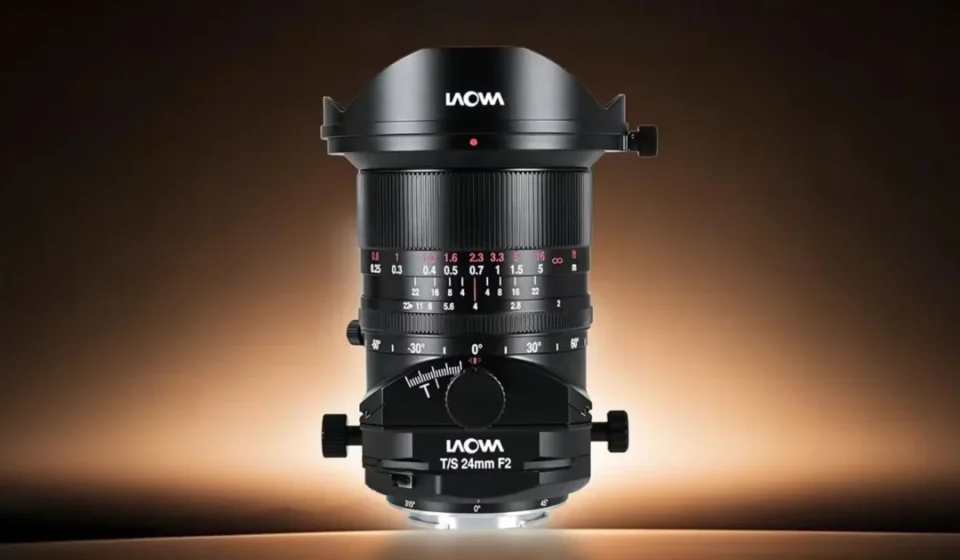
Venus Optics Shakes Up the Optical Market with the Groundbreaking Laowa T/S 24mm f/2 C-Dreamer Tilt-Shift Lens

By Optical Industry Desk
Venus Optics has once again disrupted the photographic hardware landscape, quietly rolling out one of the most ambitious and specialized optics in recent memory. While the manufacturer has yet to make a formal global or U.S. press announcement, the new Laowa T/S 24mm f/2 C-Dreamer tilt-shift lens has officially debuted in the Chinese domestic market. Spotted first by industry analysts at Canon Addict and already filtering through cross-border retail channels like AliExpress, this lens promises to redefine what photographers can achieve with perspective control, particularly in low-light environments.
By pushing the boundaries of aperture speed in a focal length historically dominated by slower f/3.5 designs, Venus Optics is continuing its crusade to make specialized optical tools accessible, fast, and versatile for a vast array of modern mirrorless and medium-format camera ecosystems.
Main Facts
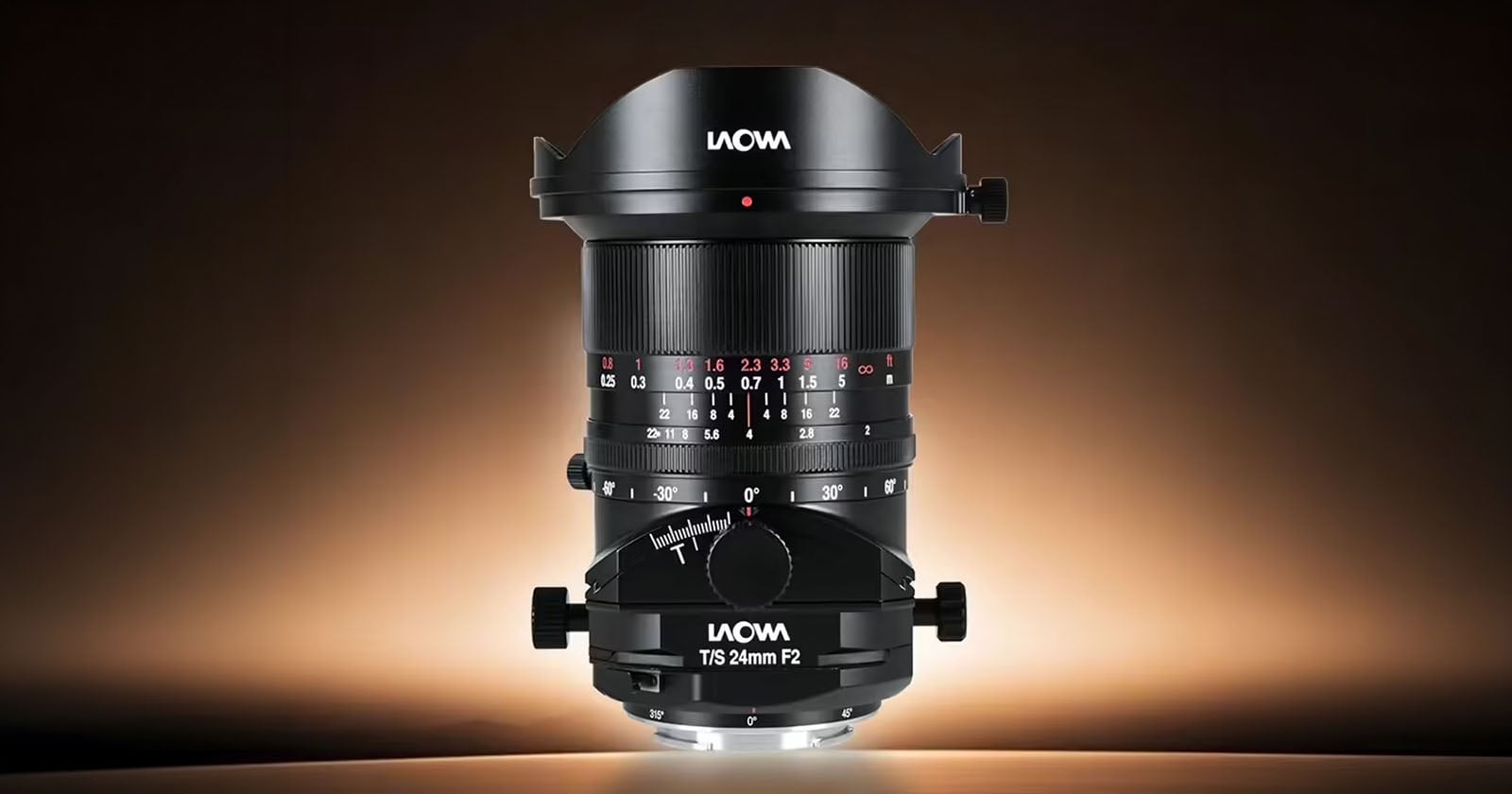
The Laowa T/S 24mm f/2 C-Dreamer is a full-frame manual-focus tilt-shift lens designed to bridge the gap between architectural precision and low-light capability.
- Exceptional Aperture Speed: Operating at a maximum aperture of f/2, this lens is more than a full stop faster than historical industry standards like the Canon TS-E 24mm f/3.5L II and the Nikon PC-E Nikkor 24mm f/3.5D ED.
- Comprehensive Mount Compatibility: Mirrorless shooters using Sony E, Nikon Z, Canon RF, and Leica/Panasonic/Sigma L-mount systems are fully supported. Crucially, the lens is also engineered to cover medium-format systems, including Fujifilm GFX and Hasselblad XCD mounts, without suffering from the reduced movement range that historically plagued some cross-format lenses.
- Complex Optical Construction: The internal layout consists of 13 optical elements organized into 10 groups. This sophisticated formulation includes five Extra-Low Dispersion (ED) elements, two aspherical elements, and four high-refractive-index glass elements to combat chromatic aberrations, distortion, and edge softness. A buttery 14-blade aperture diaphragm manages bokeh and sunstars.
- Mechanical Adjustments: The lens provides a shift range of +/- 12mm and a tilt range of +/- 10mm. It also incorporates an integrated rotating lens mount, enabling rapid transitions between landscape and portrait orientations without altering the tripod head position.
- Physical Specifications: The optic tips the scales at 860 grams (30.3 ounces) and features a standard 77mm front filter thread.
- Pricing Strategy: In China, the official retail price is set at RMB 7,650 (approximately $1,140 USD at current exchange rates), positioning it aggressively below many legacy brand alternatives.
Chronology of the Release
The arrival of the Laowa 24mm f/2 T/S is the latest chapter in a multi-year effort by Venus Optics to democratize tilt-shift photography, a niche segment historically reserved for deep-pocketed professionals willing to invest in bulky DSLR glass.
The Rise of Specialty Optics (2018–2023)
For decades, tilt-shift lenses were synonymous with massive DSLR bodies and astronomical price tags. Major camera manufacturers treated them as legacy tools for architecture and studio product photography, rarely updating them for modern mirrorless mounts. Venus Optics recognized a market gap. Over the years, Laowa introduced innovative specialty glass—such as the Laowa 15mm f/4 Wide-Angle 1:1 Macro and the ultra-wide Laowa 17mm f/4 Zero-D Tilt-Shift—proving that independent manufacturers could successfully engineer complex perspective-control optics.
The Domestic Launch and Leaks (September 2026)
The existence of the Laowa T/S 24mm f/2 C-Dreamer first came to light via regional retail listings in China. Industry blog Canon Addict quickly picked up the story on September 28, 2026, detailing the specifications and confirming that the lens had bypassed a traditional Western press event. Early adopters immediately began sourcing the lens through global export platforms like AliExpress, where initial import markups placed the early-access price above the domestic baseline, yet still within striking distance for eager professionals.
The Global Waiting Game (Present Day)
As of now, Venus Optics has not issued a formal roadmap detailing when the lens will hit shelves in North America, Europe, or other major photographic markets. However, given the precedent set by previous Laowa releases, a global rollout accompanied by localized pricing and dealer distribution is widely anticipated within the coming months.
Supporting Data and Technical Breakdown
To fully understand why the Laowa T/S 24mm f/2 C-Dreamer is turning heads, one must examine the engineering hurdles overcome by Venus Optics. Designing a tilt-shift lens requires a remarkably large image circle to ensure that when the optics are shifted or tilted to their maximum extents, the projection still covers the sensor completely without severe vignetting or mechanical clipping.
| Feature / Specification | Laowa T/S 24mm f/2 C-Dreamer | Canon TS-E 24mm f/3.5L II | Nikon PC-E Nikkor 24mm f/3.5D ED |
|---|---|---|---|
| Maximum Aperture | f/2 | f/3.5 | f/3.5 |
| Optical Design | 13 elements in 10 groups | 16 elements in 11 groups | 10 elements in 7 groups |
| Special Glass | 5 ED, 2 Aspherical, 4 High-Refractive | 4 UD, 1 Aspherical | 3 ED, 1 Aspherical |
| Aperture Blades | 14 blades | 8 blades | 9 blades |
| Shift Range | +/- 12mm | +/- 12mm | +/- 11.5mm |
| Tilt Range | +/- 10mm | +/- 8.5mm | +/- 8.5mm |
| Weight | 860g (30.3 oz) | 780g (27.5 oz) | 730g (25.7 oz) |
| Filter Thread | 77mm | 82mm | 77mm |
Optical Performance and Glass Architecture
The inclusion of five ED elements and four high-refractive-index elements is particularly telling. Wide-angle lenses operating at wide apertures (let alone f/2) are notoriously prone to chromatic aberration (color fringing) and coma. By deploying this heavy array of specialized glass, Laowa aims to control optical aberrations across the entire extended image circle.
Furthermore, the 14-bladed diaphragm is a signature Laowa touch. While many modern lenses cut costs with 7 to 9 blades, Laowa frequently opts for high-blade-count configurations to ensure that stopped-down point light sources (such as streetlights in nightscapes or candles in architectural interiors) render with smooth, attractive 14-point sunstars and circular out-of-focus highlights.
Official Responses and Market Reactions
The photography community’s reaction to the Laowa T/S 24mm f/2 has been overwhelmingly enthusiastic, though tempered by the realities of importing unreleased gear.
Industry analysts have noted that Venus Optics is strategically undercutting legacy camera giants who have largely abandoned rapid innovation in the tilt-shift category. While Canon’s esteemed TS-E series remains the gold standard for many commercial shooters, those lenses were built for the DSLR era and require bulky EF-to-RF adapters when used on modern Canon EOS R mirrorless bodies. Nikon users face a similar adapter paradigm with their F-mount PC-E lenses.
By designing the Laowa 24mm f/2 natively for mirrorless flanges (Sony E, Nikon Z, Canon RF, L-Mount) and even extending coverage to medium format (Fujifilm GFX and Hasselblad XCD), Venus Optics has bypassed the optical compromises introduced by adapter spacing.
Early user reviews filtering out of Asian online communities highlight the sheer brightness of the viewfinder when composing shots in dim interiors—a direct benefit of the f/2 maximum aperture compared to the dimmer f/3.5 viewfinders of competing lenses.
Implications for the Photographic Industry
The launch of this lens carries profound implications across multiple genres of photography:
1. The Dawn of Tilt-Shift Astrophotography
Perhaps the most exciting implication of an f/2 tilt-shift lens is its potential application in nightscape and astrophotography. Traditionally, astrophotographers shooting the Milky Way or deep-sky landscapes rely on fast prime lenses (f/1.4 to f/2.8) but struggle with perspective distortion when shooting sweeping landscapes beneath towering monuments, trees, or structural foregrounds.
Conversely, architectural photographers using tilt-shift lenses to keep buildings perfectly vertical were constrained to f/3.5 or f/4, requiring long exposures, high ISOs, or heavy tripod stacking in low light. An f/2 aperture allows photographers to capture twice as much light as an f/3.5 lens, opening the door to true twilight architectural shots and starry sky compositions with controlled perspective.
2. Medium-Format Viability
The fact that the Laowa 24mm f/2 covers medium-format sensors like the Fujifilm GFX series without movement restrictions is a massive win for landscape and commercial professionals. Medium-format sensors demand an exceptionally large image circle to prevent corner shading when shift movements are applied. Delivering this coverage alongside an f/2 aperture without ballooning the weight beyond 860 grams is a notable engineering triumph.
3. Pricing Pressure on Legacy Brands
With a domestic Chinese price equivalent to roughly $1,140 USD, the Laowa T/S 24mm f/2 positions itself as an aggressive disrupter. Even factoring in international shipping, potential tariffs, and retail margins, it is poised to enter global markets significantly below the cost of brand-name alternatives—many of which have not seen structural updates in well over a decade.
What Lies Ahead
As photographers await the official global announcement from Venus Optics, the Laowa T/S 24mm f/2 C-Dreamer stands as proof that independent lens manufacturers are driving the most creative hardware innovations in the mirrorless era. Whether you are an architectural creator looking for better low-light performance, a landscape artist seeking perspective control under the stars, or a medium-format shooter demanding uncompromised image circles, this lens signals a bold new chapter for optical design.
Related posts: