
The Quiet Leak on the Expo Floor: How AI Badge Scanners and Workarounds are Costing Event Organizers Trade Show Revenue

By Event Industry News Desk
Published: September 2026
Main Facts
Picture a familiar scenario on a bustling trade show floor: A prospective buyer walks up to an exhibitor’s booth, captivated by a pitch, and displays clear, undeniable buying signals. Instead of opening the official event application or using the organizer-provided lead retrieval tool, the exhibitor pulls out a smartphone, points the camera at the attendee’s lanyard badge, and taps the screen once.
Within seconds, an independent third-party tool uses optical character recognition (OCR) and data scraping to fill in the attendee’s name, corporate title, and company profile.
Notice what did not happen in that interaction:
- The exhibitor never opened the official event app.
- They never scanned the organizer’s Quick Response (QR) code.
- They never purchased the event’s lead capture software add-on.
Across the convention center, another booth has quietly stopped paying for the lead retrieval technology that event organizers have historically monetized as a lucrative add-on.

This modern reality was thrust into the spotlight during EventMobi’s masterclass, Inside Job: What AI Badge Scanners Are Costing You in Trade Show Revenue (And How to Fight Back). The session peeled back the layers on the hidden economics of exhibitor lead capture. During a live poll conducted during the webinar, a striking 65% of event organizers revealed they still rely on selling lead capture strictly as a paid add-on, while 15% admitted they have no visibility into what software or methods their exhibitors are actually using on the floor.
The financial and operational stakes are remarkably high. When exhibitors bypass official channels to use unauthorized scanners and third-party scraping apps, revenue evaporates from the organizer’s budget. Crucially, the contact data never touches the official registration database, blinding organizers to the metrics they desperately need to prove return on investment (ROI) and secure future sponsor renewals. Worse, exhibitors often walk away with inaccurate, non-compliant data, creating a lose-lose ecosystem.
Chronology: The Evolution of Lead Retrieval
To understand how the trade show industry arrived at this critical juncture, it is helpful to trace the timeline of how lead capture models have shifted over the last three decades.
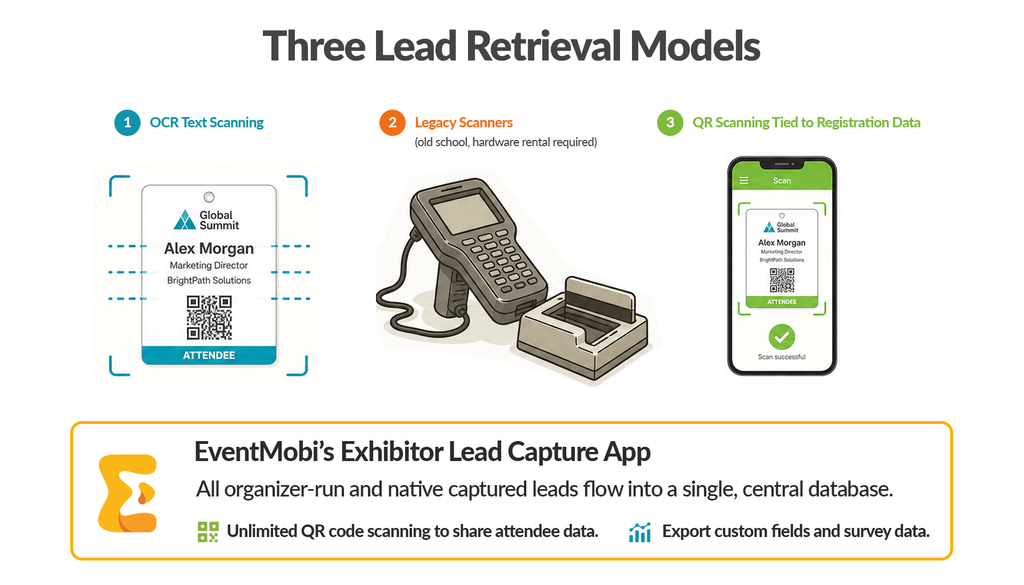
1. The Hardware Era (1990s – Early 2000s)
Decades ago, lead capture was entirely hardware-dependent. Exhibitors rented specialized, bulky equipment—such as laser barcode scanners and magnetic stripe readers—directly from designated show vendors. Because event organizers did not want to manage or store this heavy gear, third-party technology suppliers provided the hardware and split the rental revenue with the venue or organizer. This established lead capture as a standalone, highly profitable line item.
2. The Mobile App Era (2010s)
As smartphones saturated the market, mobile event apps revolutionized the space. Lead capture was folded directly into comprehensive event management platforms. Scans were instantly tethered to the central registration system, allowing exhibitors to log notes, rate leads, and synchronize data instantly with their Customer Relationship Management (CRM) tools.
3. The Unbundled, Multi-Tool Era (Present Day)
Today, three distinct technological forces are colliding to fracture this centralized model:
- Ubiquitous smartphone cameras capable of instant optical character recognition.
- The rise of AI-powered badge-scanning apps that operate independently of any event database.
- Aggressive multi-event subscription models, where exhibitors pay a flat monthly fee to a third-party vendor and reuse the same scanning app across dozens of unrelated trade shows throughout the year.
For a busy corporate sales team chasing efficiency and consistency across multiple events, these agile, cross-platform tools represent an appealing shortcut.
Supporting Data: Where Bring-Your-Own Scanners Fail
On paper, third-party and bring-your-own (BYO) scanning apps look robust. They boast bulleted feature lists: badge scanning, contact information extraction, offline mode, and basic note-taking fields. However, organizers and exhibitors alike quickly discover hidden structural flaws when examining the two fields that sales teams depend on most: accurate names and current, deliverable email addresses.
[Official Lead Retrieval App]  --> Resolves against Central Registration Data -> 100% Verified, Compliant, Deliverable
[Third-Party OCR Scanners]     --> Relies on Image Scraping & AI Guesswork    -> Mispelled Names, Bounced Emails, GDPR Violations
1. The Data Accuracy Problem
OCR and AI badge scanners rely heavily on visual approximations. If an attendee’s badge has a crowded layout, a small font, or an unusual corporate title, the scanning software frequently misreads characters. Exhibitors end up with misspelled names, truncated company names, and obsolete email addresses harvested from public web directories rather than the fresh corporate data provided during event registration.
2. The Consent and Compliance Gap (GDPR and Beyond)
Perhaps the most dangerous pitfall of unauthorized third-party scrapers is the regulatory exposure it creates. When an independent app scrapes or purchases data to enrich a scanned badge, it often operates outside the explicit consent framework established by the event organizer.
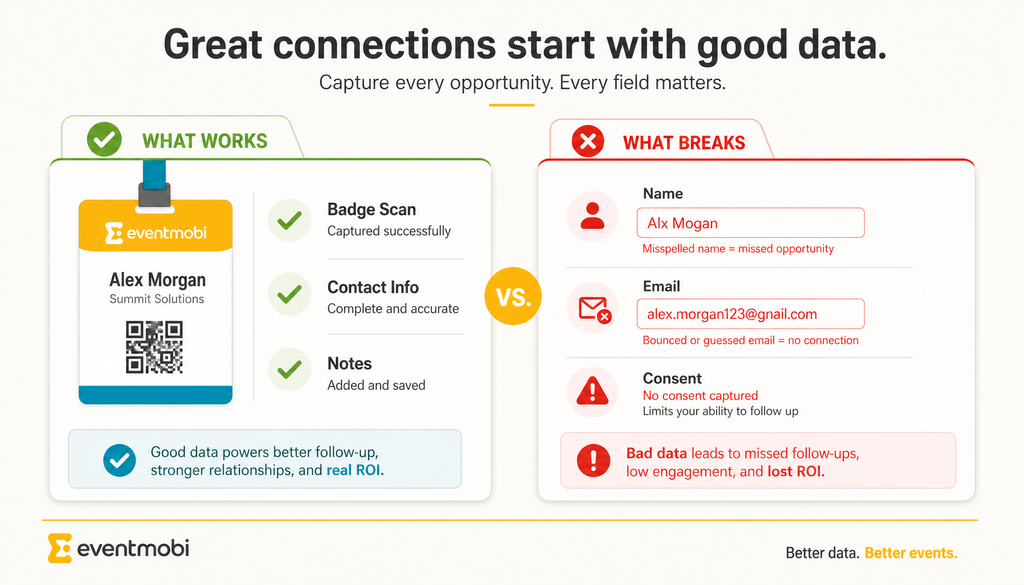
If an attendee is bombarded with unsolicited marketing emails at a personal address following a show, the angry compliance complaint lands squarely on the event organizer’s desk—not the app vendor’s.
This is far from a theoretical risk. In December 2024, France’s data protection regulator, the CNIL, issued a resounding warning to the industry by fining data enrichment vendor Kaspr €240,000 for scraping and processing professional contact details without a valid legal basis under the European Union’s General Data Protection Regulation (GDPR).
Official lead retrieval apps eliminate this vulnerability because every scan is cryptographically resolved against verified registration records, maintaining an unbroken, legally compliant audit trail.
Official Responses and Industry Perspectives
Faced with declining add-on revenues and rampant workarounds, industry leaders argue that event organizers must fundamentally alter their approach. Stubbornly clinging to old sales models is no longer viable.
During the EventMobi masterclass, Adam Parry, Founder of Event Tech Live, offered a blunt and compelling perspective on the psychology of modern exhibitors:
"Charging a mandatory lead capture fee feels like walking into a restaurant, ordering a steak, but getting asked to pay for the plate for it to sit on in order for you to eat it."
— Adam Parry, Founder, Event Tech Live
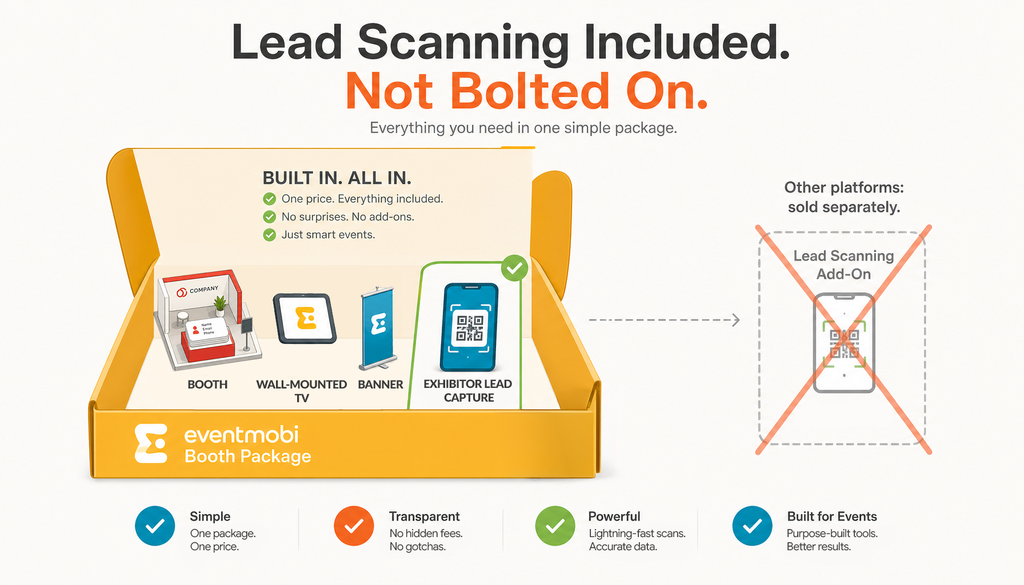
Parry argues that lead capture should no longer be treated as a luxury add-on, but rather as foundational infrastructure—bundled directly into the baseline booth package.
The mathematics supporting this shift are remarkably straightforward. Modern platforms like EventMobi price exhibitor lead capture apps cost-effectively (such as US$50 per pack of ten company licenses). This price point is low enough for organizers to absorb into standard booth packages, or fold into overall floor-space pricing, while completely neutralizing the exhibitor’s incentive to seek out risky third-party workarounds.
When lead capture is included universally, the adversarial upsell conversation disappears, booth staff adoption skyrockets, and organizers retain total visibility over floor activity.

Implications: Monetizing "Event Signals"
While bundling basic badge scanning solves the revenue leak, smart event organizers are realizing there is an even greater opportunity: monetizing data that no outside app can possibly replicate.
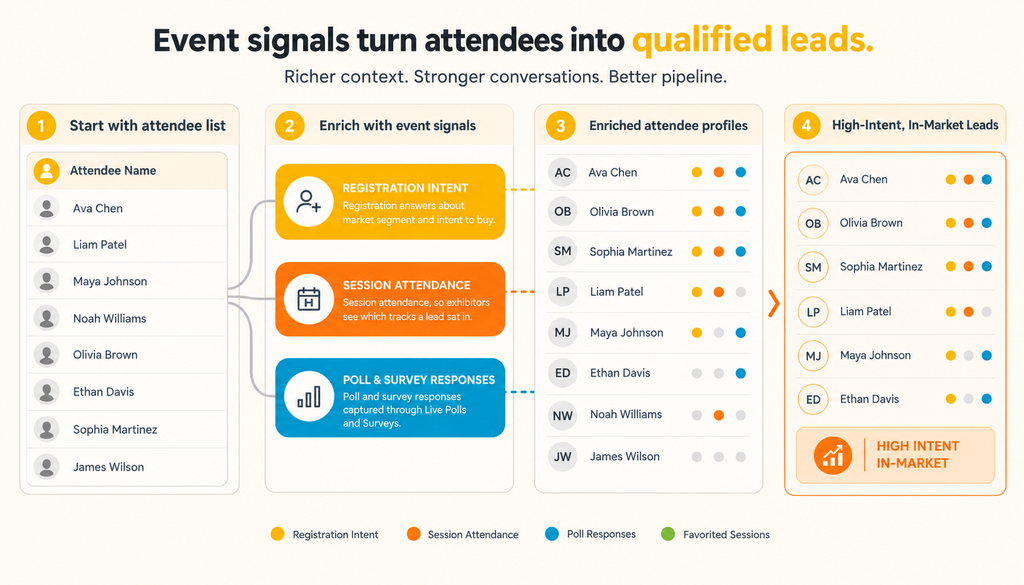
A smartphone camera can take a picture of a badge and guess a corporate title, but it cannot observe human behavior inside the event ecosystem. These behavioral data points are known in the industry as event signals, and they live exclusively within the official event technology platform:
- Session Attendance: Which educational workshops, keynotes, or panel discussions did the attendee join?
- Digital Engagement: Did the attendee participate in live polls, submit questions to speakers, or download specific whitepapers?
- Exhibitor Interaction: Did they bookmark the sponsor’s virtual booth or interact with gamification challenges?
The Power of Behavioral Enrichment
To a commercial sponsor, raw contact data has a low ceiling of value. A scraped list hands a sales team 200 generic names. In contrast, rich event signals allow an organizer to provide a high-value narrative:
"Here are 200 verified names from our floor, and of those, 30 specifically attended the cybersecurity keynote, completed our interactive floor game, and indicated in their registration profile that they are actively sourcing new vendors this quarter."
Organizers can expose these behavioral insights as advanced filtering columns within an exhibitor’s post-show data export, or package them as a high-margin digital sponsorship tier. For instance, organizers can segment attendees based on demonstrated intent and orchestrate hyper-targeted post-event email campaigns on behalf of key sponsors. This transforms basic badge scanning into a premium marketing channel.
Actionable Takeaways: The Pre-Show Checklist
To regain control of the expo floor, secure sponsor retention, and protect attendee data privacy, event organizers should implement the following pre-show checklist:
- Audit Your Current Offerings: Review your exhibitor manual and determine how many booths currently purchase legacy lead capture versus those using unauthorized third-party apps.
- Re-evaluate Pricing Models: Consider unbundling lead capture as a separate fee. Roll basic, unlimited scanning licenses directly into standard exhibitor fees to eliminate friction.
- Upgrade Badge Technology: Ensure your badges feature high-contrast, optimized QR codes that are instantly readable by official applications, rendering slow OCR workarounds obsolete.
- Educate Exhibitors Early: Send pre-show communication to exhibitors highlighting the compliance risks (such as GDPR penalties) and data inaccuracies associated with external scraping tools.
- Promote Behavioral Data: Showcase the unique value of your event’s proprietary event signals (session tracking, engagement metrics) to upsell premium sponsorship packages.
The Bottom Line
The migration away from traditional lead retrieval apps is not just a technological challenge—it is an urgent business wake-up call for trade show organizers.
Protecting your event’s revenue model relies on three fundamental pillars:
- Stop selling the scan as a standalone line item, as cheap external alternatives have commoditized basic optical reading.
- Bundle lead capture into every booth package, distributing the modest cost across your entire exhibitor base to eliminate the motivation to seek workarounds.
- Monetize the insights only you own, leveraging rich behavioral event signals to convert raw contact names into qualified, high-intent sales leads.
By shifting the narrative from a transactional software fee to a comprehensive data-driven partnership, event organizers can turn badge scans from a fading revenue leak into a powerful engine for renewable, long-term trade show growth.