The Shifting Digital Frontier: Navigating the Global Wave of Youth Social Media Bans and Brand Compliance

The modern digital landscape has grown increasingly harrowing. Internet users worldwide are routinely subjected to the psychological toll of "doom-scrolling," absorbing the relentless intensity of global political, humanitarian, and climate crises with a mere flick of a thumb. Compounding this is the pressure of an artificial economy of perfection—comparing one’s authentic, everyday life against the glossy highlight reels of influencers and acquaintances alike. For years, the psychological cost of hyper-connectivity has simmered on the back burner of public discourse. Today, however, it has boiled over into legislative action.
As lawmakers worldwide grapple with the darker sides of social media—ranging from algorithmic radicalization to youth mental health crises—a profound policy shift is underway. Governments from Canberra to London are asking a fundamental question: Do technology platforms and state bodies have a legal responsibility to enact social media bans to protect children?
Consumers overwhelmingly believe they do. According to Sprout Social’s Q1 2026 Pulse Survey, a striking 68% of consumers support youth social media bans, with parents of young children forming the most vocal and unified bloc rallying behind the movement.
For social media marketers, who already navigate a volatile matrix of internal pressures and external platform changes, these sweeping legislative shifts introduce unprecedented brand safety risks and operational hurdles. With multiple nations implementing, passing, or seriously considering sweeping age restrictions, and landmark judicial resolutions—such as Meta’s youth safety settlement—reshaping the architecture of Instagram and Facebook, the digital marketing playbook requires a complete rewrite.
Main Facts: The Global Regulatory Paradigm Shift
The global momentum behind restricting youth access to social media represents a decisive move away from the unregulated "Wild West" era of the internet. Rather than relying solely on voluntary terms of service, governments are codifying strict age boundaries, mandatory age-assurance mechanisms, and stringent platform liabilities into national law.
At the core of this movement are four primary realities:
- Widespread Public Backing: Nearly seven in ten consumers support regulatory intervention, reflecting a deep societal concern over digital wellbeing.
- Platform-Level Liability: In almost every proposed and enacted model, the legal duty to regulate, verify ages, and enforce restrictions falls squarely on the social media networks and app stores, rather than parents or children.
- The Rise of Judicial Precedents: Landmark legal settlements—such as Meta’s recent youth safety agreement—are accelerating compliance timelines faster than traditional legislative bills can pass through slow-moving parliaments.
- Strategic Pivot for Brands: Global marketing teams can no longer rely on blanket, algorithmic "confetti posting." Instead, they must pivot toward age-aligned content, robust digital governance, and hybrid real-world (IRL) marketing strategies.
Chronology of Action: How We Reached the Global Ban Era
The transition from open digital access to strict legislative gating did not happen overnight. It is the culmination of years of escalating concerns over youth mental health, data privacy breaches, and algorithmic exploitation.
- Early 2020s: Grassroots advocacy groups, pediatric associations, and academic researchers begin publishing compelling data linking heavy, unmitigated social media use among minors to rising rates of anxiety, depression, sleep deprivation, and body dysmorphia.
- Mid-2024 to 2025: Several pioneering nations begin drafting legislation. State legislatures across the United States introduce dozens of age-verification and parental-consent bills, sparking fierce legal battles over free speech and digital access.
- April 2026: Turkey passes a landmark law banning children under 15 from maintaining personal social media accounts, while establishing strict parental control mandates for users aged 15 to 17.
- June 2026: The United Arab Emirates (UAE) officially sets a minimum social media use age of 15, disabling specific interactive features for users aged 15 and 16.
- August 2026: France’s top constitutional court strikes down a national youth social media ban on the grounds that it curtails freedom of expression, though legal experts anticipate a swift revision. Simultaneously, Meta agrees to a landmark youth safety settlement, fast-tracking a series of mandatory safeguards across Instagram and Facebook and setting a precedent for competitor networks.
- Late 2026 and Beyond: Countries like the United Kingdom, Greece, Denmark, and New Zealand advance varying degrees of restrictions, ranging from complete algorithmic bans for under-16s to late-night curfews and gaming platform regulations. Meanwhile, the European Commission calls for a bloc-wide approach to protect all minors aged 16 and under.
Supporting Data: Regional Breakdown of Restrictions
The legislative landscape varies significantly by region, but the underlying trajectory is uniform: tighter controls, higher stakes for noncompliance, and a shrinking window for brands to adapt their audience targeting strategies.
Europe, Middle East, and Africa (EMEA)
| Country | Minimum Age & Effect on Addressable Audience | Duty to Regulate Falls On | Current Status |
|---|---|---|---|
| UAE | Under-15s cannot hold personal accounts; ages 15–16 face disabled features. | Networks | In Action |
| Turkey | Under-15s barred from personal accounts; ages 15–17 require strict parental controls. | Networks | Passed / Pending Implementation |
| United Kingdom | Under-16s lose access to algorithmic networks; ages 16–17 face overnight app curfews. | Networks | Proposed / Under Review |
| Greece | Under-15s prohibited from registering personal accounts. | Networks | Proposed / Under Review |
| Denmark | Under-15s restricted from personal accounts (terms under negotiation). | Networks | Under Negotiation |
| France | Under-15s barred from personal accounts. | Networks | Struck down by court; revision expected |
Note: The European Commission is currently evaluating a unified, bloc-wide framework for all EU member states targeting users aged 16 and under.
Asia-Pacific (APAC)
| Country | Minimum Age & Effect on Addressable Audience | Duty to Regulate Falls On | Current Status |
|---|---|---|---|
| Australia | Youth under 16 barred from holding personal social media accounts. | Networks | In Action |
| Indonesia | Under-13s restricted to child-specific products; ages 13–16 require parental consent; high-risk platforms restricted to 16+. | Networks | In Action |
| Malaysia | Minors under 16 prohibited from registering new social media accounts. | Networks | In Action |
| New Zealand | Minors under 16 barred from accessing networks classified as "high risk." | Networks | Proposed / Under Review |
United States Regulatory Models
While nearly half of U.S. states have introduced varying bills—many of which face ongoing First Amendment legal challenges—regulators generally rely on four primary structural models:
- Age Restrictions + Parental Consent: Imposes a strict floor age for social media access while allowing parental approval mechanisms for older brackets.
- Feed and Design Restrictions: Eliminates infinite scroll and algorithmic curation for minors, enforcing nighttime lockouts and reduced notifications while keeping users on the platform.
- Usage and Time Limits: Imposes strict daily hourly caps on minor accounts per platform.
- App-Store Verification: Shifts the compliance burden entirely onto tech giants like Apple and Google, requiring age verification and parental consent at the point of application download.
Official Responses and Platform Adaptations
Social media networks are no longer sitting passively as targets of regulation; they are actively redesigning their technical architecture to preempt total bans and comply with sweeping judicial settlements.
According to Sprout Social’s Q1 data, consumers display a marked preference for networks implementing nuanced parental consent tools and robust age-verification technology over blunt, total bans. Aligning with these consumer preferences, major platforms have rolled out sophisticated protective suites:
- Meta, Snapchat, WhatsApp, and YouTube have significantly tightened parental controls, introducing family-friendly interfaces, automated time limits, and strict barriers against sensitive content.
- Platforms are now granting parents unprecedented visibility into minor accounts—allowing them to monitor privacy settings, supervise direct messaging activity, and limit interactions with embedded AI chatbots.
The Ripple Effect of the Meta Youth Safety Settlement
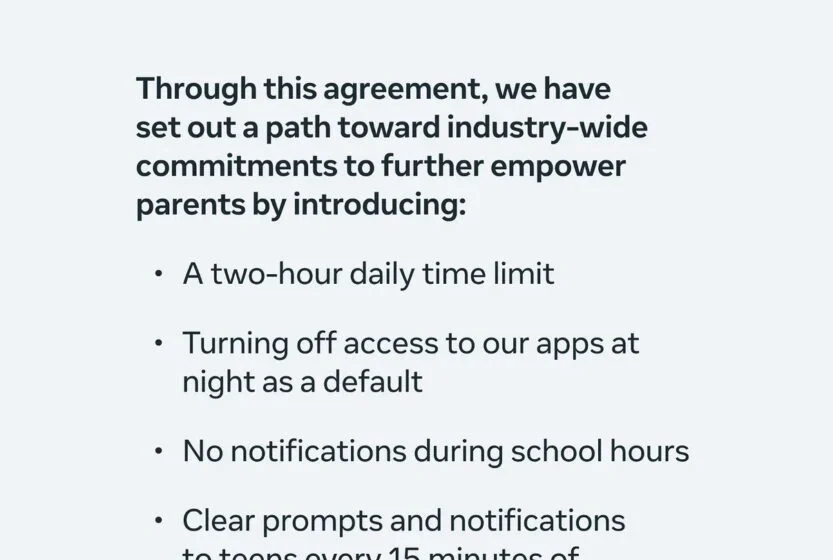
While voluntary self-regulation has been slow, Meta’s landmark youth safety settlement has dramatically accelerated industry-wide changes. Under the terms of the settlement, Meta has committed to stringent platform restrictions designed to shield minors. Crucially, a portion of Meta’s financial penalty is contingent on competitor networks—including TikTok, YouTube, and Snapchat—adopting parallel safety standards.
This settlement establishes a powerful precedent: legal constraints on youth marketing and audience reach are arriving faster through binding judicial settlements than through legislative enactments.

Implications for Global Brands and Social Media Marketers
Even for brands that do not directly target minors, the cascading effects of global social media bans and the Meta settlement demand a strategic operational overhaul. The era of passive, broad-spectrum digital marketing is officially over.
1. Moving Toward Age-Aligned, Defensible Content
Marketers can no longer rely blindly on algorithms to sort audiences or "throw confetti" across the digital ether in hopes of organic virality.
"The days of blanket posting and trusting the algorithm are over," explains Sam Morgan-Smith, Head of Social at UK-based PR agency The Romans. "Brands will need to get far more strategic. Content needs to be age-aware and legally defensible."
Tiffany Sayers, co-founder of Australian agency Loft Social, echoes this sentiment: "If underage users are legislatively restricted or platforms are penalized for blurred lines, we’ll need more rigour in how brands brief talent, capture first-party data, and define success."
2. Refined Brand Safety and Governance Protocols
Compliance can no longer be treated as an afterthought bolted onto a campaign at the eleventh hour. It must be embedded directly into daily creative workflows.
"We need to move beyond relying solely on platform policies and start embedding internal frameworks," Sayers advises. This includes tightening influencer briefs to ensure age-appropriate messaging, rigorous vetting processes, comprehensive content archiving, and legally reviewed guidelines for interactive elements such as giveaways, comments, and Calls-to-Action (CTAs).
Morgan-Smith stresses that education is foundational: "Compliance needs to be built into the workflow. That includes governance playbooks, data protocols for consent, and tools that adhere to emerging publishing rules. Above all, training is fundamental. Not just for social teams, but all digital-facing departments need regular updates on global legislation—like COPPA in the U.S., the UK Online Safety Act, and Australia’s age-verification laws—to avoid accidental noncompliance."
3. The Renaissance of Real-World (IRL) Immersion
As organic social reach contracts and digital gatekeeping increases, forward-thinking brands are rediscovering the power of physical, real-world experiences to complement their digital footprint.
"We’re seeing a strong shift back to IRL-led storytelling: micro-events, brand installations, peer-to-peer word of mouth, and influencer content that lives beyond a grid," notes Sayers.
Morgan-Smith views this not as a retreat from digital spaces, but as a sophisticated recalibration: "This isn’t about abandoning digital—it’s about recalibrating to environments where attention, access, and trust intersect. Online, brands should explore gaming integrations, instant messaging, and youth-safe content platforms. In real life, we’re seeing a creative resurgence—including university activations, experience-led marketing, and retail theater."
Conclusion: An Evolution, Not an Erosion
The global wave of social media bans and tighter platform regulations should not be viewed as the death knell of digital marketing, but rather as a sign of industry maturation. Much like television and traditional broadcast media decades ago, social media is transitioning from an unregulated Wild West into a mature, highly accountable media environment.
"This is an evolution, not an erosion," Morgan-Smith concludes. "Compliance challenges signal legitimacy, not demise. Rather than abandoning social, this is the moment to reimagine it. Invest in multi-channel ecosystems, build first-party relationships with younger consumers with proper consent, and champion network accountability."
For marketing leaders, navigating this complex new terrain requires shifting the internal organizational dialogue away from superficial vanity metrics. As Tiffany Sayers aptly summarizes: "Social still delivers ROI at every stage of the funnel. It just requires smarter systems and more intentional content now. It’s about shifting the conversation with your leaders from ‘how many likes’ to ‘how many hearts and minds.’”
Disclaimer: The information provided in this article does not, and is not intended to, constitute formal legal advice; all information, content, points, and materials are for general informational purposes only. Readers should consult their own legal counsel or compliance team regarding specific regulatory requirements in their operating jurisdictions.
Related posts: