Comments Off on The Vibe-Coding Disruption: How DIY AI Apps Are Rewriting the Rules of Event Lead Capture
By Global Events Industry Desk Published: September 2026
Main Facts: The Rise of DIY Lead Capture
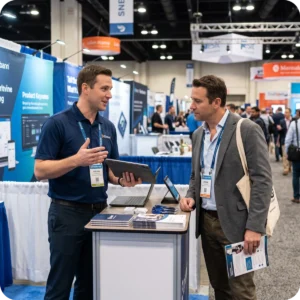
The modern exhibition floor is undergoing a quiet, high-stakes technological transformation. Traditionally, lead capture has been a standardized ecosystem dominated by official, app-driven badge scanners provided by event organizers. For exhibitors, securing these tools has meant paying steep additional fees on top of already expensive booth space.
Now, a new paradigm is emerging. Fueled by the rise of "vibe coding"—a software development approach where users build functional applications using natural language prompts via platforms like Replit, Lovable, and data tools like Clay—cash-strapped exhibitors are increasingly bypassing official event tech. Instead, they are deploying custom, AI-engineered web apps to scan badges, log interactions, and harvest data directly.
According to Adam Parry, co-founder of Event Tech Live, this grassroots shift carries profound consequences. While it offers a low-cost workaround for smaller exhibitors, it creates a massive "data black hole" for event organizers, disrupts conference analytics, introduces severe cybersecurity vulnerabilities, and forces a necessary re-examination of how the industry monetizes exhibition spaces.
Chronology: From Business Cards to the AI Era
Understanding the current tension requires looking at how exhibition data collection has evolved over the decades:
The Analog Era (Pre-2010s): Exhibitors relied on the physical exchange of paper business cards, supplemented by manual note-taking and manual post-show data entry into Customer Relationship Management (CRM) systems.
The Standardized Digital Era (2010s–Early 2020s): Event organizers centralized data collection. Barcode and QR-code scanners integrated into event-specific mobile apps became table stakes. Organizers monetized this infrastructure by selling lead-capture licenses as premium add-ons to booth packages.
The AI and API Expansion (2024–2025): The widespread availability of advanced Application Programming Interfaces (APIs), paired with rapidly improving large language models from OpenAI, Anthropic, and others, lowered the barrier to software creation.
The Vibe-Coding Disruption (2025–Present): Exhibitors discovered they could bypass expensive software licenses by building their own lightweight lead-capture solutions using AI-assisted development tools. What once required a dedicated software development team can now be prompted into existence in minutes, triggering regulatory, financial, and structural shockwaves across the global events industry.
Supporting Data: Risks, Regulations, and Revenues
The widespread adoption of decentralized, AI-generated apps on the convention floor highlights several critical data points regarding security, privacy, and economic impact:
The Security Vulnerability Gap: Recent reports from cybersecurity researchers and outlets like Wired have demonstrated that thousands of "vibe-coded" applications deployed across the open web inadvertently expose sensitive corporate and personal data due to a lack of standard security hardening.
Regulatory Precedents: While data privacy regulations such as the General Data Protection Regulation (GDPR) loom large over European and international events, actual regulatory enforcement within the events sector remains relatively rare. A notable historical benchmark includes the 2023 GDPR fine issued to the Mobile World Congress (GSMA) over its deployment of biometrics, signaling that regulatory bodies can and will scrutinize event data collection practices.
The Cost-to-Value Disconnect: For many small-to-medium enterprises (SMEs), official lead-capture fees represent an unwelcome administrative hurdle. Parry points out that treating lead capture merely as an ancillary revenue line on a budget sheet overlooks the catastrophic impact that fragmented data has on the broader event ecosystem.
Official Responses and Industry Perspectives
Industry leaders are divided on whether vibe-coded tools represent a destructive threat or a long-overdue catalyst for industry reform.
Adam Parry characterizes the low barrier to entry of vibe coding as a "gateway drug" for exhibitors looking to circumvent costly event infrastructure. However, he warns that the systemic damage to the data pipeline outweighs the immediate cost savings for individual companies.
"The challenge and problem that’s creating for the show organizer is they’ve got a massive black hole in their data: their engagement data, their lead quality data, and who spoke to whom," Parry explains.
From Parry’s perspective, the onus is on event organizers to fundamentally alter their pricing and operational models. He argues that lead-capture capabilities should no longer be treated as a profitable upsell, but rather as a foundational utility bundled directly into standard exhibition fees.
"I think lead capture should be given to exhibitors and sponsors ubiquitously, not necessarily sold as an additional add-on to them participating at the event," he states, adding that viewing lead capture solely as a short-term revenue line "is missing the big picture of it all."
Regarding data compliance and the law, Parry acknowledges a persistent psychological double standard among corporate entities:
"It’s kind of like we all know that you shouldn’t speed on the highway or in town, but every now and again, you go over the speed limit."
Large organizations invest in thoroughly tested, compliant commercial platforms to protect their brand reputation, while smaller, resource-constrained players often take calculated risks with unvetted DIY software in order to secure a competitive edge.
Implications: Where Does the Events Industry Go From Here?
The rise of vibe-coded lead capture is not necessarily a death knell for established event technology providers; rather, it serves as an urgent wake-up call. The implications of this trend stretch across three key areas:
1. The Death of the "Data Black Hole"
If show organizers continue to lose visibility over who is meeting whom on the exhibit floor, they lose the ability to accurately prove Return on Investment (ROI) to prospective sponsors. Without unified engagement data, the entire value proposition of a physical trade show or conference weakens. Organizers must close this data gap by offering centralized portals that seamlessly integrate lead collection, exports, and analytics without pricing out smaller participants.
2. A Shift Toward Built-In Utility
To combat the temptation of shadow-IT solutions and DIY apps, exhibition organizers will likely need to absorb lead-capture costs into overall booth pricing. By making badge scanning and basic CRM synchronization universal and free at the point of use, organizers remove the primary financial incentive that drives exhibitors toward risky home-brewed applications.
3. The Evolution of Commercial Event Tech
Far from being rendered obsolete, established event tech platforms are leveraging the very same AI advancements that power vibe-coding tools to upgrade their own software suites. Features such as automated audio transcription of booth conversations, AI-assisted lead qualification, and frictionless post-event surveys are finding their way into enterprise roadmaps.
As Parry notes, the competitive pressure exerted by agile, AI-literate exhibitors may ultimately push established tech providers to take bold creative risks:
"I think AI is massively helping support, you know, established companies like EventMobi and others to enhance their existing offering with AI tools and solutions… developing something that wouldn’t even make it on the road map in the past."
Ultimately, if the chaotic democratization of event software forces organizers and tech providers to raise their standards, streamline their pricing, and deliver unmatched value, the vibe-coding disruption may prove to be the best thing to happen to the events industry in decades.