The Anthropologist in the Kitchen: How Caitlin Mateo is Redefining Farm-to-Table at Founding Farmers

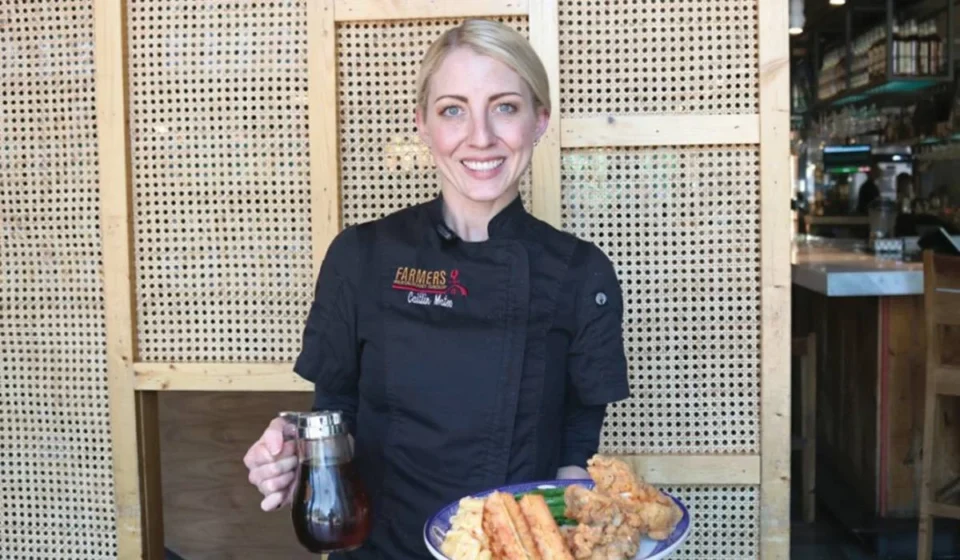
In the high-pressure world of multi-unit restaurant management, executive chefs often focus on the bottom line, yield percentages, and labor costs. For Caitlin Mateo, the Director of Kitchen Operations and Development at Founding Farmers, these metrics are merely the scaffolding for a much deeper inquiry. Mateo, who began her professional life as an anthropologist, views the kitchen not just as a place of production, but as a laboratory for human connection, regional history, and cultural preservation.
By bridging the gap between social science and culinary arts, Mateo has helped transform Founding Farmers into one of the most successful, mission-driven restaurant groups in the United States. Her career trajectory—from a college student fascinated by the roots of human behavior to an executive overseeing thousands of daily prep items—serves as a blueprint for a new generation of leaders who prioritize sustainable supply chains and the human element in hospitality.
The Intersection of Culture and Cuisine: The Foundational Philosophy
For Mateo, the fascination with food began as an intellectual pursuit. During her teenage years, she was captivated by the "why" behind human behavior. She wanted to understand how geography dictated belief systems, social structures, and, most importantly, dietary habits.
"When you study food, you look at what grows regionally, how it gets cooked, and how it gets utilized," Mateo explains. "But this also tells you about the history of people, how they act, what their background is, and what motivates them. I think [anthropology and culinary] studies come together beautifully, if you are willing to learn and dine with people."
This academic background provides her with a unique lens through which to view ingredients. Take, for instance, the pecan. As the only major nut tree native to North America, the pecan is not merely an ingredient; it is a historical artifact. For Native American tribes, it was a vital, high-density energy source during harsh winters. Today, it remains a symbol of regional identity, manifesting in holiday pies and pralines. For Mateo, these connections are the essence of her work: treating every menu item as a vessel for generations of cultural resilience.
A Chronology of Growth: From Student to Executive
Mateo’s path to the kitchen was not linear, but it was driven by a natural aptitude for the craft. While catering for friends and weddings in her youth, she discovered a tactile joy in cooking. Her true culinary awakening, however, occurred in college when she crossed paths with a mentor who owned a high-end French restaurant.
"I took a part-time job working in the kitchen, and she showed me everything from running a dish room to fabricating beef tenderloins and trimming lamb racks," Mateo recalls. That mentorship served as a catalyst, prompting her to pivot from purely theoretical studies to the rigorous environment of the Walnut Hill School of the Arts in Philadelphia.
Following her formal training, Mateo spent several years operating her own culinary consulting firm. This period of independence proved essential, allowing her to understand the logistical hurdles of the restaurant industry from the ground up. In 2008, when Founding Farmers opened its doors just blocks from the White House, the brand’s mission—to connect urban diners with the agricultural heartland—aligned perfectly with Mateo’s own philosophy. She joined the team, methodically rising through the ranks to her current role as Director of Kitchen Operations and Development.
The Founding Farmers Model: Unbundling the Supply Chain
Founding Farmers is a unique entity in the restaurant space. Majority-owned by the North Dakota Farmers Union and thousands of Midwest farmers, the brand operates as a vertical integration of the farm-to-table concept. With locations spanning Washington, D.C., Maryland, Pennsylvania, and Virginia, the challenge of maintaining quality at scale is immense.
Mateo oversees a staggering daily prep list of over 200 items. Under her leadership, the brand has made a radical departure from the standard industrial food service model. "Our goal is to unbundle the supply chain," Mateo says. "Mass-production companies who are turning out products like sixty-second parsley are very cool, but it takes the art of true farming and agriculture away. It takes away jobs and sustainable, delicious products."
The operation is highly logistical. The brand runs its own trucks to suppliers in North Dakota and maintains deep relationships with independent, locally owned distributors. This allows for a hyper-localized menu that shifts with the seasons. Nothing is bought in a container and shipped in to be served; everything from the bread to the chocolate is made from scratch.
Operational Agility: The Science of the Kitchen
Running "The Farm," as Mateo calls it, requires a split-brain approach. She spends roughly half of her time managing complex data sets—shelf-life tracking, inventory forecasting, and cost-of-goods analysis—and the other half on the floor, conducting research and development.
This duality was put to the test recently during the opening of a new location in Alexandria, Virginia. Despite meticulous planning and theoretical modeling of the product mix, the reality of consumer behavior proved different. "We underestimated the amount of grilled food that would be ordered on the weekends," Mateo admits. "Within three days of opening, we took all the burners out and replaced them with a new grill."
This kind of rapid, evidence-based decision-making is a hallmark of her leadership. Mateo argues that success in the restaurant industry is not about sticking to a plan, but about the "intense listening" to the needs of the space and the people within it.
Leadership and Mentorship: The Human Element
Central to Mateo’s management style is the rejection of the "siloed" leadership model. In a kitchen environment that relies on labor-intensive tasks—like hand-rolling pasta or brining chicken for 24 hours—the quality of the work is directly tied to the morale and training of the staff.
"Everything we do with them as leaders and culinarians has to be side by side," she asserts. "We never leave people with a pamphlet or recipe and let them figure it out on their own. Exceptional leadership is done together, talking about it, using all of your senses, developing and investing time in others."
This philosophy extends to her personal life as well. Mateo credits her experiences as a mother—including the time she famously went into labor while running a kitchen—as the defining crucible of her career. "I always felt like I had something to prove, but when I had more to work for than just myself, I had to learn how to evolve in motherhood and in my career," she says. "I’ve got to guide little human beings in life… nothing scares me anymore. I can do anything."
Implications for the Future of Hospitality
Caitlin Mateo’s career trajectory offers profound insights for the restaurant industry. As the sector faces increasing pressure to become more sustainable and transparent, her "anthropological" approach—viewing the supply chain as a community of human relationships rather than a spreadsheet of commodities—is gaining traction.
By prioritizing the "why" alongside the "how," Mateo has created a resilient business model that respects both the land and the laborers. Whether she is overseeing the production of chocolate at the commissary or adjusting kitchen equipment to meet real-time demand, Mateo remains, at her core, a student of people.
In an era where the divide between corporate efficiency and artisanal quality often seems insurmountable, Mateo’s work at Founding Farmers proves that with enough investment in people and a willingness to adapt, the two can coexist. Her story is a testament to the idea that the best leaders are those who never stop observing, never stop learning, and never stop trying to understand the human story behind every plate of food.
Related posts: