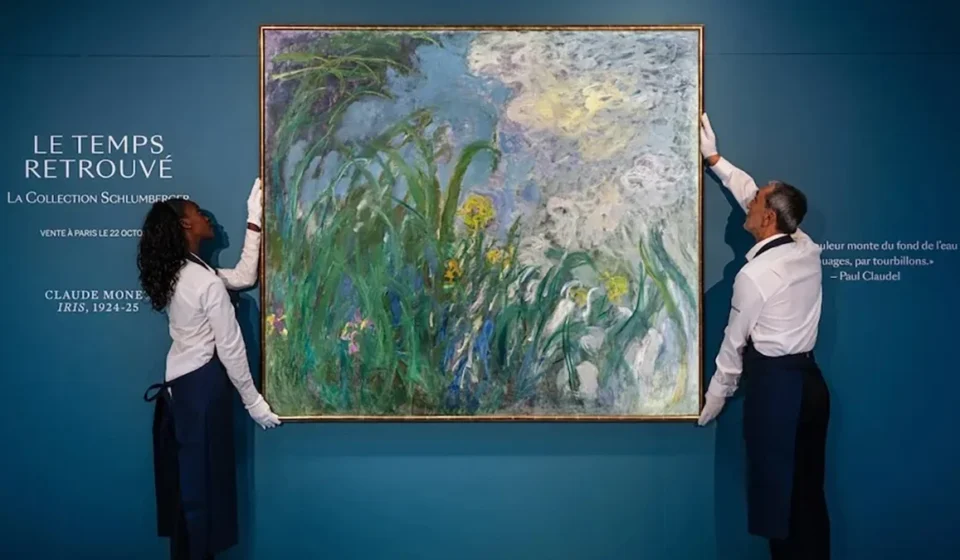
Claude Monet’s Iris Smashes French Auction Records with a €50 Million Sale at Sotheby’s Paris

PARIS — In a historic night for the French art market, a masterpiece by Impressionist pioneer Claude Monet shattered previous auction benchmarks on Thursday. Monet’s vibrant floral canvas, Iris, achieved a staggering €50 million ($56.2 million) at Sotheby’s Paris, instantly eclipsing all previous records for any artwork sold at a public auction on French soil.
The breathtaking result crowned an exceptional evening dedicated to the esteemed collection of the late Jeanne Schlumberger. The white-glove sale—where every single lot found a buyer—netted a combined total of €74.4 million ($83.7 million), establishing an all-time high for a fine art auction at Sotheby’s French headquarters.
Driven by fierce international competition, institutional prestige, and a remarkable cache of fresh-to-market Impressionist and Modern masterworks, the event signaled robust health and surging appetite within the upper echelons of the global art market.
Main Facts
The headline-grabbing moment of the evening centered on Monet’s Iris, a radiant exploration of color and light that far surpassed its pre-sale expectations. Initially estimated by auction specialists to fetch between €22 million and €30 million, the painting sparked an intense, 45-minute proxy and telephone bidding war. Six dedicated collectors vied for the prize before it was ultimately hammered down to an anonymous private buyer in Asia, represented on the telephone by Jen Hua, Sotheby’s deputy chairman.
The sale of Iris represents a watershed moment for the French auction ecosystem, proving that Paris can successfully rival traditional contemporary and modern art market capitals like New York and London for multi-million-dollar masterworks.
Monet dominated the evening’s financial ledger, accounting for the lion’s share of the night’s blockbuster revenues. A second Monet masterwork, Saule pleureur ou L’Arbre de feu—a poignant, swirling depiction of a weeping willow in the artist’s legendary garden at Giverny—commanded €9.7 million ($10.9 million). Two additional canvases by the Impressionist master also outperformed expectations: La Seine à Vernon, Arbres (1894) brought in €4.3 million ($4.8 million), while La Maison à Travers les Roses realized €2.5 million ($2.9 million).
Beyond the Impressionist giant, the auction saw multiple records fall. Pierre Bonnard’s La Cueillette des Prunes, a vibrant composition that had remained out of the public eye and unexhibited since 1956, achieved €2.5 million ($2.9 million)—more than triple its high estimate of €800,000, setting a new French auction record for the artist. Gustave Moreau’s delicate work on paper, Rêve d’Orient, realized €1.4 million ($1.6 million) to set a new high-water mark for a drawing by the artist. Meanwhile, Camille Claudel’s expressive 1905 bronze cast, La Valse, more than doubled its low estimate to fetch €832,000 ($935,000).
Chronology of a Legendary Collection
The exceptional provenance of the works offered on Thursday night adds a layer of art-historical intrigue to the financial triumphs. The four Monet paintings shared a remarkable, interconnected lineage before entering the public spotlight.
Following the artist’s death, the paintings passed directly from Claude Monet to his son, Michel Monet. Eventually, the cache was acquired by visionary art dealer Katia Granoff, before ultimately finding a permanent home within the distinguished collection of Jeanne Schlumberger. For decades, these masterworks remained protected in private hands, shielded from the cyclical fluctuations of the public market.
Jeanne Schlumberger began assembling her formidable collection during the 1950s, a period when the art market still largely undervalued Monet’s radical, loose late-career works—now celebrated as precursors to abstract expressionism. Working closely with dealer Katia Granoff, Schlumberger demonstrated profound foresight. In 1958, Schlumberger notably helped finance Granoff’s acquisition of numerous canvases directly from Michel Monet’s studio. This crucial financial backing gave Granoff unprecedented access to a trove of paintings that would, decades later, be recognized as among the most sought-after and influential pieces in art history.
The evening’s catalog also featured a trio of early paintings by Paul Cézanne. However, these works were absent from the auction room. Sotheby’s announced prior to the sale that the Cézanne canvases had been officially withdrawn following delicate discussions between the Schlumberger family and municipal authorities in Aix-en-Provence, the artist’s beloved hometown.
Supporting Data and Market Metrics
The financial metrics of Thursday evening’s auction underscore a deeply competitive environment for blue-chip art:
- Total Evening Sales: €74.4 million ($83.7 million), marking a record for Sotheby’s Paris.
- Sell-Through Rate: 100% (a "white-glove" auction, with every lot successfully finding a buyer).
- Above-Estimate Performance: Nearly three-quarters (75%) of all lots sold above their initial high estimates.
- Top Lot Price: €50 million ($56.2 million) for Claude Monet’s Iris.
- Bidding Duration for Top Lot: 45 minutes of sustained competition among six international bidders.
- Record Breakers:
- Highest-priced artwork ever sold at auction in France (Iris).
- Record auction price in France for Pierre Bonnard (La Cueillette des Prunes at €2.5 million).
- Record auction price for a drawing by Gustave Moreau (Rêve d’Orient at €1.4 million).
Note: All reported sale prices across the catalog are inclusive of the buyer’s premium.
Official Responses and Institutional Intervention
The most significant diplomatic development of the evening involved the withdrawal of the Paul Cézanne paintings. Designated recently as French national treasures, the works were pulled from the auction block to facilitate a civic acquisition.
In a joint statement released on Thursday, Sotheby’s and representatives of the Schlumberger family confirmed that discussions with the municipality of Aix-en-Provence yielded a preservation agreement. The city, acting in direct partnership with France’s Ministry of Culture, intends to acquire the Cézanne paintings privately so they can be permanently housed in the Musée Granet in Aix-en-Provence.
This move ensures that the artist’s formative early works will remain accessible to the French public and scholars, avoiding the risk of dispersion into overseas private collections. Local cultural officials praised the Schlumberger family and Sotheby’s for their cooperation in prioritizing national cultural heritage over speculative auction returns.
Implications for the Global Art Market
The monumental success of the Schlumberger collection sale carries several far-reaching implications for the international and European art markets:
1. The Ascent of Paris as a Primary Art Hub
In the wake of post-Brexit adjustments in London and fluctuating economic indicators in New York, Paris has steadily reclaimed its status as a premier global capital for fine art. Breaking the €50 million barrier for a single lot on French soil demonstrates that Paris-based auction houses can successfully command the attention of top-tier ultra-high-net-worth collectors from Asia, the Middle East, and the Americas.
2. Enduring Appetite for Fresh-to-Market Masterworks
The fierce 45-minute battle for Iris and the surging prices for unexhibited works like Bonnard’s La Cueillette des Prunes confirm that collectors remain ravenous for museum-quality pieces with pristine, long-dormant provenances. When works emerge from decades of private ownership with rich historical documentation, standard market caution frequently gives way to aggressive bidding.
3. The Balance Between Private Wealth and Public Heritage
The resolution surrounding the Cézanne paintings highlights an ongoing, delicate dance between private estate liquidation and national heritage preservation. By stepping in to designate and subsequently acquire the works for the Musée Granet, the French Ministry of Culture underscored its commitment to safeguarding foundational artistic roots, setting a collaborative precedent for future high-profile estate sales in France.
As Sotheby’s Paris continues its high-stakes auction schedule with dedicated sales focusing on Modern art and Surrealism, Thursday’s triumph sets an exceptionally high bar, confirming that the appetite for canonical masterworks remains undiminished.
Related posts: