The Return of the Porthole: How Hublot’s New Classic Fusion Tributo Honors the 1980 Disruptor That Shocked the Watch World

To contemporary watch enthusiasts, the name Hublot is practically synonymous with unbridled maximalism. Mention the brand, and most collectors immediately conjure images of the Big Bang—the towering, multi-layered marvel that transformed the Swiss watchmaker into a cultural household name following its explosive debut in 2005 under the visionary, high-octane marketing of industry icon Jean-Claude Biver.
Yet, for a more seasoned generation of horophiles, "Hublot" represents something entirely different: a singular, radical avant-garde design launched in 1980 by Italian entrepreneur Carlo Crocco under his MDM (Manufacture du Montagne) brand. While just as disruptive as Biver’s later commercial juggernaut, Crocco’s original creation operated on an entirely different philosophy—one rooted in quiet, understated luxury, refined elegance, and an unprecedented juxtaposition of precious metals and utilitarian rubber.
Now, over four decades later, the modern-day house of Hublot is reaching back into its archives to capture the lightning-in-a-bottle verve of the 1980s. Enter the Classic Fusion Tributo, an all-new, deeply faithful homage to Crocco’s foundational masterpiece. Blending historical reverence with contemporary watchmaking engineering, the Tributo bridges the gap between Hublot’s controversial past and its ultra-modern present.
Main Facts: What is the Hublot Classic Fusion Tributo?
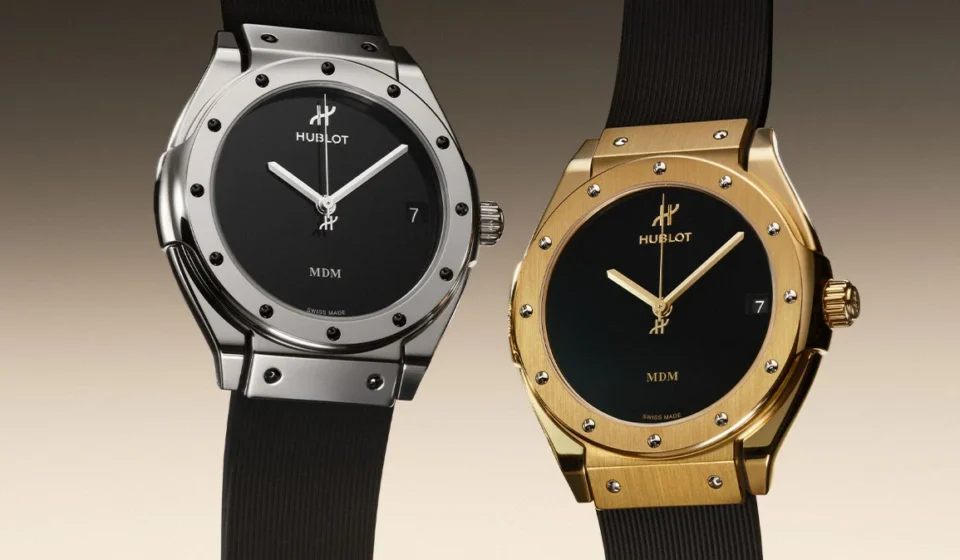
The newly announced Classic Fusion Tributo is a limited-production timepiece designed to meticulously recreate Carlo Crocco’s groundbreaking 1980 original, while subtly upgrading its mechanical and material specifications for today’s discerning collector.
Key Specifications at a Glance:
- Case Diameter: 38mm (a 2mm increase over the 1980 original to suit modern wrists).
- Construction: Seven-part case design featuring steeper edge slopes and advanced finishing techniques to visually streamline its slightly larger footprint.
- Movements & Materials: Powered by the in-house HUB 1711 automatic movement, moving away from the ultra-slim quartz mechanism of the vintage predecessor.
- Editions & Pricing: Available in a strictly limited initial run of 400 pieces globally, split evenly into two variants:
- 200 pieces in white gold paired with a deep onyx dial.
- 200 pieces in yellow gold paired with a matte black dial.
- Retail Price: $30,900 USD per model.
- Philanthropic Component: Hublot has pledged a donation of CHF 100,000 from the sales proceeds directly to Main dans le Main, the humanitarian foundation established by Crocco in 1998.
Chronology: From Baselworld Shockwaves to Royal Endorsements
To truly understand the weight of the Classic Fusion Tributo, one must look back at the arduous and improbable journey of the original Hublot watch—a timepiece born out of sheer intuition rather than market research.
1980: The Baselworld Debut
When Carlo Crocco introduced his unnamed porthole-shaped watch at the 1980 Basel Watch Fair, the luxury establishment reacted with a mixture of confusion and outrage. Traditional Swiss watchmaking was built upon gold cases matched to gold bracelets or refined leather straps. Crocco’s design shattered this sacred convention by pairing a luxurious gold case with a utilitarian rubber strap—a material previously restricted to dive watches or industrial equipment.
Adding to the visual shock was a minimalist, jet-black dial devoid of traditional numerals or batons, featuring instead 12 exposed screws on the bezel to mimic the locking mechanism of a ship’s porthole. "Nobody knew about us when we went to the Basel watch show in 1980," Crocco recalls, reflecting on the launch. "The price was high, the watch was unlike anything else, and we had done no market research, so it could have been a flop."

The Royal Catalyst
Despite its striking design, early commercial success was far from guaranteed. Slim, elegant, refined, and undeniably expensive, the watch needed a champion. That champion arrived unexpectedly in the form of yachting enthusiast King Constantine of Greece.
While flipping through Time magazine, King Constantine spotted an advertisement for the watch—a solitary Hublot photographed against the backdrop of a churning sea, with the faint silhouette of a sailboat cutting through the corner. Captivated, the King immediately purchased two: one for himself, and another for his brother-in-law, King Juan Carlos of Spain.
Opening the VIP Floodgates
That royal endorsement inadvertently unlocked the floodgates of high-society patronage. Overnight, the watch became a status symbol for the global elite. The roster of early adopters read like a who’s who of international fame and influence:
- Fashion & Royalty: Giorgio Armani, Queen Noor of Jordan
- Motorsports: F1 driver Jacques Lafitte
- Arts & Entertainment: Elton John, Andy Warhol, Eddie Murphy
The list expanded exponentially, driving sales through the roof during the brand’s first five years. However, this meteoric rise soon attracted unwanted attention. "So many copies and fakes began to be made that soon everyone had a watch like ours," Crocco notes, explaining how widespread market imitation eventually diluted the exclusivity that defined the brand’s infancy.
Supporting Data: Evolution of Design and Engineering
While the casual observer might struggle to tell the original 1980 model and the new Tributo apart from a distance of a few feet, a closer examination reveals a masterclass in modern horological adaptation.
Case and Movement Adjustments
The original 1980 model measured a modest 36mm and housed an ultra-thin quartz movement. To meet contemporary wearability standards without losing the watch’s delicate proportions, Hublot’s creative team engineered a 38mm, seven-part case for the Tributo.
Because housing an automatic movement (the in-house HUB 1711) naturally adds thickness compared to a quartz caliber, the designers utilized clever optical tricks. The slope of the case where it meets the strap—both top and bottom—has been made noticeably steeper. This geometry, combined with a sophisticated interplay of satin-brushed and polished finishes, successfully disguises the added millimeter footprint and height.

The Modernization of the Rubber Strap
Perhaps the most famous quirk of the original 1980 Hublot buying experience was the strap customization process. Customers were handed a luxurious presentation coffret containing five different strap sizes. Because early natural rubber lacked chemical stability, it was famously infused with a distinct vanilla scent to mask its unpleasant organic odor.
The Classic Fusion Tributo leaves the vanilla-scented past behind. It utilizes high-spec FKM (fluorocarbon rubber)—a cutting-edge synthetic elastomer that replicates the tactile feel and visual appearance of the original while offering vastly superior tensile strength, UV resistance, and chemical resilience. Furthermore, the archaic custom-cut sizing method has been replaced with a fully adjustable, highly practical deployant buckle crafted from titanium.
Dial Details and Heritage Branding
True to its lineage, the Tributo maintains the iconic MDM logo on its dial. However, in a touching nod to Crocco’s later life work, the acronym now honors Main dans le Main ("Hand in Hand"), the charitable foundation he established in 1998 to support disadvantaged children around the world.
Official Responses: Perspectives from Past and Present
The unveiling of the Classic Fusion Tributo in Milan brought together the heritage of the past and the execution of the present, eliciting poignant reflections from the brand’s founder and its current creative leadership.
Carlo Crocco, celebrating his 82nd birthday this month, attended the launch event and expressed genuine admiration for how the current management team treated his legacy. Rather than altering the design beyond recognition, Hublot chose to honor the original vision while correcting the technical constraints of the era.
"The price was high, the watch was unlike anything else… We wanted to appeal to the higher end of buyers, and we did," Crocco told attendees in Milan. "The Hublot was chosen by many important people and production went, roughly, 50 percent to men and 50 percent to women—and we never once gave a watch away."
Crocco reminisced about the purity of the early days before rampant counterfeiting muddied the waters. "In my time, I could still recognize a true Hublot from 10 meters away," he smiled, visibly moved by the tribute.

Meanwhile, Hublot’s creative director, Alessandro Camilli, emphasized that the Tributo is not intended to be a static museum piece, but a living, breathing part of the brand’s commercial collection. According to Camilli, while the initial run is strictly capped at 400 pieces across the white gold and yellow gold variants, subsequent production numbers will be dynamically governed by global collector demand.
Implications: Where the Tributo Fits in Modern Horology
The release of the Classic Fusion Tributo carries significant implications for Hublot’s brand narrative and the broader luxury watch market.
For years, mainstream watch discourse has pigeonholed Hublot as a brand defined strictly by the high-tech, oversized, and often polarizing aesthetics of the Big Bang and its derivatives. While those lines remain commercial powerhouses, the Tributo serves as a vital reminder that Hublot’s DNA is fundamentally rooted in a daring, dress-watch-adjacent disruption. It highlights that long before skeletonized tourbillons and sapphire crystal cases dominated the brand’s catalog, Hublot invented the modern luxury-sports watch category by daring to pair gold with rubber.
Furthermore, the choice to limit the initial run to 400 pieces priced at $30,900 signals a clear strategy: catering to high-end collectors, purists, and historians who appreciate the vintage crossover space. By anchoring the launch to a charitable contribution for Main dans le Main, Hublot also infuses the release with a sense of philanthropic gravity, uniting Crocco’s personal legacy with contemporary corporate social responsibility.
Ultimately, the Classic Fusion Tributo is more than just a nostalgic exercise. It is a bridge connecting two distinct eras of Swiss watchmaking—proving that the audacity, elegance, and sheer disruption that shocked Baselworld in 1980 remain just as relevant, and captivating, on the wrists of collectors today.