Beyond the Blueprint: How Bitreel’s AI Knowledge Agents are Revolutionizing Architecture Workflows

In the high-stakes world of architecture and interior design, the bridge between creative vision and technical execution is often cluttered with administrative friction. For even the most prestigious firms, the "creative flow"—that delicate state of deep work—is frequently interrupted by the mundane: scouring endless email chains for a specific textile finish, hunting down legacy spec sheets, or manually cross-referencing product availability across a dozen disparate vendor platforms.
This systemic inefficiency has long been the industry’s "dirty little secret," a silent tax on productivity that consumes hours of billable time every week. Enter Bitreel, a technology firm dedicated to digitizing the architecture and design (A&D) landscape. By launching its new AI Knowledge Agents—developed in strategic partnership with Amazon Web Services (AWS)—Bitreel is aiming to replace this fragmentation with a seamless, intelligent infrastructure that promises to return the focus of designers back to where it belongs: the craft.
Main Facts: The Anatomy of a Design Bottleneck
The professional landscape for architects and designers is currently defined by a "data silos" problem. As projects scale in complexity, the amount of documentation, regulatory compliance data, and product specifications grows exponentially. When a designer needs to find a specific mounting detail for a lighting fixture or a flame-retardant rating for a custom upholstery, they are often forced to navigate a labyrinth of PDF archives, proprietary vendor portals, and outdated internal folders.
Bitreel’s AI Knowledge Agents are designed to act as a centralized, intuitive interface for this disorganized data. By integrating directly into a firm’s existing digital ecosystem, these agents act as an "intelligent librarian." They can ingest, index, and retrieve precise technical information in seconds, effectively eliminating the need for manual file-searching.
Unlike general-purpose generative AI tools that often hallucinate or struggle with the granular precision required in construction, Bitreel’s agents are built for the enterprise. They are designed to operate with high-fidelity, verified data, ensuring that the information retrieved is not just fast, but accurate to the millimeter.

Chronology: Building the Digital Ecosystem
The evolution of Bitreel from a visualization startup to an essential infrastructure provider did not happen overnight. The company’s journey reflects a methodical approach to solving the A&D industry’s deepest pain points.
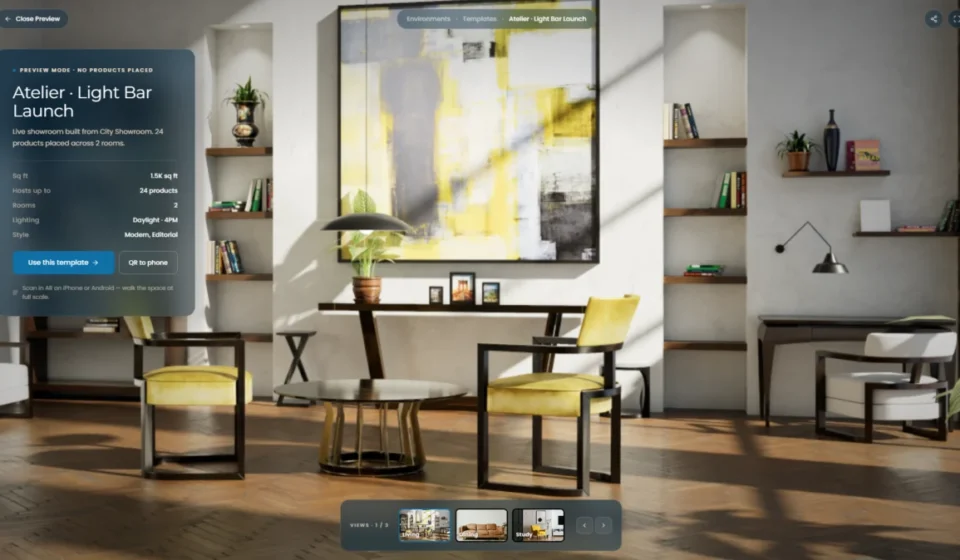
- Phase 1: The Visualization Foundation. Bitreel began by addressing the "display" problem. They introduced Virtual Environments, a tool designed to map photorealistic spaces, allowing designers to visualize concepts before a single material is ordered.
- Phase 2: Precision Configuration. Recognizing that beautiful visuals were useless if they couldn’t be built, the company developed the 3D Configurator. This tool moved beyond mere aesthetics, focusing on the technical logic of product offerings—ensuring that configurations were as mathematically exact as they were visually compelling.
- Phase 3: The Integration Layer. With the tools for visualization and configuration in place, the final piece was the "glue"—the ability for these tools to communicate with the massive, unstructured data sets residing in a firm’s legacy systems.
- Phase 4: The AI Knowledge Era. In late 2026, the culmination of these efforts arrived with the AI Knowledge Agents. By partnering with AWS, Bitreel moved from being a design tool to an enterprise-grade operating system for architectural firms.
Supporting Data: The Impact on Productivity
While industry-wide metrics on "time lost to file searching" vary, anecdotal reports from firms utilizing Bitreel suggest that designers spend upwards of 20% of their week—an entire workday—managing data retrieval.
The Bitreel ecosystem addresses this through a three-pronged approach:
- Semantic Retrieval: The agents use natural language processing, meaning a designer doesn’t need to know a specific file name. They can simply ask, "What is the lead time for the brushed nickel hardware on the HBF credenza?" and receive an instant, accurate answer.
- Visual Synthesis: The agents pair with Bitreel’s existing 3D tools. If a designer asks to see a room with specific criteria, the agent pulls the product specs, the configurator generates the 3D model, and the virtual environment renders the space.
- The "Guardrail" Effect: Crucially, the system is governed by Bitreel Connect. This acts as a logical firewall, preventing the AI from suggesting products or configurations that are structurally impossible, discontinued, or outside of the project’s specific constraints. This ensures that every generated option is "build-ready."
Official Responses: The Philosophy of Invisible Infrastructure
At the heart of the company’s mission is a philosophy that borders on the ascetic. Cosmo Kramer, CEO of Bitreel, argues that the best technology is the kind that recedes into the background.
"The best infrastructure is the kind nobody has to think about," Kramer states. "If someone’s paying attention to the system instead of the work, we haven’t done our job yet."

Kramer’s approach to implementation is notably non-disruptive. Rather than forcing firms to abandon their established workflows for a "Bitreel way of doing things," the company takes a boutique approach.
"We don’t show up with a fixed idea of how a team should work," says Kramer. "We spend time learning how they already work, then build around that. It’s slower up front. It’s the only way it holds up over time." This consultative, bespoke implementation model has already garnered traction with major industry players like HBF, 3form, Hellman-Chang, and even the U.S. General Services Administration (GSA), all of whom require systems that are not only fast but compliant with rigorous enterprise security and archival standards.
Implications: The Future of the Design Firm
The integration of AI Knowledge Agents into the A&D sector signals a broader shift in the "digital architecture" of the profession.
The Rise of the "Augmented" Designer
The role of the junior designer—often tasked with the drudgery of spec-gathering and file management—is likely to undergo a significant evolution. With these tasks automated, the junior designer is freed to engage in higher-level creative decision-making earlier in their career. The focus shifts from "information management" to "design synthesis."
The Death of the Disconnected Workflow
For decades, the industry has relied on disparate software packages that struggle to talk to one another. Bitreel’s model implies a future where the "source of truth" for a building project is unified. When the CRM, the procurement database, and the visualization engine are all linked via an AI layer, the margin for error in specification decreases significantly.

Enterprise-Grade Intelligence
By building on top of AWS, Bitreel is signaling that architecture is finally entering the era of "Big Data." For large-scale firms and government agencies, the ability to query their entire historical project archive—to ask, "How did we solve this specific structural problem in 2019?" and receive an immediate answer—is a massive competitive advantage.
A New Standard for Collaboration
Ultimately, the Bitreel model suggests that the future of architecture is collaborative not just between people, but between humans and their tools. By removing the friction of the administrative process, Bitreel isn’t just saving hours—it is protecting the "creative flow."
As the industry continues to grapple with increasing project complexity and tighter deadlines, the ability to harness institutional knowledge will become the primary differentiator between firms that merely survive and those that define the built environment of the future.
For those looking to explore how these agents can be integrated into their specific workflows, more information is available at bitreel.com. As we look toward the end of the decade, it is becoming clear that the most successful design firms will be those that view their software stack not as a necessary evil, but as a silent, intelligent partner in the creative journey.