Comments Off on Beyond the Dial: Audemars Piguet Unveils the Royal Oak Joaillerie Collection in Paris
PARIS — Amid the high-octane frenzy, flashing paparazzi bulbs, and sartorial curation of Paris Fashion Week, Swiss haute horlogerie icon Audemars Piguet has pulled off one of the season’s most unexpected and strategic surprises. The Le Brassus-based manufacturer has officially launched the Royal Oak Joaillerie collection—an 18-piece suite comprising necklaces, chokers, earrings, and cuffs.
For watch aficionados worldwide, the name "Royal Oak" is instantly evocative. It calls to mind the legendary, luxury sports watch designed by Gérald Genta in 1972, characterized by its iconic octagonal bezel, exposed hexagonal screws, and integrated bracelet. Yet, in a bold twist that has set the luxury sector abuzz, this debut high-jewelry collection does not feature a single watch.
Instead, Audemars Piguet is reinterpreting its most sacred design codes entirely through the lens of high jewelry, marking a calculated, high-stakes expansion into the fastest-growing segment of the global luxury market.
Main Facts: The Anatomy of the Royal Oak Joaillerie Collection
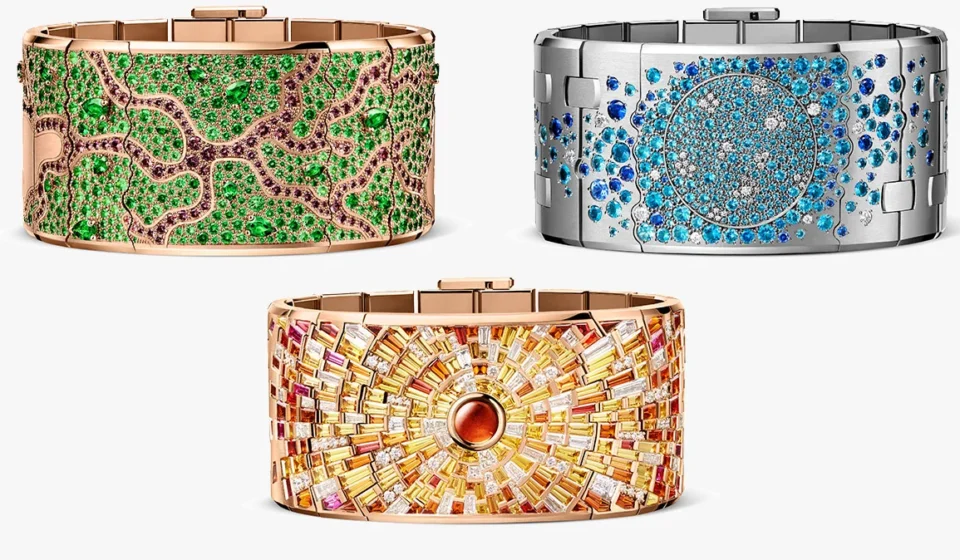
Spanning 18 meticulously crafted pieces, the Royal Oak Joaillerie collection utilizes precious and non-precious stones set in yellow, white, and blackened gold, alongside aerospace-grade titanium.
Rather than simply shrinking or pasting watch faces onto bands, AP’s designers focused on the intrinsic geometry of the Royal Oak bracelet. The collection translates the signature interlocking links—famous for playing with light through alternating polished and satin-brushed finishes—into dynamic, wearable sculptures.
The collection draws deep inspiration from the natural topography of the Vallée de Joux, the Swiss cradle of watchmaking where Audemars Piguet has operated since 1875:
The Dream of Joux Suite: Serving as the crown jewel of the launch, this tie-style necklace and matching earring set is crafted from white gold and anodized blue titanium, mirroring the icy, crystalline lakes of the Swiss Jura mountains. The necklace is lavishly trimmed with 42 pear-shaped diamonds totaling approximately 63 carats, alongside a staggering 1,670 blue sapphires exceeding five carats. The accompanying earrings feature pear-shaped diamonds ranging from 1.5 to 3 carats each, complemented by 196 blue sapphires.
The Risoud Eclipse Suite: Named after the local Risoud forest, this edgy, nocturnal design plays with blackened titanium and white gold. The necklace features five sugarloaf emeralds totaling roughly 16.5 carats, while its matching cuff boasts three emeralds of about 12 carats, both pieces heavily dusted with brilliant-cut diamonds.
The Nature-Inspired Cuffs: Six distinct bejeweled cuffs pay homage to regional flora. The Sunburst Royal Oak cuff explodes in a vibrant palette of orange and yellow sapphires and spessartites. Meanwhile, the Blueberries Royal Oak cuff offers a literal yet sophisticated interpretation of a blueberry bush branch, meticulously engineered with 506 leaf-shaped and brilliant-cut diamonds, 19 amethyst cabochons, and 16 black spinel cabochons.
Frosted Gold Chokers and Cuffs: Designed for everyday wear and effortless stacking, these pieces utilize AP’s signature "Frosted Gold" finish. Pioneered by the watchmaker in collaboration with Florentine jeweler Carolina Bucci in 2016, this technique uses a diamond-tipped tool to hammer gold, creating a subtle, shimmering diamond-dust effect that has become a collector favorite.
Chronology: A Historical Precedent for AP’s Jewelry Ambitions
While launching a pure high-jewelry collection in 2026 feels like a sudden departure for a brand known predominantly for complicated mechanical timepieces, Audemars Piguet’s relationship with jewelry is deeply rooted in its history.
The 19th and Early 20th Centuries: Since the 1800s, Audemars Piguet frequently collaborated with premier Parisian and international jewelry houses—including Tiffany & Co., Cartier, and Bulgari—to create stylized pendant and ring watches that blurred the line between horology and adornment.
The 1980s: Recognizing the potential of independent creation, the maison established its own dedicated in-house jewelry workshop, allowing master artisans to experiment with gem-setting techniques native to high jewelry.
The 2000s (The 125th Anniversary): To celebrate its milestone anniversary, the house unveiled jaw-dropping high-jewelry masterworks, most notably the Baroque cuff watch, dazzlingly set with diamonds and yellow and pink sapphires.
2015–2017: Collectors welcomed the punk-inspired Diamond Trilogy secret watch collection, proving that the brand was not afraid to push avant-garde aesthetic boundaries.
Today (Paris Fashion Week, 2026): The evolution culminates in the debut of Royal Oak Joaillerie, shifting the focus entirely from time-telling to pure, unadulterated gem-set artistry.
Supporting Data: Navigating a Muted Luxury Landscape
Audemars Piguet’s strategic pivot into pure jewelry is underpinned by hard market realities. The global luxury sector is currently navigating a period of macroeconomic cooling and geopolitical uncertainty.
The Slowdown in General Luxury: In May, financial services giant Morgan Stanley downgraded its growth forecasts for the broader luxury sector to a modest 2.5 percent for 2026. Ongoing conflicts in the Middle East and cooling consumer confidence in key markets have weighed heavily on apparel and traditional accessories.
The "Flight to Quality" in Jewelry: Amid these headwinds, high jewelry has emerged as a resilient, high-performing asset class. Consumers are increasingly bypassing seasonal fashion in favor of hard assets, driven by a "flight to quality" mindset and robust gold prices.
Divergent Growth Rates: The strength of the jewelry market is clearly evidenced by industry giants like Richemont. In its third-quarter earnings report for the period ending June 30, Richemont’s dedicated jewelry maisons posted an extraordinary 24 percent year-over-year growth, vastly outperforming its watchmaking division, which grew at a comparatively modest 8 percent.
For Audemars Piguet, capturing a share of this booming market is not just an artistic exercise—it is a commercially brilliant diversification strategy.
Official Responses: What Leadership Is Saying
For decades, Audemars Piguet has wrestled with the "monoculture" of the Royal Oak. While the watch remains an undisputed titan of modern horology, efforts to diversify—such as expanding the round-cased Code 11.59 collection with new dials and high-complication movements—have met with mixed enthusiasm from purists. The Royal Oak Joaillerie collection, however, was born from listening directly to consumer behavior.
Chief Executive Officer Ilaria Resta revealed that the inspiration for the line came from observing how clients were already styling existing AP timepieces.
"We saw clients stacking and wearing them almost as jewelry, which showed us that there was a very contemporary way of living with the Royal Oak beyond the watch itself," Resta explains.
Rather than relying on literal translations, Resta emphasizes that the design team treated the legendary bracelet as a blank canvas:
"We wanted to explore that design language in a new form. Rather than reproducing familiar Royal Oak codes, we looked at the bracelet almost as an object in its own right and asked how its geometry, rhythm, and movement could translate into jewelry. That opens up a different creative space for us."
Implications: A New Era for Le Brassus
The debut of the Royal Oak Joaillerie collection carries profound implications for Audemars Piguet and the wider luxury landscape:
Empowering the Female Collector: By utilizing rare colored gemstones—such as sugarloaf emeralds and vibrant blue sapphires—and creating pieces explicitly designed for self-purchase by women, AP is aggressively targeting the lucrative female luxury demographic. The massive popularity of smaller iterations like the 23 mm Royal Oak Mini laid the groundwork for this demographic shift.
Mitigating Horological Cyclicality: By establishing a footing in high jewelry, AP is insulating itself against the cyclical nature of the watch market. If mechanical watch demand cools, high jewelry provides a lucrative, highly stable revenue buffer.
Redefining Brand Boundaries: Audemars Piguet has always thrived on disruption, hype-led releases, and rule-breaking design. By proving that the DNA of a sports watch can successfully morph into haute joaillerie without losing its soul, AP has unlocked a vast, uncharted playground.
As industry insiders file out of the Paris showrooms, one prevailing sentiment remains: this is only the beginning. If the execution of the Royal Oak Joaillerie collection is any indication, Audemars Piguet is poised to conquer the world of high jewelry with the exact same ferocious momentum that conquered modern watchmaking.