
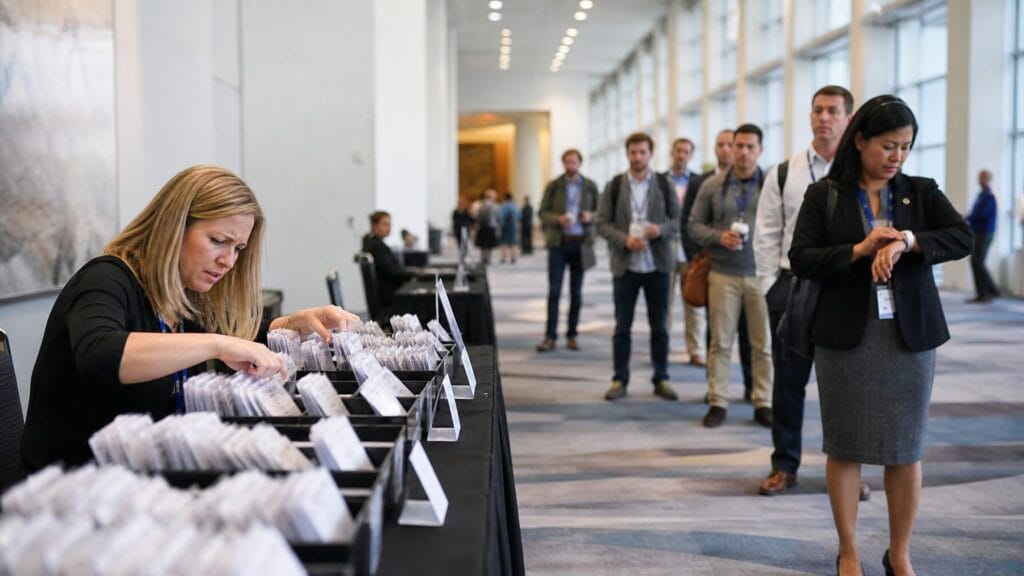
The registration desk was never formally designed; it simply evolved. It emerged from a necessity born of paper-based manifests and manual labor—a long table, a stack of alphabetized name tags, and a team of volunteers tasked with managing a bottleneck. For decades, this "arrival ritual" has stood as the gatekeeper of the live event industry. Yet, in an era of heightened attendee expectations and tightening operational budgets, this archaic model has become a glaring liability.
Today, the traditional registration desk is a prime source of friction, characterized by winding queues, misprinted badges, and volunteer burnout. It is the first point of contact for every attendee, and when it fails, it casts a shadow over the entire event experience. As industry leaders pivot toward more sophisticated, data-driven arrival workflows, the focus has shifted from mere "processing" to crafting a seamless, welcoming, and intelligent entry experience.
The Evolution of Arrival: A Chronology of Inefficiency
To understand why the registration desk is failing, one must look at the trajectory of event logistics. For most of the 20th century, registration was a static, physical act. Planners would spend weeks printing thousands of badges, organizing them into bins, and hoping for the best. If an attendee’s name was misspelled or they didn’t show up, that badge became a sunk cost—both in terms of material waste and administrative effort.
As events grew in scale and complexity, the manual nature of this process remained largely stagnant. While the rest of the event experience—from mobile apps to hybrid streaming—leaped into the digital age, the lobby remained a vestige of the past. The "Escape the Lobby" movement, spearheaded by industry experts and thought leaders, marks a turning point in this chronology. It signifies a realization that the bottleneck is not caused by the attendees themselves, but by a flawed, outdated infrastructure that treats human beings like files in a cabinet.
Why the Traditional Desk Fails: Quantifying the Cost
The failure of the traditional registration desk is rooted in its rigidity. It forces every attendee to follow a linear, location-bound path. When 1,000 attendees arrive within the same 60-minute window, a single line of six to ten volunteers is mathematically destined for disaster.
EventMobi CEO Bob Vaez highlights a sobering reality: the average attendee often waits eight minutes or longer just to check in. For a 1,000-person conference, that equates to 133 lost hours. If those hours were spent networking, visiting exhibitor booths, or participating in opening keynotes, the ROI for both the attendee and the organizer would skyrocket. Instead, those hours are spent staring at the back of a stranger’s head in a crowded lobby.
The Hidden Financial Drain
Many planners stick to pre-printed badges because they appear cheaper on a spreadsheet. However, a "sticker price" analysis ignores the "Total Cost of Ownership" (TCO). When you factor in the following, the traditional model often becomes the most expensive option:
- Reprinting Fees: Last-minute changes, typos, or lost badges require costly onsite emergency printing.
- Shipping & Logistics: Moving crates of pre-printed materials to a venue incurs significant freight and drayage costs.
- Operational Overhead: Managing the sorting, distribution, and storage of physical badges requires more staff hours and more specialized training.
- Waste: Any badge printed for a "no-show" is 100% wasted capital.
For a mid-size event of 1,000 people, the conservative costs of these "invisible" factors frequently exceed the savings of a low-cost print quote. On-demand printing shifts these costs to a predictable, per-label model, eliminating the risk of over-ordering.
The QR Code Imperative: More Than Just a Name Tag
Perhaps the most damaging aspect of the traditional, pre-printed badge is the absence of functional technology. A badge without a scannable QR code is effectively a glorified sticker. It provides no data to the organizer and no value to the sponsor.
Industry specialist Brandt Krueger has long advocated for the "digital-first" badge. When a badge features a live, system-synced QR code, it transforms from a static ID card into a powerful engagement tool.
- Attendance Tracking: Organizers can see exactly which sessions are popular in real-time.
- Lead Capture: Sponsors can scan attendees to instantly retrieve contact information, moving from business card collection to digital CRM integration.
- Post-Event Analytics: By mapping the attendee journey from the moment they check in to the final session they attend, organizers gain actionable insights to improve future event design.
On-Demand Printing: The Practical Middle Ground
The shift toward on-demand printing is not just a technological upgrade; it is an operational liberation. By generating badges at the moment of arrival, organizers eliminate the need for pre-event stress.
Modern solutions, such as EventMobi’s BadgeON™, demonstrate how this works in practice. The workflow is a simple four-step process:
- Scan: The attendee scans a QR code from their confirmation email (or searches their name on an iPad).
- Verify: The system confirms the registration details.
- Print: A personalized badge is printed in under 10 seconds.
- Assemble: The attendee attaches their badge to a lanyard or holder, and they are ready to enter.
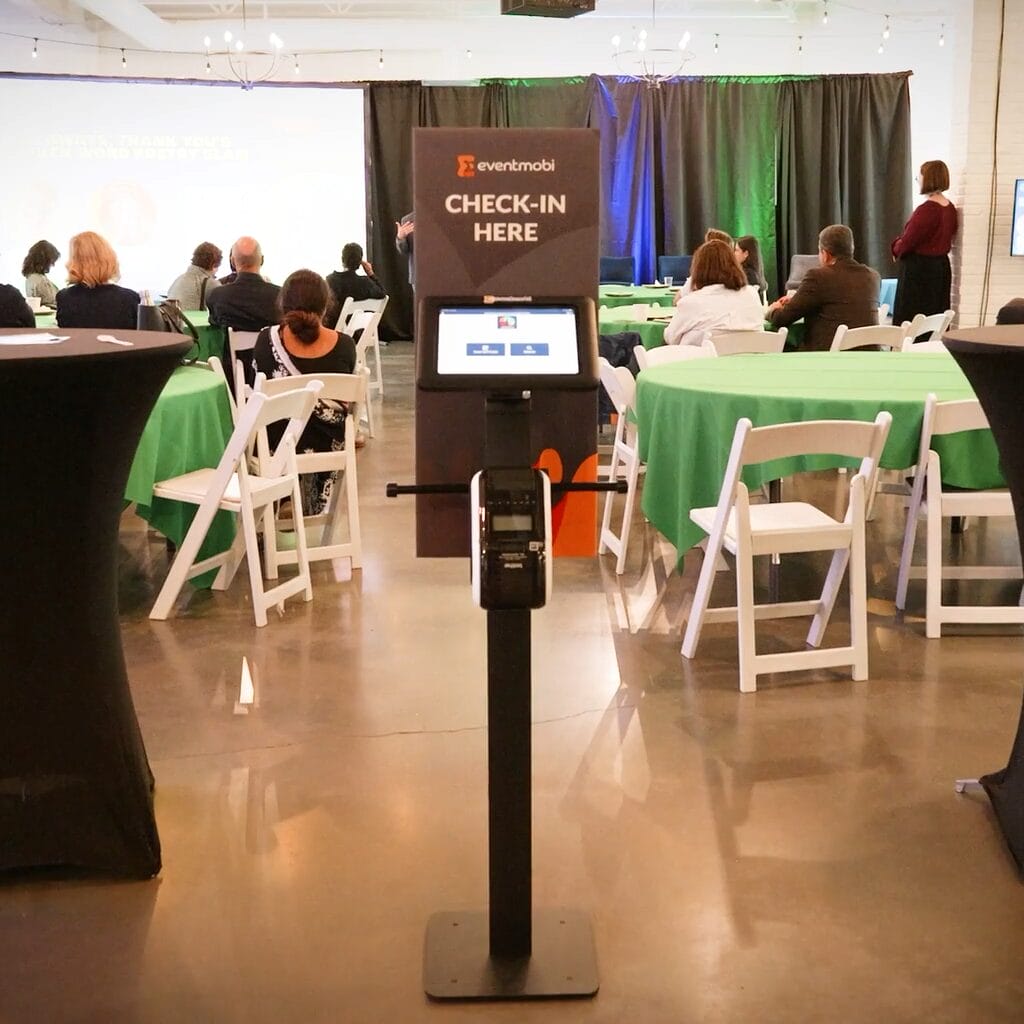
The hardware required—a compact label printer, an iPad, and a stand—is remarkably unobtrusive. For 90% of events, this equipment is self-managed by the organizer, eliminating the need for expensive, dedicated IT technicians on-site.
Wireless Flexibility: Moving Beyond the Desk
The final piece of the modern registration puzzle is the removal of the "desk" itself. With the advent of battery-powered, cellular-connected (5G) hardware, registration can now occur anywhere.
This is a game-changer for event flow. Instead of funneling all attendees through a single lobby, organizers can place wireless stations at:
- Airport arrival lounges for VIPs.
- Hotel foyers for multi-day conferences.
- Parking garage entrances to prevent congestion before attendees even reach the main building.
This distributed model prevents "lobby crush" and allows for a personalized, high-touch arrival experience. Organizations like MPI and Go West Live have already begun deploying these wireless solutions to spread the load, proving that when you remove physical constraints, you increase attendee satisfaction.
Implications: Designing for Success
The implications for event planners are clear: the registration desk is a strategic asset, not a logistical chore. By embracing on-demand printing and wireless, data-enabled check-in, planners can achieve three critical goals:
- Faster Arrival: Reducing the check-in process to under 30 seconds per person minimizes frustration and maximizes event time.
- Better Data: QR-enabled badges ensure that every interaction is tracked, providing the granular data that sponsors and stakeholders demand.
- Scalability: Whether managing 200 attendees or 2,000, the modular nature of on-demand hardware allows the check-in process to grow without requiring a proportional increase in complexity.
Expert Advice for the Future
For planners looking to transition, the experts recommend a clear timeline. Begin by evaluating your current "bottleneck" points—where do lines form, and why? Consult with providers about the Total Cost of Ownership rather than the unit price of a badge. Test your badge designs and network connectivity three to four weeks before the event.
As the industry continues to evolve, the "Escape the Lobby" philosophy will remain a cornerstone of professional event management. The registration experience is the first handshake of your event. If it is cold, slow, and uninspired, that is the impression that will follow your attendees through every session and networking event that follows. By choosing to innovate, you are not just fixing a queue; you are setting the stage for a world-class experience.
Are you ready to rethink your registration desk?
To learn more about how to integrate on-demand badge printing and wireless check-in into your next event, book a consultation with our team. Discover how to shift your focus from managing lines to managing experiences.
Related posts: