Beyond the Lobby: How Modernizing Registration is Transforming the Attendee Journey

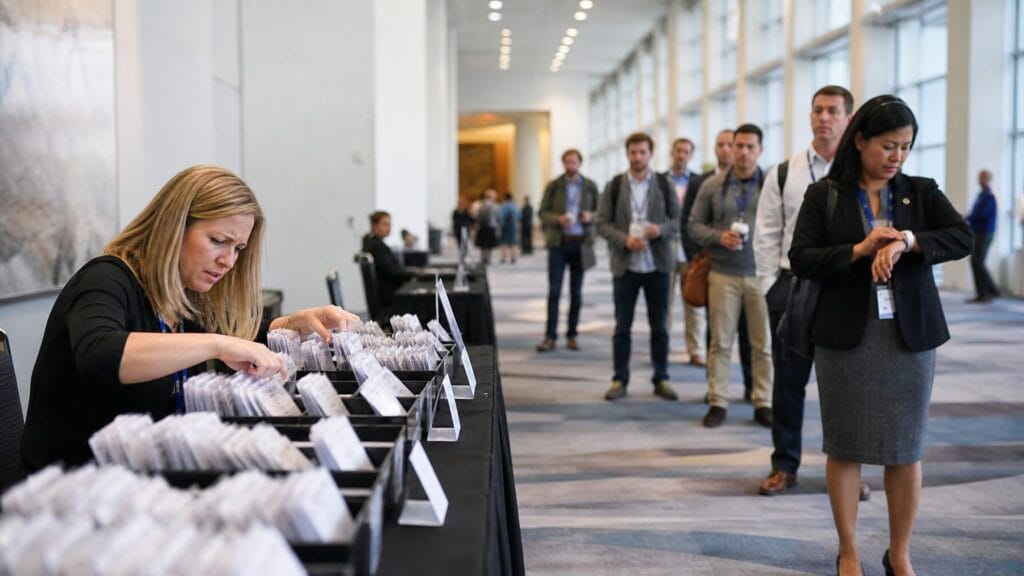
The registration desk was never truly "designed"—it was inherited. For decades, the arrival experience at professional events has been defined by the same predictable, often frustrating ritual: a long table, a snaking queue, and a sea of alphabetized bins filled with pre-printed badges.
However, in an era of heightened attendee expectations and tightening event budgets, this legacy model is no longer just an inconvenience; it is a significant operational failure. Modern event planners are finding that the "old way" of doing things—relying on manual, location-bound check-ins—creates a bottleneck that sets a negative tone for the entire event. By shifting toward on-demand badge printing and decentralized check-in workflows, organizers are turning the arrival process from a point of friction into a seamless, data-rich welcome experience.
The Architecture of Failure: Why the Traditional Desk Fails
The traditional registration desk is a relic of an era when events were simpler and data requirements were minimal. Today, it stands as a major obstacle to efficiency. When an attendee arrives at a conference, they are often tired from travel and eager to begin networking. Instead, they are met with a manual search-and-find process that forces staff to rifle through hundreds of badges, leading to long wait times and inevitable human error.
The Cost of Inefficiency
During the “Escape the Lobby” webinar, EventMobi CEO Bob Vaez highlighted a sobering statistic: attendees frequently wait eight minutes or longer in check-in lines. For a modest gathering of 1,000 people, those eight-minute increments compound into 133 hours of lost time. That is nearly six full days of professional life that could have been spent engaging with sponsors, attending keynote sessions, or building valuable business connections.
The bottleneck isn’t just about time; it’s about the psychological impact on the attendee. A disorganized arrival suggests an unorganized event. When a guest spends their first ten minutes standing in a crowded lobby, their perception of the event’s professionalism—and the value of their registration fee—is instantly diminished.
The Financial Mirage of Pre-Printed Badges
Many planners cling to pre-printed badges under the impression that they are the most budget-friendly option. This is a common fallacy. While a quote for pre-printed stock may look attractive on a spreadsheet, it obscures the "total cost of ownership" associated with the process.
The Hidden Costs of Legacy Printing
When you factor in the lifecycle of a pre-printed badge, the costs mount quickly:
- Logistics and Shipping: Sending boxes of heavy, pre-printed materials to a venue incurs significant freight costs and risks damage or loss during transit.
- The "Reprint" Tax: At every event, a percentage of attendees will have misprinted names, incorrect titles, or last-minute registration changes. Each reprint requires manual intervention, extra material, and wasted time.
- Staffing Overload: A manual desk requires more personnel to sort, find, and organize badges. These are hours that could be reallocated to guest services or content management.
- Waste: Any badge printed for a "no-show" is money thrown directly into the trash. In a post-COVID environment, where attendance rates can be volatile, this waste is increasingly difficult to justify.
The Data Gap: Why Badges Without QR Codes are Just Name Tags
In the modern event landscape, a badge is more than a name tag; it is a data-capture instrument. As Bob Vaez notes, "A badge without a working QR code is just a piece of paper."
When a badge lacks a functional, integrated QR code, the organizer loses the ability to track the attendee’s journey. Without that digital link to the event platform, organizers cannot:
- Track Session Attendance: You lose the ability to see which topics were most popular or which rooms were at capacity.
- Simplify Lead Retrieval: Sponsors lose the ability to capture information with a single scan, significantly reducing the ROI they receive from exhibiting at your event.
- Enhance Networking: Attendees cannot easily exchange contact information, which is often the primary reason they attend the event in the first place.
A truly modern badge acts as a bridge between the physical and digital worlds. By integrating QR codes that sync in real-time with your registration database, you transform the badge into a key that unlocks a more personalized experience for the attendee and deeper insights for the organizer.
The Evolution: On-Demand Printing as the New Standard
The shift to on-demand badge printing represents the most significant advancement in event operations in recent years. Instead of printing thousands of badges weeks in advance, organizers now print badges at the moment of check-in.
How the Workflow Works
Using systems like EventMobi’s BadgeON™, the process is streamlined into four simple, rapid steps:
- Registration: The attendee arrives and presents a QR code or their name.
- Scan: The staff member scans the code or performs a quick search on an iPad.
- Print: The badge is generated instantly on a high-speed thermal label printer.
- Assemble: The label is applied to a pre-branded badge stock, and the attendee is ready to enter.
This process takes approximately 30 seconds per attendee. It eliminates the risk of misprints, allows for last-minute registration changes without panic, and ensures that every attendee has a badge that is current, accurate, and functional.
Breaking the Boundaries: The Rise of Wireless Check-In
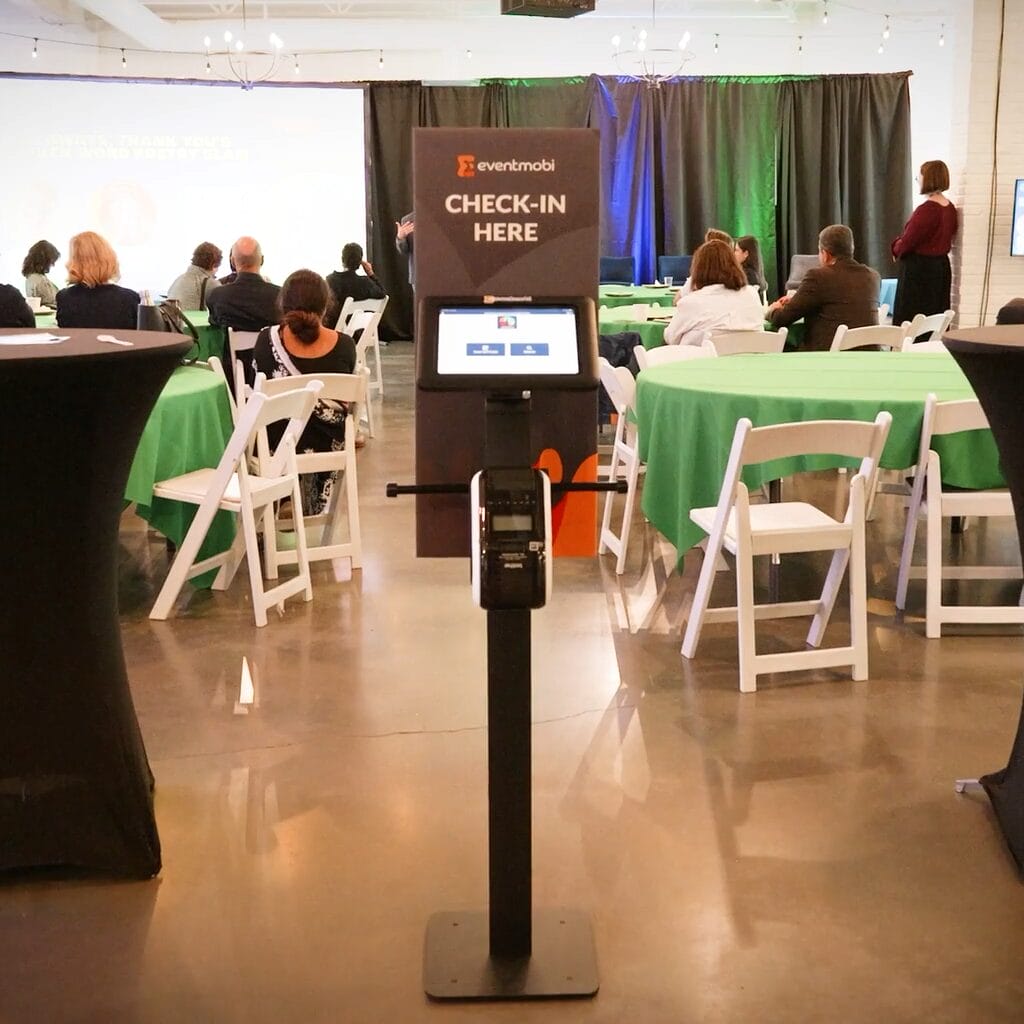
If the registration desk is the problem, then the solution is to remove the "desk" entirely. Wireless, battery-powered check-in stations allow organizers to place registration points anywhere—in hotel lobbies, outside session rooms, or even at airport arrivals.
Flexibility and Connectivity
Modern wireless stations, such as those utilized in the BadgeON™ ecosystem, operate independently of venue infrastructure. They utilize cellular (5G) connections and high-capacity battery packs, meaning they don’t require power outlets or complex hardwired networking.
This creates a "distributed arrival" model. Instead of forcing 1,000 people through a single bottleneck, you can scatter ten stations across your venue. This not only eliminates the crowd but also allows for a better flow of traffic, ensuring that the first impression is one of ease rather than congestion.
Implications for Future Event Planning
The implications of this shift are clear: the "traditional" registration desk is a legacy cost center that hinders growth. As the industry moves forward, the competitive advantage will go to those who treat arrival as a critical component of the overall experience.
Strategic Considerations for Organizers:
- Evaluate Total Cost of Ownership: Look beyond the unit price of badges. Calculate the cost of labor, shipping, and the lost data value of non-scannable badges.
- Focus on Scalability: Whether your event is for 200 or 2,000 people, the workflow should be consistent. On-demand printing scales effortlessly as your events grow.
- Prioritize Data Integrity: Ensure your registration system and your badge printer are fully integrated. The data captured at the point of entry should inform your marketing, sponsor reporting, and session management.
- Plan for Flexibility: Use wireless stations to experiment with different traffic patterns. Use the data from your check-ins to see where people are arriving and adjust your station placement for future events.
Conclusion: The Arrival is the First Impression
The registration experience is the "handshake" of your event. It sets the tone for the entire attendee journey. By moving away from manual, pre-printed workflows and embracing on-demand, wireless, and data-driven check-in technology, organizers can finally "escape the lobby."
When the friction of arrival is removed, attendees are freed to do what they came to do: learn, connect, and engage. In a world where time is the most valuable commodity, the greatest service an event organizer can provide is a seamless, professional, and rapid welcome. It is time to retire the alphabetical bins and the long tables—the future of event registration is fast, digital, and, above all, designed with the attendee in mind.
Related posts: