Beyond the Logo: Architecting the Celebrity Brand in High-Stakes Hospitality

Translating a larger-than-life personality into the built environment requires more than simply applying a logo and a signature color palette. In the modern era of hospitality, a restaurant bearing a celebrity chef’s name is no longer merely a place to eat; it is a physical, immersive extension of a persona that guests have come to know intimately through television, social media, and digital streaming. When a brand is this recognizable, the stakes for physical design are astronomical. Get the environment right, and the space amplifies the brand’s narrative, fostering a profound connection with the guest. Get it wrong, and the dissonance is immediate, unforgiving, and damaging to the brand’s equity.
Nowhere are these stakes higher than in the transient, high-pressure crucible of an international airport. The recent launch of Flavortown Kitchen + Bar at Phoenix Sky Harbor International Airport (PHX) serves as a masterclass in this architectural tightrope walk. By blending the high-octane energy of Guy Fieri’s brand with the ruthless operational demands of an airport terminal, the project provides a blueprint for how future celebrity-driven concepts can survive and thrive in the world’s most demanding hospitality landscapes.
The Chronology of a Concept: From Personality to Blueprint
The journey of Flavortown Kitchen + Bar began not with a floor plan, but with a deep-dive analysis into the "DNA" of the Fieri brand. The design team, led by Jeffrey Teuton of Ideation Design Group (IDG), understood early on that a brand is not a static graphic—it is a feeling.
Phase 1: Distillation of the Brand
The process commenced with a conceptual audit. What does Flavortown actually feel like? The consensus was three-fold: energetic, irreverent, and profoundly welcoming. Designers moved from these abstract emotional pillars to "mood boards," which acted as the foundational vocabulary for the space.
Phase 2: From 2D Mood to 3D Reality
While mood boards established the palette, the team transitioned quickly into three-dimensional rendering. This allowed for the spatial choreography of the restaurant, ensuring that the brand’s story was told through volume, light, and texture. The goal was to ensure the Phoenix location felt like a distinct "jewel" in a larger, global brand crown—individualistic enough to be memorable, but consistent enough to be recognized by any traveler passing through Terminal 4.
Phase 3: The Build and Operational Integration
The final phase involved the implementation of high-impact design elements that could survive the rigors of 24/7 airport traffic. Custom lighting, bold metalwork, and meticulously curated material transitions were installed to capture the chef’s vibrancy without sacrificing the sophisticated, contemporary polish required for a high-traffic travel hub.
Supporting Data: The Architecture of Durability
Airport restaurants operate at a velocity that makes traditional street-side dining look leisurely. With constant turnover, erratic dwell times, and the physical battering caused by rolling luggage, spills, and the around-the-clock service model, the choice of materials is not merely an aesthetic decision—it is a life-cycle cost investment.
Material Performance Metrics
In the case of Flavortown, the design team adopted a "performance-first" philosophy. Every upholstery and vinyl selection underwent rigorous vetting for durability. Specifications were set at the highest commercial levels, ensuring that fabrics could withstand high-frequency friction and chemical cleaning agents.
- Edge Protection: A major failure point in airport design is the degradation of corners and joints. The project utilized specialized transition detailing, ensuring that edges were shielded from the impact of heavy luggage and the wear-and-tear of heavy foot traffic.
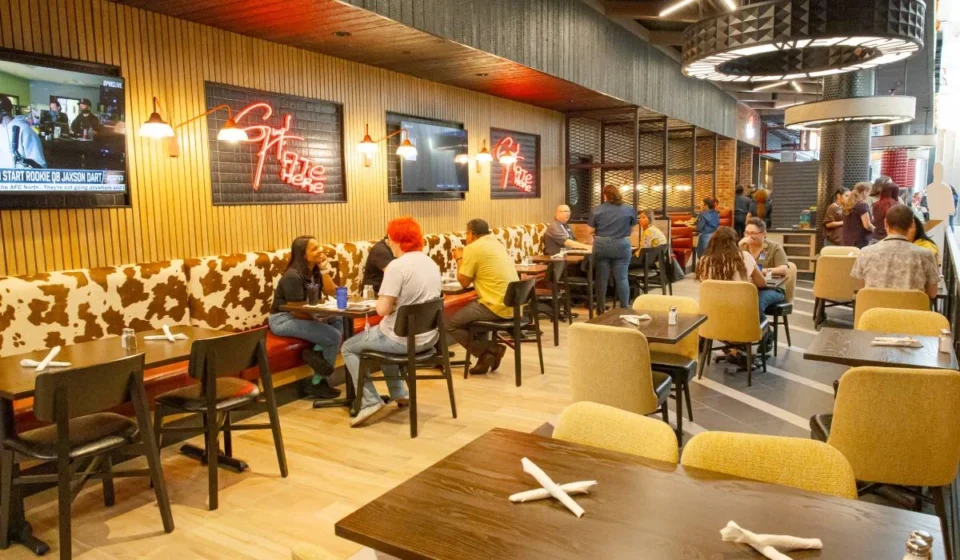
- The Ceiling Plane: Often the most underused surface in design, the ceiling at Flavortown was utilized as a primary brand canvas. A custom red metal structure with integrated lighting carries the brand’s visual energy across the room, keeping the aesthetic impact elevated and away from the reach of everyday physical contact.
The takeaway for operators is clear: Durability specified at the design phase is an investment in brand longevity; durability retrofitted after the fact is an admission of decline.
Choreographing the Traveler’s Experience: Circulation and Zoning
In a high-traffic airport terminal, space is a finite resource. A successful restaurant must act as a chameleon, serving three distinct guest archetypes simultaneously:
- The Settler: The traveler with time for a full, multi-course meal.
- The Socializer: The passenger grabbing a drink and an appetizer before a connection.
- The Commuter: The guest with only seven minutes before boarding who needs a grab-and-go solution.
The Flavortown layout was engineered to resolve these divergent needs through clear, intentional zoning. Banquettes and flexible table seating anchor the perimeter, providing comfort for the "Settler." The bar and counter areas are positioned to project social energy toward the concourse, serving as a magnetic "billboard" for passersby. Finally, the mid-point of the floor plan houses a grab-and-go section, strategically placed to capture the "Commuter" without disrupting the experience of those seated for a full meal.
By orchestrating visual depth, the design ensures that every zone is legible from the concourse. A traveler can identify the experience they need in a matter of seconds, reducing the friction of decision-making in a high-stress environment.
Official Perspectives: The Philosophy of "Be Bold or Go Home"
Jeffrey Teuton, Director of Interior Design at Ideation Design Group, views his work as a form of storytelling. His motto, "Be Bold or Go Home," is not merely a slogan—it is an architectural mandate.
"The space must function as well as it looks," says Teuton. Reflecting on the Flavortown project, Teuton emphasizes that the most successful designs are those that recognize where to concentrate their impact. "Brand expression should be concentrated in high-value areas—lighting, ceiling planes, and feature walls—rather than spread thin across every square inch of the space."
For IDG, the success of a project is measured by the "unexpected detail." Whether it is a giant, whimsical art installation or a refined material transition, the goal is to create a moment of joy for the traveler. This is the heart of the celebrity brand: providing an escape from the sterility of the airport terminal.
The Implications for Future Hospitality
The success of Flavortown Kitchen + Bar at PHX marks a significant shift in how celebrity brands enter the non-traditional market. As licensing deals and celebrity-chef partnerships expand into stadiums, casinos, and transit hubs, the "template-and-paste" approach is rapidly becoming obsolete.
Key Implications for the Industry:
- Operational Design: Design firms must now act as both interior designers and operational consultants. Understanding how a kitchen flow integrates with front-of-house circulation is no longer optional; it is the foundation of the brand experience.
- High-Touch, High-Performance: The future of hospitality design relies on the intersection of luxury aesthetics and industrial-grade durability. If a space cannot handle a spill or a stray suitcase, it cannot handle the public.
- The "Jewel in the Crown" Strategy: Brands must evolve to fit specific locations while maintaining a unified identity. Future concepts will succeed by being locally relevant while staying true to the overarching brand narrative.
As the industry moves forward, the concepts that will thrive are those that recognize the dual mandate of the modern restaurant: to be an immersive, high-energy environment that simultaneously functions with the precision of an engine. By prioritizing the "built" in "built environment," operators can ensure that a celebrity brand is not just a passing trend, but a lasting landmark in the landscape of global travel.