
Main Facts
For decades, a stubborn misconception has lingered in the world of spirits: the belief that all Scotch whisky is defined by a heavy, medicinal peat smoke. In reality, the exact opposite is true. The vast majority of Scotch produced across Scotland’s storied whisky-making regions is entirely unpeated, lacking any trace of bonfire smoke. However, a select group of distilleries has leaned heavily into the peat fire, creating single malts that taste less like a traditional spirit and more like a roaring campfire.
The ultimate tightrope walk for a distiller producing these heavy-peat expressions is ensuring that the whisky remains enjoyable rather than overwhelming—a sensory balance masterfully executed by Islay’s Bruichladdich distillery through its legendary Octomore series.
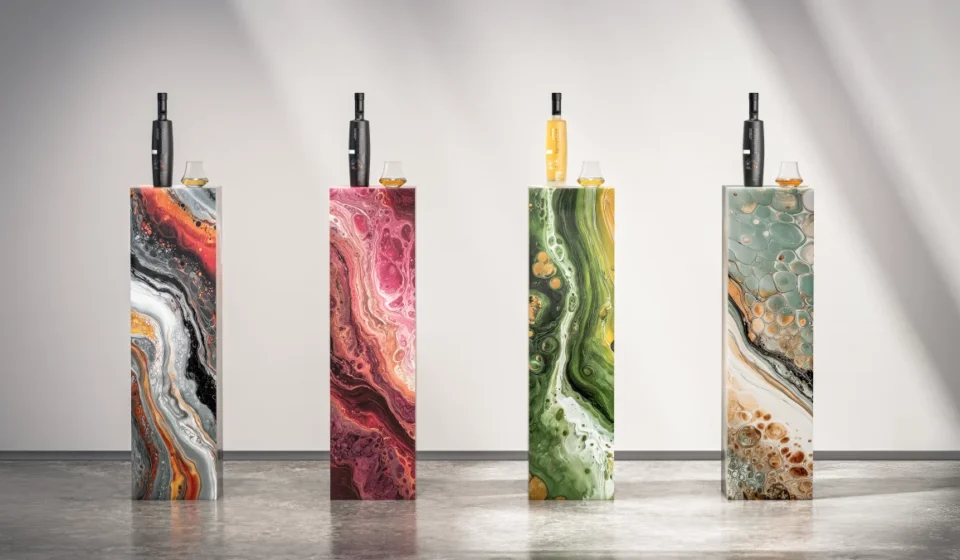
The latest chapter in this unfolding saga is the Octomore 17 series, a collection of four distinct single malt whiskies that prove immense smoke does not have to come at the expense of nuance, elegance, and complexity.
- Octomore 17.1: The baseline reference point for the series, malted to 81 ppm (parts per million), distilled from 100 percent Scottish mainland Concerto barley, and aged for five years exclusively in first-fill bourbon barrels.
- Octomore 17.2: Sharing the same barley and phenol levels as 17.1, this expression spent four years in second-fill French oak casks formerly holding bourbon, followed by a one-year finish in first-fill port barriques—a finishing combination never before used by Bruichladdich.
- Octomore 17.3: A true "peat monster" clocking in at 132.1 ppm, distilled from barley grown on Irene’s Field at Octomore Farm, and matured for five years across a complex matrix of first-fill bourbon, second-fill Ribera del Duero, Sauternes, Eiswein, and Syrah casks.
- Octomore 17.4: Malted to 108.2 ppm, aged for seven years in first-fill Oloroso sherry casks, and finished in French virgin oak barrels. Notably, this marks the first time a
.4release in the Octomore series is receiving a broad U.S. release rather than remaining a distillery-exclusive bottling.
The first three expressions are currently rolling out to specialty retailers with suggested retail prices ranging from $205 to $280 per bottle, while the highly anticipated 17.4 will officially launch in the United States on October 1 with a price tag of $250.
Chronology of an Islay Icon: The History of Octomore
To truly understand the audacity of the Octomore 17 series, one must look back at the history of the Bruichladdich distillery and the experimental farm-to-glass ethos that birthed the brand.
2008: The Birth of a Legend
Located on the remote Scottish island of Islay—a region globally famous for heavy-hitting, smoky whiskies like Laphroaig, Ardbeg, and Lagavulin—Bruichladdich released its very first Octomore whisky in 2008. The name was borrowed from the nearby Octomore Farm, situated on the hills overlooking Loch Indaal, which supplied a portion of the experimental barley used in the distillation process.
That inaugural release shattered industry conventions by registering a staggering 131 ppm (parts per million) of phenols. To put that number into perspective, Laphroaig—long considered the benchmark for heavily peated traditional Islay Scotch—typically hovers around 45 ppm. The whisky world watched in disbelief as Bruichladdich proved that malted barley could absorb more than triple the traditional limit of smoke-derived chemical compounds during the kilning process.
The Escalation: Series 8 and Beyond
As the years progressed, Bruichladdich refused to pull back the reins. Subsequent iterations of the Octomore series pushed the boundaries of phenolic measurement to astronomical heights. The Series 8 Octomore took the experiment to a dizzying extreme, pushing phenol levels past 309 ppm for select expressions.
This meteoric rise in ppm sparked fierce debates among connoisseurs and blenders alike. Skeptics questioned whether a spirit charred to such an aggressive degree could retain any discernable flavor profile beyond pure carbon and ash. Yet, time and again, Bruichladdich’s master blenders managed to craft spirits that bypassed the sensory shock of the smoke, unearthing hidden layers of floral, fruity, and mineral characteristics beneath the heavy shroud of peat.
The Present: The 17 Series Era
Today, the Octomore project is no longer viewed as a reckless stunt, but rather as one of the most intellectually rigorous and innovative single malt programs in the global spirits industry. The release of the 17 series marks a maturity in the project, balancing the high-octane phenol levels that fans demand with sophisticated cask-management programs that highlight terroir, grain variety, and wood interaction.
Supporting Data: Understanding Peat, PPM, and Cask Science
The language of peat can be opaque to even seasoned whisky drinkers. To appreciate the engineering behind the Octomore 17 series, it is helpful to break down the scientific metrics and agricultural choices that dictate every bottle.
What is PPM?
PPM stands for parts per million, which measures the concentration of phenolic compounds (phenols) absorbed by the barley grain during the malting process when it is exposed to burning peat smoke.
- Unpeated Scotch (e.g., standard Bruichladdich, Glenfiddich): 0 ppm
- Medium-Peated Scotch (e.g., Highland Park): 10 to 15 ppm
- Heavy Islay Standard (e.g., Laphroaig, Lagavulin): 40 to 50 ppm
- Octomore Baseline (e.g., 17.1 & 17.2): 81 ppm
- Octomore Extreme (e.g., 17.3): 132.1 ppm
While high ppm counts are a reliable indicator of smoky potential, Bruichladdich is quick to remind consumers that ppm measured in the malted barley does not directly correlate one-to-one with the ppm in the final bottled spirit. Distillation cuts, maturation time, and cask interaction all act as filters, mellowing and transforming the raw smoke into something vastly more complex.

Agricultural Traceability and Cask Matrix
Bruichladdich operates under a philosophy of agricultural transparency that is rare in the Scotch whisky industry. The distillery frequently utilizes 100% traceable barley, specifying the exact farm, soil type, and region where the grain was cultivated.
In the 17 series, this commitment to origin and finishing is on full display:
- The Grain: The series utilizes specific barley strains, such as Concerto grown on the Scottish mainland, and local Islay-grown barley harvested from Irene’s Field at Octomore Farm.
- The Cask Architecture: The series relies on a diverse array of wood programs. Bourbon barrels provide a sweet vanilla foundation; European wine casks (such as Sauternes, Port, Ribera del Duero, and Syrah) introduce rich stone-fruit and berry flavors; rare Eiswein (ice wine) casks contribute vibrant acidity; and virgin French oak adds deep, spicy structural tannins.
Official Responses and Perspectives
The philosophy driving the Octomore 17 series is rooted in a desire to challenge consumer expectations and push the boundaries of liquid art. In an official statement accompanying the launch, Bruichladdich Master Blender Adam Hannett elaborated on the vision behind the new expressions:
"Octomore embodies Bruichladdich’s core purpose: to create thought-provoking whiskies that challenge industry norms and offer consumers something they cannot get anywhere else," Hannett stated.
He further emphasized the meticulous craftsmanship required to balance such intense raw materials with delicate cask maturation:
"We’ve used traceable, super-heavily peated barley from mainland Scotland and Islay, maturing each expression in a selection of high-quality casks, including bourbon, Sauternes wine, Port wine, Eiswein, and Oloroso sherry."
Industry analysts and spirits critics have praised the distillery’s willingness to experiment without losing sight of drinkability. While other distilleries rely on age statements or traditional finishes to market their high-end bottles, Bruichladdich utilizes Octomore as a canvas for flavor science—proving that smoke can act as a frame rather than a cage for a spirit’s true character.
Implications for the Whisky Industry
The release of the Octomore 17 series carries significant implications for the broader spirits landscape, signaling shifts in consumer demand, agricultural transparency, and the future of luxury single malt Scotch.
1. The Elevation of Alternative Terroir
For centuries, the Scotch whisky industry marketed regional generalities—such as "Speyside is fruity," "Islay is smoky," and "Highland is robust." Bruichladdich’s hyper-focus on specific farm plots (like Irene’s Field) and distinct barley varietals (like Concerto) mirrors the terroir-driven mindset of the wine world. The success of the Octomore series proves that modern consumers are increasingly hungry for provenance and agricultural storytelling, paving the way for other distilleries to highlight grain origins just as rigorously as vineyard owners do.
2. Redefining Luxury in Spirits
With prices ranging from $205 to $280 per bottle, the Octomore 17 series firmly occupies the ultra-premium tier of the spirits market. However, unlike many luxury spirits that rely on decades of age or crystal decanters to justify their cost, Octomore commands its price point through sheer production complexity, agricultural labor, and intense flavor experimentation. At only four to seven years of age, these whiskies challenge the outdated notion that older automatically equals better in the world of single malt.
3. Broadening Accessibility for Cult Releases
One of the most notable developments in the 17 series rollout is the decision to bring the .4 bottling—traditionally a coveted distillery-exclusive item reserved for travelers making the pilgrimage to the remote Rinns of Islay—to the broader U.S. market. By expanding the geographic footprint of Octomore 17.4, Bruichladdich is acknowledging the fierce global appetite for its experimental releases, ensuring that collectors stateside have direct access to the distillery’s most innovative wood-finish combinations without needing a passport.
As the whisky world continues to evolve, the Octomore 17 series stands as a testament to the fact that tradition and radical innovation are not mutually exclusive. By taking the heaviest peat smoke known to the industry and tempering it with world-class cask selection and agricultural transparency, Bruichladdich has once again redefined what a smoky single malt can—and should—be.