Comments Off on Chasing Totality: Inside Kiko Fairbairn’s Masterclass Astrophotography Execution in Northern Spain
Main Facts
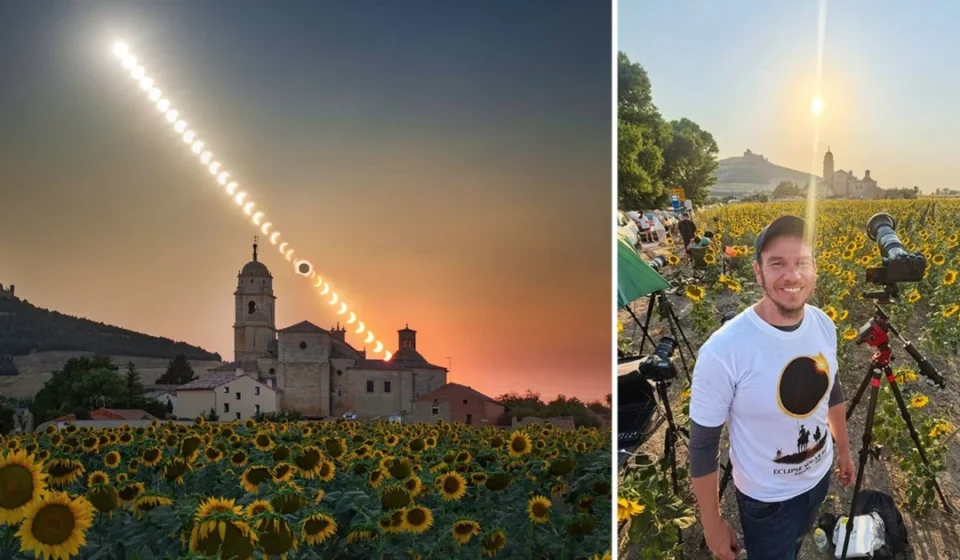
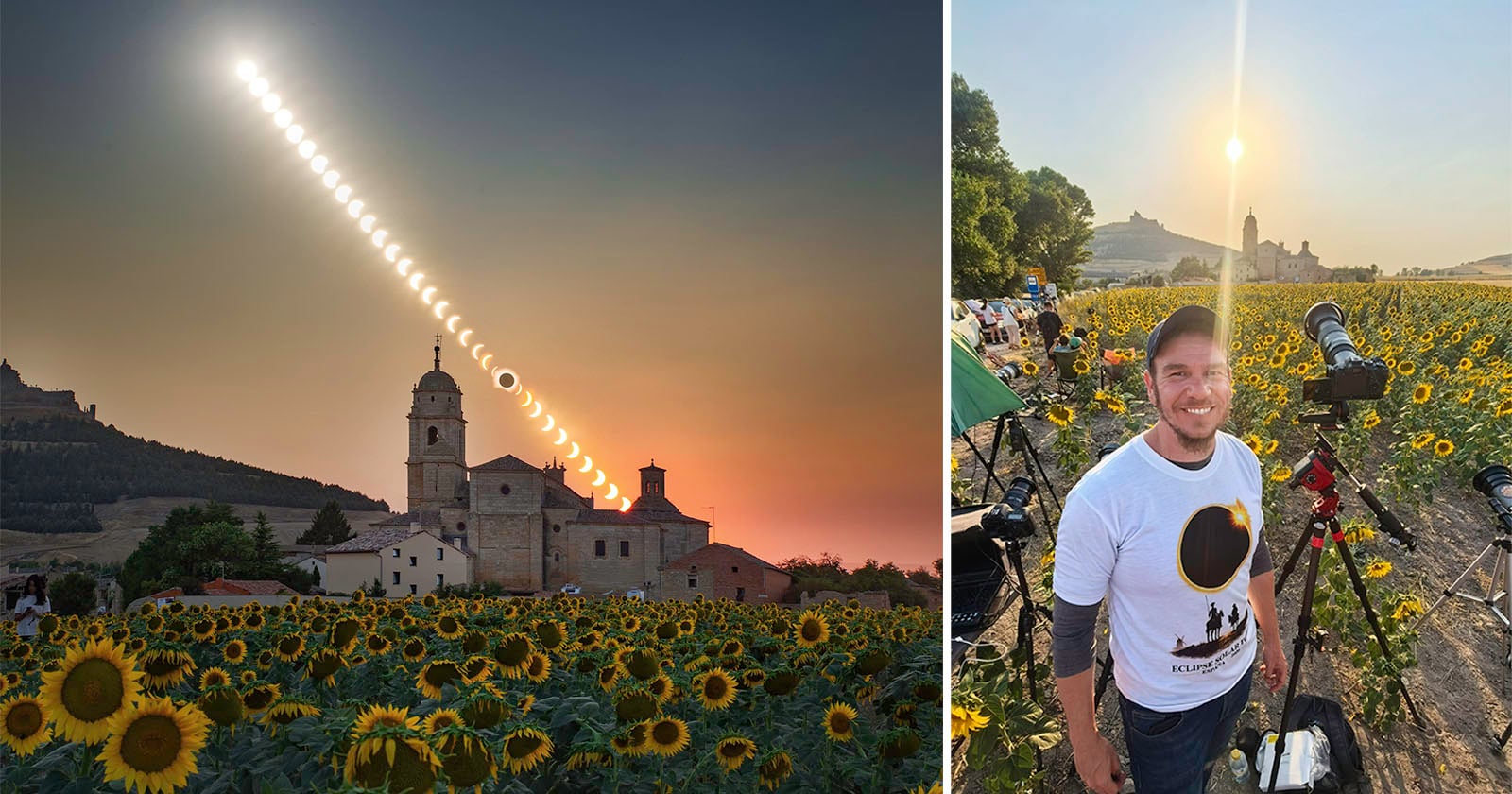
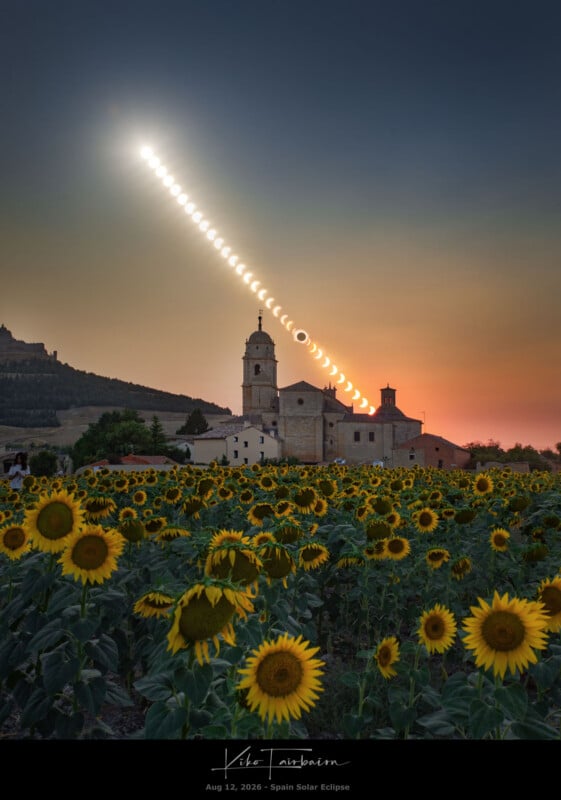
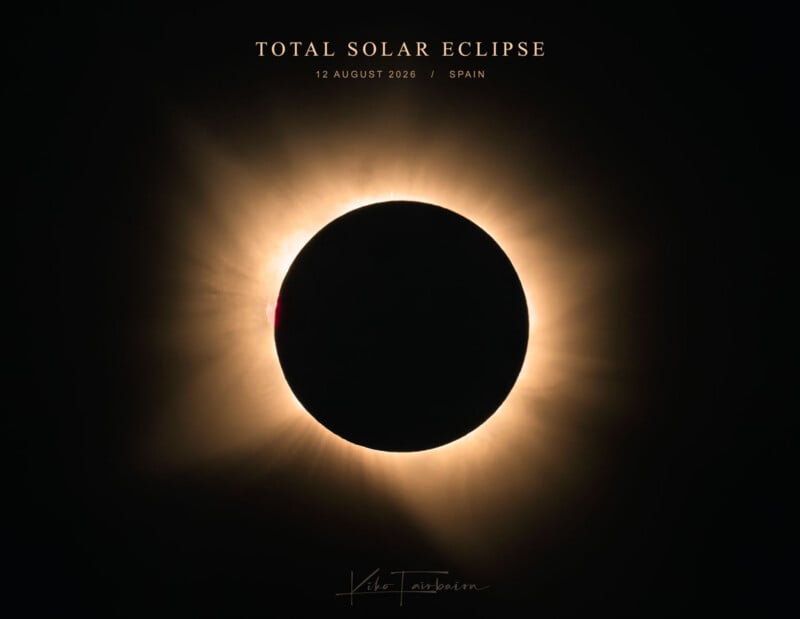
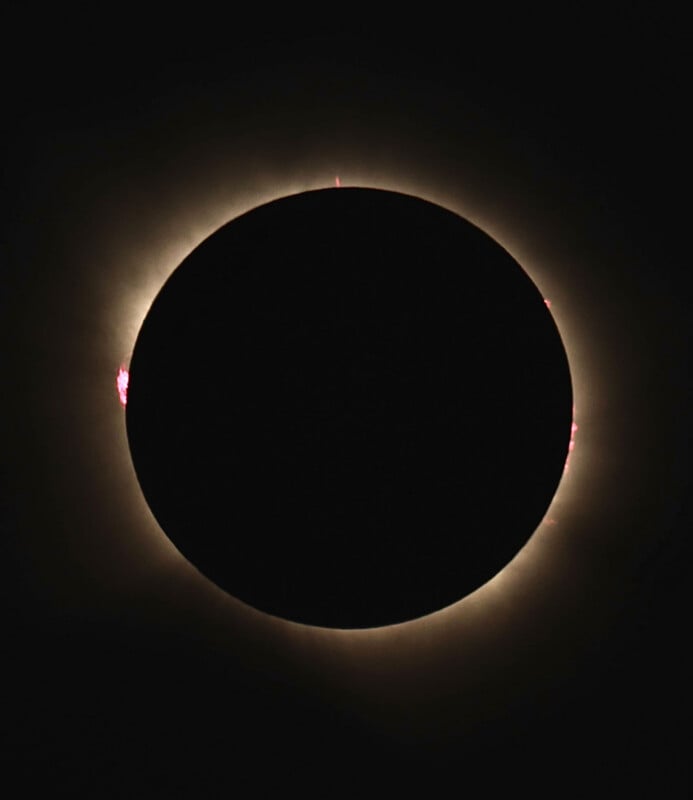
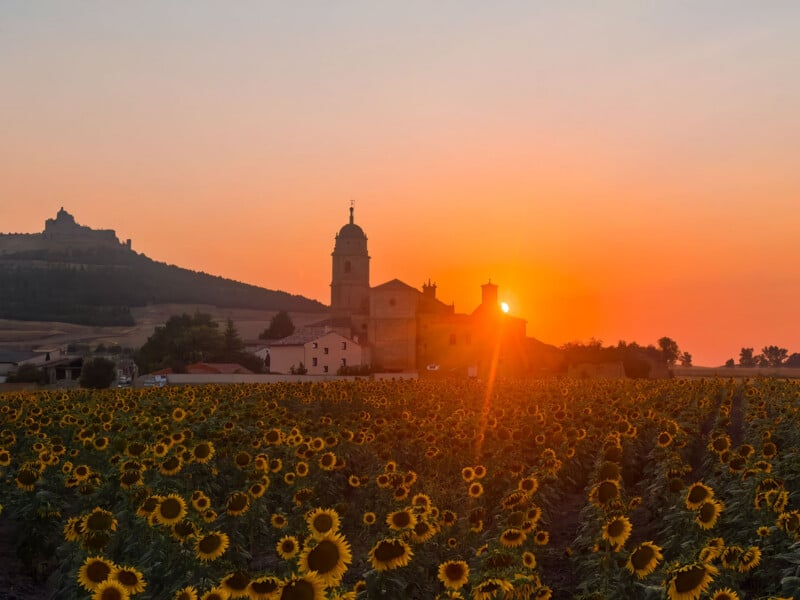
When award-winning Brazilian astrophotographer Kiko Fairbairn set his sights on the August 12, 2026, total solar eclipse, he knew that a masterpiece would require far more than showing up with a high-end camera. The result of his meticulous labor was a breathtaking series of composite images featuring a diagonal arc of the solar eclipse tracking gracefully across a Castilian sunset, framed by a vibrant field of sunflowers, a historic stone church, and ancient medieval castle ruins near Castrojeriz, Spain.
The project was the culmination of over 12 months of geographic research, digital planning, and logistical coordination from thousands of miles away. Fairbairn deployed a dual-camera strategy: a modern Canon EOS R6 Mark III paired with a 150-600mm telephoto zoom and a 2x teleconverter to continuously capture close-up details of the Sun, and his trusted, vintage Canon EOS 5D Mark III DSLR paired with a 24-70mm lens to anchor the grand landscape narrative. Over the course of 300 meticulously bracketed RAW frames, Fairbairn captured the dynamic shifts in ambient light during the precious 106 seconds of totality, proving that deliberate preparation combined with artistic vision can turn a fleeting astronomical occurrence into a timeless visual story.
Chronology: From Digital Scouting to the 106 Seconds of Totality
Phase One: The Year-Long Conceptualization
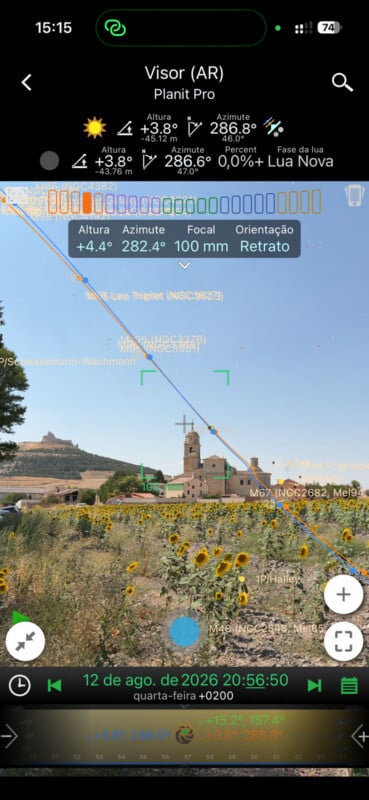
Planning for an interplanetary alignment of this magnitude cannot be improvised. More than a year prior to the August 2026 event, Fairbairn began mapping out prospective paths of totality across Europe, eventually settling on northern Spain for its predictable August weather patterns and rich historical architecture. Using augmented reality astronomy applications and topographical maps from afar, he established rough geolocations, plotting out how the path of the Moon would intersect with European landscapes.
Phase Two: Boots on the Ground in Burgos
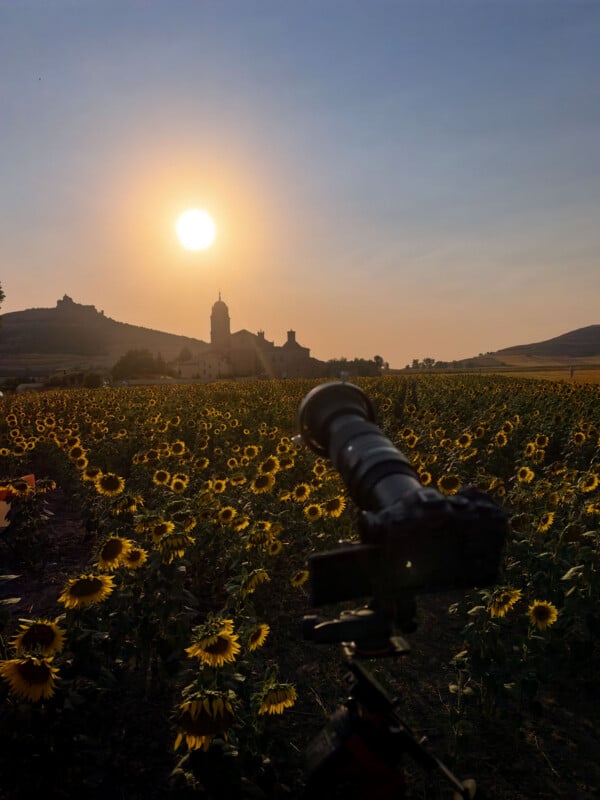
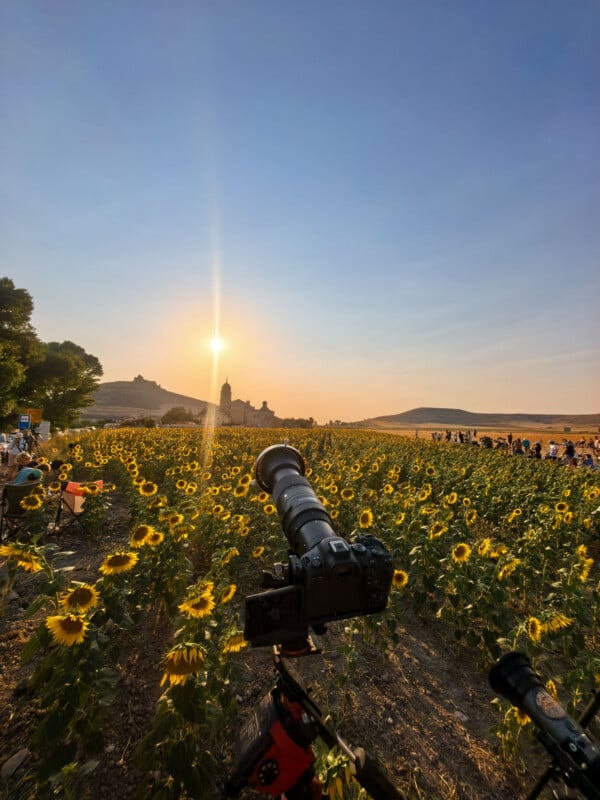
Arriving in Spain days before the eclipse, Fairbairn shifted from digital conceptualization to physical exploration. Scouting the terrain near Burgos, he navigated rural backroads until he stumbled upon an expansive, radiant field of sunflowers near the historic town of Castrojeriz.
"The moment I saw that scene, something clicked," Fairbairn recalls. "After months thinking about this eclipse, suddenly I could actually see the photograph in front of me. The landscape, the sunflowers, the old architecture and the path of totality all seemed to come together."
After experimenting with a wider 16-35mm lens that made distant architectural elements look disproportionately small, Fairbairn settled on a 38mm focal length using a 24-70mm lens. This composition successfully tied together the expressive foreground sunflowers, the distant medieval church, the hilltop castle ruins, and the calculated trajectory of the celestial alignment.
Phase Three: The Execution and Technical Setup
On August 12, 2026, minutes before first contact, the tension reached its peak. Fairbairn set up his dual-camera rigs.
The Solar Rig: Mounted on a star tracker with a dedicated solar filter, the Canon EOS R6 Mark III recorded the Sun’s progression autonomously.
The Landscape Rig: Fixed firmly on a heavy-duty tripod, the Canon EOS 5D Mark III captured bracketed sequences (using a base exposure, plus shots two stops darker and two stops brighter) through a Haida ND 3.0 filter. A dummy battery connected to an external power bank ensured uninterrupted shooting.
Throughout the eclipse’s progression, Fairbairn maintained a static composition, trusting his automated bracketing strategy to manage the radical shifts in light as totality approached, bypassing the need to fiddle with camera settings during the event.
Phase Four: The Precious Moments of Totality
When totality finally hit northern Spain, Fairbairn experienced 106 seconds of pure cosmic surrealism. Having automated his camera systems precisely to avoid staring at a digital viewfinder, he deliberately turned his attention upward. Accompanied by his sister—who captured behind-the-scenes photographs and documented his raw emotional reaction—Fairbairn witnessed the corona unfurl in the darkened Castilian sky.
Supporting Data and Technical Specifications
To achieve an exhibition-quality final composite without missing the human experience of the event, Fairbairn relied on a rigorous technical protocol:
Event Date: August 12, 2026
Location: Near Castrojeriz, Burgos Province, Northern Spain
Duration of Totality: 106 seconds
Landscape Camera: Canon EOS 5D Mark III (DSLR)
Landscape Lens: Canon EF 24-70mm (shot primarily at 38mm)
Solar Close-Up Camera: Canon EOS R6 Mark III (Mirrorless)
Solar Lens/Setup: 150-600mm telephoto zoom with a 2x teleconverter, star tracker, and solar filter
Filtration: Haida ND 3.0 filter for the landscape system.
Power Solutions: Continuous external power banks via dummy batteries to prevent mechanical failure during automated sequencing.
Official Perspectives and Reflections
Kiko Fairbairn is no stranger to celestial phenomena. A veteran astrophotographer of over 15 years, his portfolio includes deep-sky and landscape panoramas published by prestigious outlets such as National Geographic, NASA, the BBC, and Scientific American. In 2019, he earned the prestigious Sir Patrick Moore Prize at the Astronomy Photographer of the Year competition, and he has shared his expertise globally through TED talks and observatory lectures. Yet, he notes that total solar eclipses stand entirely apart due to their ephemeral nature.
"Photographing an eclipse is extraordinary," Fairbairn reflects. "As a photographer, being able to create a composition, document the different phases, and tell a visual story about such a rare astronomical event is incredibly rewarding. But actually witnessing totality with your own eyes is something else entirely."
Fairbairn emphasizes the psychological trap that modern photographers frequently fall into during rare events: becoming so obsessed with gear operation and framing that they fail to register the emotional reality of the moment.
"One of the biggest mistakes we can make as photographers during an eclipse is becoming so focused on capturing it we forget to actually experience it," he warns. "If someone ever has the opportunity to witness a total solar eclipse, I would tell them: take the photograph, absolutely — but make sure you look up. Some photographs stay with you because of the image you bring home. Others stay with you because you remember exactly what it felt like to be standing there when you made them."
Furthermore, Fairbairn stresses the importance of community. Traveling alongside his sister and close friends from the Brazilian astronomy and astrophotography community provided a vital support network that alleviated the intense pre-eclipse anxiety inherent in a shoot with zero margin for error.
Implications for Modern Astrophotography and Landscape Art
Fairbairn’s successful execution in Spain highlights several critical evolutions in modern hybrid astrophotography:
1. The Intersection of Science and Storytelling
While pure scientific astrophotography focuses heavily on data acquisition, spectral analysis, and clean planetary disks, Fairbairn’s work bridges the gap between hard science and emotional storytelling. By selecting foreground elements rich with metaphorical weight—such as sunflowers, whose heliotropic nature ties them inextricably to our daylight star—the artist elevates an astronomical event into a cultural and aesthetic narrative.
2. The Danger of Over-Automation vs. Presence
As camera technology advances—featuring intervalometers, star trackers, and automated bracketing algorithms—photographers are increasingly tempted to turn themselves into camera operators rather than experiential observers. Fairbairn’s workflow serves as a blueprint for modern creators: invest heavily in prior planning and technical automation so that when the defining moment (in this case, 106 seconds of totality) arrives, the creator is free to lower the camera, look up, and absorb the human experience.
3. The Power of Community in Solo-Endeavor Fields
Astrophotography is often perceived as an isolated discipline requiring solitary nights under dark skies. However, major international expeditions like the 2026 Spanish eclipse underscore the value of collective expertise. Shared troubleshooting, mutual encouragement, and communal celebration transform high-stress technical expeditions into lifelong bonding memories, proving that even when framing the vastness of the cosmos, human connection remains the ultimate focal point.