From Golf GT to Porsche Design: Orlando Bloom on Automotive Passion, Minimalism, and the Evolution of Car Culture

NEW YORK CITY — Long before he was rubbing elbows with automotive executives or collaborating with Stuttgart’s elite designers, Orlando Bloom was navigating the bustling streets of London in a battle-scarred, forest-green Volkswagen Golf GT. Purchased for a modest £160, the hatchback was a faithful companion through the grueling days of art and drama school, endless audition circuits, and the quiet hustle of an aspiring actor paying his dues.
Yet, fate—or rather, a careless driver—intervened to change the trajectory of Bloom’s automotive journey.
"It was parked, and I came out to it, and somebody had just driven down the whole side of it," Bloom recalls with a wry smile, speaking exclusively with Robb Report from a private room inside Manhattan’s ultra-exclusive Zero Bond social club in NoHo.
That unfortunate parking lot incident became a blessing in disguise. By his mid-20s, global superstardom had arrived courtesy of major, career-defining roles in Peter Jackson’s original The Lord of the Rings trilogy. With newfound success came the means to reward himself. Eschewing modern flash, Bloom’s first major automotive splurge was a timeless piece of engineering: a classic black 1973 Porsche 911S.

Getting behind the wheel of the vintage air-cooled sports car was a revelation. It wasn’t merely about transportation; it was an introduction to a distinct philosophy. For Bloom, driving a great car transcended the physical act of commuting—it became "an experience and a moment of meditation."
"It’s a sort of feeling that you get, of clarity," Bloom explains. "And that’s all from the passion of the people behind it."
That initial spark ignited a lifelong passion affair with Porsche, eventually drawing him into the inner sanctum of the brand’s design universe.
Main Facts: The Intersection of Celebrity and Car Culture
Bloom’s journey from a classic 911 owner to an official Porsche Design ambassador highlights a broader cultural shift in how high-end automotive brands engage with collectors, tastemakers, and enthusiasts. Two years ago, Bloom’s relationship with the marque deepened when he visited Porsche’s exclusive Sonderwunsch (special wishes) customization workshop in Stuttgart. There, he built his dream specification: a bespoke 911 GT3 Touring finished in Underberg green over Cohiba brown.

The collaboration sparked deeper creative conversations, ultimately cementing his role as a brand ambassador for Porsche Design—the automaker’s wholly owned lifestyle and industrial consultancy. Known for crafting iconic timepieces, luxury luggage, avant-garde sunglasses, and ultra-exclusive real estate developments (such as Miami’s famous cylinder-shaped tower where residents can drive their cars straight into their apartments), Porsche Design is constantly redefining what it means to live alongside one’s vehicles.
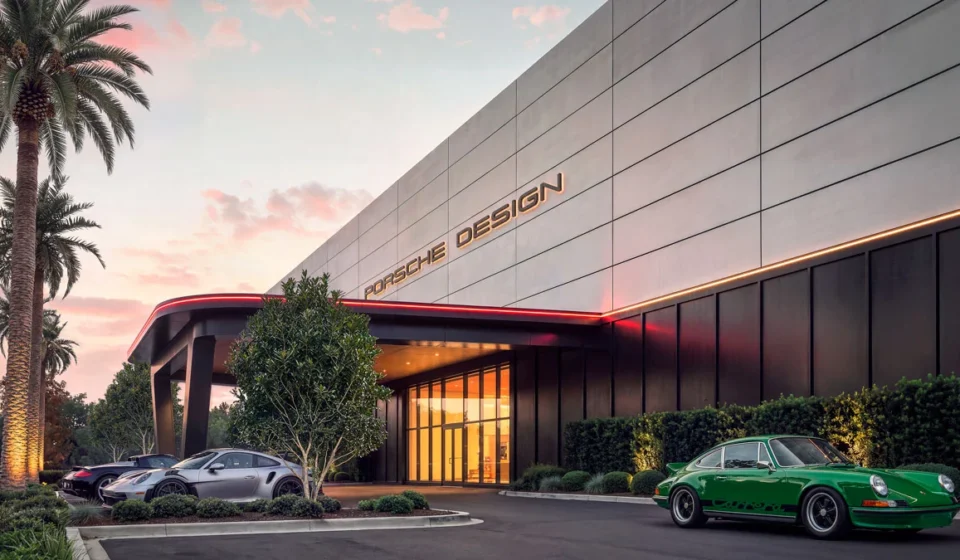
The brand’s latest venture, the Porsche Design Concours, takes this automotive lifestyle ethos to an entirely new echelon. Developed in partnership with the Newgard Development Group, the project introduces a nationwide series of hyper-curated, self-contained destinations designed specifically for car collectors.
Rather than functioning as mere parking garages, these complexes are high-design architectural sanctuaries where owners can house, display, and commune with their prized vehicles while engaging with a like-minded community of motoring enthusiasts. The inaugural locations are slated for Dallas, Texas, and West Palm Beach, Florida, signaling a major investment in the burgeoning market of luxury automotive real estate.
Chronology: From London Pavements to Stuttgart Workshops
To understand Bloom’s affinity for automotive design, one must trace the chronological evolution of his personal garage alongside his cinematic career:

- The Early Years (Late 1990s): While studying in London, Bloom tools around the city in a forest-green Volkswagen Golf GT purchased for £160—a dependable, if unglamorous, tool for an aspiring actor.
- The Breakthrough (Early 2000s): International fame arrives with The Lord of the Rings. Following a hit-and-run incident that sideswipes his parked Volkswagen, Bloom treats himself to his first major automotive investment: a vintage black 1973 Porsche 911S.
- The Rotating Stable (2000s–2010s): Over the years, Bloom’s garage plays host to several legendary classics, including a 1971 Aston Martin DBS V8 and a Series 1 Jaguar E-Type. Regrettably, some of these automotive works of art eventually cycle out of his collection.
- The Sonderwunsch Creation (Mid-2020s): Bloom visits Porsche’s legendary customization division in Stuttgart, Germany, to configure his ultimate modern driver’s car: a 911 GT3 Touring specified in Underberg green over Cohiba brown.
- Ambassadorship & The Concours (Present Day): Having officially partnered with Porsche Design two years ago, Bloom serves as a prominent voice for the brand as it unveils the Porsche Design Concours project in partnership with Newgard Development Group.
Supporting Data: The Architecture of the Porsche Design Concours
The Porsche Design Concours is designed to disrupt the traditional concept of automotive storage, bridging the gap between fine art galleries, luxury social clubs, and private-use real estate.
According to Volker Strotmeier, a member of the Porsche Lifestyle Executive Board, the initiative reimagines how collectors interact with their machines. "It redefines the concept of a traditional garage," Strotmeier notes, emphasizing the goal of "creating a design-led destination where exceptional cars, world-class architecture, and extraordinary experiences converge to create a truly special community for car collectors."
Key Features of the Porsche Design Concours:
- Boutique Scale: Each development will house precisely 22 exclusive units, ensuring an intimate, high-end community atmosphere rather than an overcrowded industrial warehouse.
- Holistic Amenities: Moving far beyond basic security and climate control, each location will feature an on-site fine-dining restaurant, a luxury spa, state-of-the-art racing simulators, and curated social events.
- Curated Driving Experiences: Owners will have access to organized group rallies and driving programs tailored to highlight the performance capabilities of their machines.
- Marque Independence: Unlike southern California’s famed Thermal Club or South Florida’s Concours Club, the properties will not feature an on-site private racetrack. Furthermore, Porsche ownership is not a requirement to purchase a unit.
- Inclusive Curation: As Newgard founder and CEO Harvey Hernandez points out, "Great collections are rarely defined by a single marque. We want each studio to reflect the personality and passions of its owner." Whether a collector houses vintage Ferraris, modern McLarens, or classic American muscle alongside their Porsches, the studios are built as blank canvases for personal expression.
Official Responses and Industry Perspectives
The announcement of the Porsche Design Concours—unveiled alongside high-profile figures like Orlando Bloom, Newgard CEO Harvey Hernandez, and Porsche Lifestyle executive Volker Strotmeier—underscores a booming sector in luxury real estate: experiential storage.
For decades, car storage facilities were sterile, utilitarian spaces hidden away in industrial parks. Today, ultra-high-net-worth individuals demand spaces that match the aesthetic and mechanical pedigree of the multi-million-dollar machines they contain. By integrating wellness (spas), gastronomy (restaurants), and socialization (club environments), projects like the Concours cater to the psychological and social dimensions of automotive stewardship.

Harvey Hernandez emphasizes that the human element is just as important as the mechanical one. The architecture is intentionally oriented around fostering community among collectors who view their vehicles not just as financial assets, but as extensions of their identity and lifestyle.
Implications: The Philosophy of "Less is More"
Despite his deep ties to Porsche Design and his admiration for the upcoming Concours developments, Orlando Bloom maintains a remarkably grounded perspective on car ownership.
While his garage has seen icons come and go—including a 1971 Aston Martin DBS V8 and a Series 1 Jaguar E-Type—he currently keeps his collection tightly edited. Alongside his foundational 1973 Porsche 911S and his bespoke 911 GT3 Touring, he admits to harboring fantasies about acquiring a Porsche 911 S/T, which he affectionately dubs "the last of the action heroes."
Yet, despite his appreciation for world-class automotive real estate, Bloom is unlikely to purchase a unit at the Concours. His reasoning stems from a maturing philosophy regarding luxury and consumption.

"There is value in having great storage," Bloom reflects. "लेकिन [But] I think as time goes on, I realize that luxury isn’t necessarily more. Luxury is less of better. So, I try to keep my cars around me. I have four, so wherever possible, I try to use them and make the most out of them."
In an era characterized by hyper-accumulation and massive, sprawling car stables, Bloom’s philosophy serves as a refreshing counter-narrative. Highlighting the fundamental physical limitations of automotive enjoyment, he delivers a final, characteristically candid punchline:
"You’ve only got one ass!"
As the luxury automotive landscape marches toward increasingly sophisticated methods of display and curation, voices like Bloom’s remind us that at the heart of every great car collection lies a simple, visceral truth: cars were built to be driven, experienced, and enjoyed.
Related posts: