

Inside Sony’s Optical Masterclass: How the FE 400mm f/4.5 and FE 600mm f/6.3 GM OSS Lenses Redefine Engineering Efficiency

In the high-stakes world of professional sports, wildlife, and aviation photography, the holy grail has always been achieving maximum reach without succumbing to debilitating physical weight. For decades, manufacturers treated ultra-telephoto prime lenses as standalone monumental projects, each focal length demanding its own ground-up research and development cycle, unique tooling, and massive financial investment.
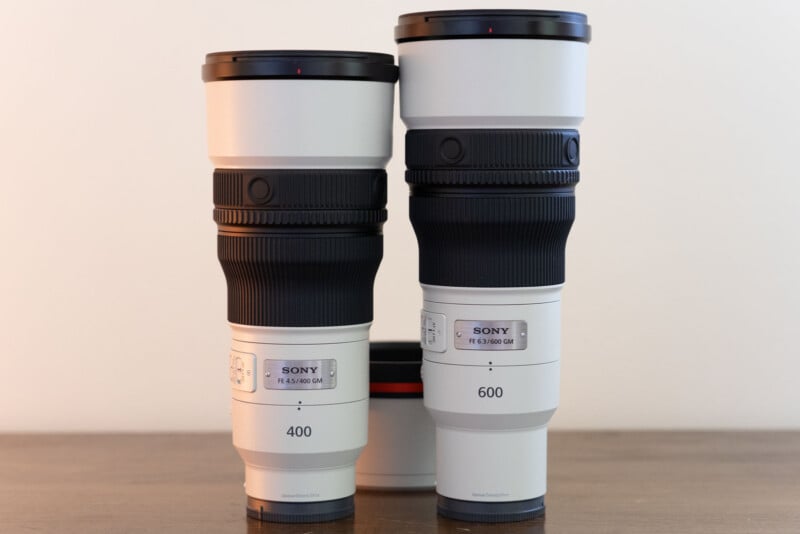
However, Sony’s recent introduction of the FE 400mm f/4.5 GM OSS and the FE 600mm f/6.3 GM OSS lenses has shattered conventional manufacturing paradigms. At a glance, these two white-barreled G Master telephotos look like siblings. Upon closer physical inspection, they share a staggering amount of DNA. But beneath their exterior housings lies a masterclass in optical engineering efficiency that blurs the line between distinct product categories and challenges how the industry conceptualizes lens development.
Main Facts
The core revelation surrounding Sony’s dual-lens drop centers on a shared architectural foundation that borders on the astonishing.
- The Weight Conundrum: Despite offering entirely different focal lengths, the FE 400mm f/4.5 GM OSS and the FE 600mm f/6.3 GM OSS are separated in weight by a mere gram—roughly equivalent to a single standard paper clip, a crisp dollar bill, or a pinch of salt.
- Physical Dimensions: The 600mm variant is physically longer by less than an inch, maintaining a shockingly compact and lightweight silhouette that defies traditional expectations for super-telephoto reach.
- Shared Technology: Both lenses utilize identical autofocus drive systems, feature the exact same minimum focusing distances, incorporate matching on-barrel physical controls, boast identical weather-resistance sealing, and deliver virtually indistinguishable levels of optical sharpness.
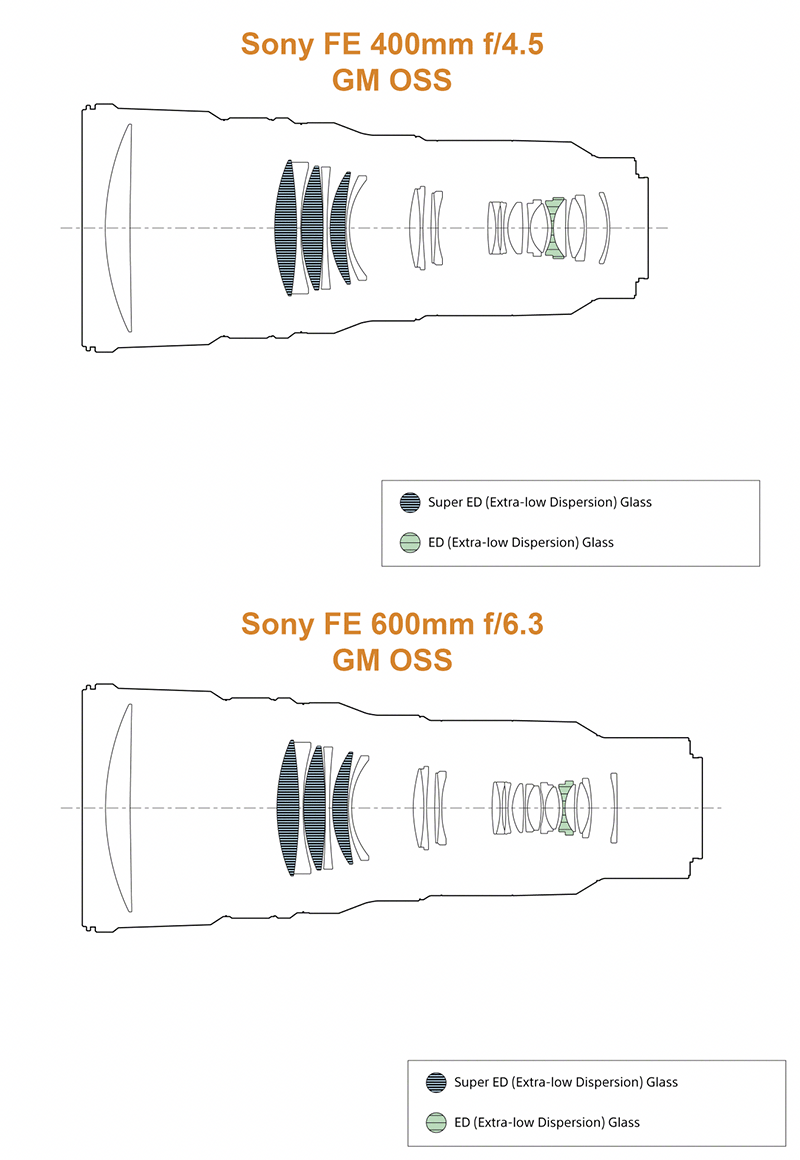
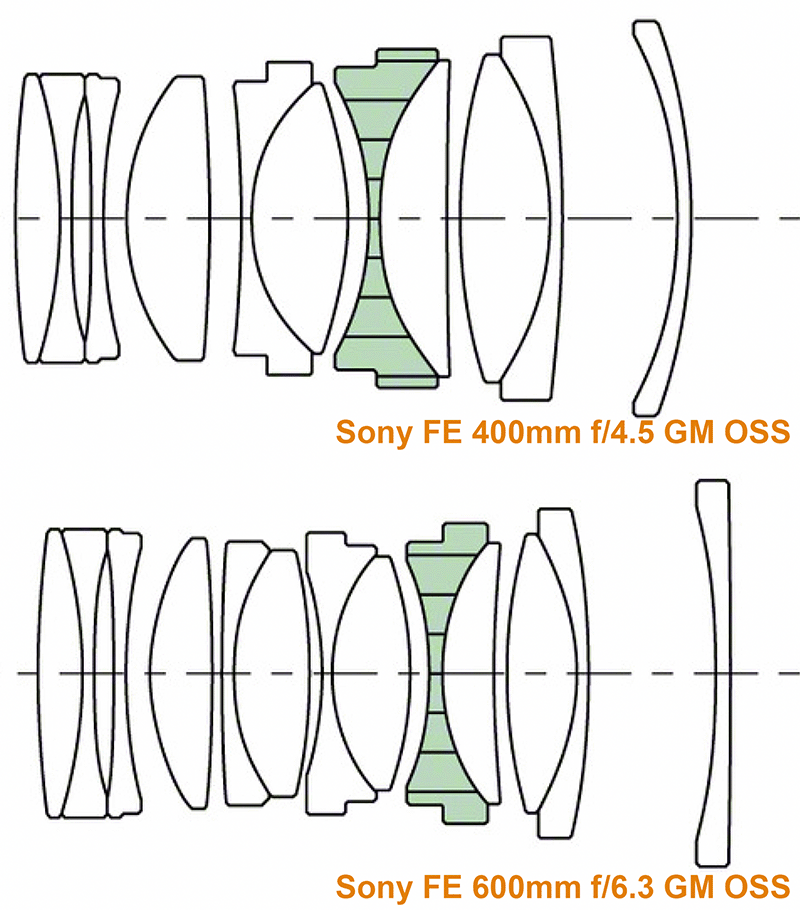
- The Shared Optical Core: Up to the midpoint of their internal designs, the optical formulas are identical. Ranging from the large front element to the central focusing groups—including premium Super ED (Extra-low Dispersion) glass elements—the lenses function as fraternal twins.
- The Divergence: To achieve the additional magnification required for the 600mm reach, Sony introduces a single extra group containing two additional elements near the lens mount, bringing the 600mm’s configuration to 24 elements in 17 groups.
Chronology
To understand the magnitude of Sony’s achievement, it helps to examine how the industry has historically approached super-telephoto lens development, and how this specific engineering breakthrough unfolded.
The Historical Precedent of Telephoto Design
Traditionally, optical designers approached every focal length as an entirely unique physics problem. A 400mm lens required a specific glass curvature, barrel diameter, and element spacing to correct chromatic aberrations and maintain edge-to-edge sharpness at a wide aperture. A 600mm lens demanded an entirely separate blueprint to handle the magnification demands, invariably resulting in significantly heavier, front-heavy glass architectures that required monopods or heavy-duty gimbals to operate comfortably for extended periods.
The Modern G Master Era
As Sony’s E-mount ecosystem matured, the company shifted focus toward aggressive miniaturization without sacrificing its flagship "G Master" (GM) resolution and bokeh standards. The development of lightweight telephotos accelerated across the industry—exemplified recently by Fujifilm’s cross-platform strategy, where a single 500mm f/5.6 optical formula was successfully adapted to both medium-format GFX systems and APS-C X-Series cameras via mount engineering.
The Sony Dual-Launch Breakthrough
Sony’s engineers realized that by designing a modular core optical framework, they could solve the physical challenges of a 400mm f/4.5 prime and adapt that exact same front-end infrastructure to support a 600mm f/6.3 variant. By maintaining the same entrance pupil size while extending the focal length, the mathematical trade-off resulted in a slower f/6.3 maximum aperture, but yielded a super-telephoto lens that retained the handling, weight, and center of gravity of its shorter sibling.
Supporting Data
A detailed comparative breakdown underscores just how remarkably similar these two flagship glass options truly are:
| Feature / Specification | Sony FE 400mm f/4.5 GM OSS | Sony FE 600mm f/6.3 GM OSS |
|---|---|---|
| Focal Length | 400mm | 600mm |
| Maximum Aperture | f/4.5 | f/6.3 |
| Optical Construction | Shared front & mid-groups (Super ED glass) | Shared front & mid-groups + 2 additional elements (24 elements in 17 groups) |
| Autofocus System | Advanced high-speed linear motors | Advanced high-speed linear motors (Identical) |
| Minimum Focus Distance | Identical performance profile | Identical performance profile |
| Weight Difference | Baseline weight | +1 gram heavier |
| Physical Length | Compact telephoto profile | Less than one inch longer |
| Weather Sealing | Comprehensive dust and moisture resistance | Comprehensive dust and moisture resistance |
The inclusion of Super ED glass across the shared optical groups ensures that both lenses suppress chromatic aberration with equal proficiency. Field tests validate that whether tracking a fast-moving bird of prey with the 400mm or capturing distant wildlife with the 600mm, the micro-contrast, color rendering, and resolving power remain at the absolute pinnacle of modern optical engineering.

Official Responses and Industry Reception
Industry analysts, professional reviewers, and technical testers have expressed widespread admiration for Sony’s manufacturing efficiency.
Prominent photography reviewers have noted that from a user experience standpoint, there are virtually no compromises. Photographers transitioning between the two focal lengths do not need to retrain their muscle memory regarding weight distribution, button placement, or tripod collar handling.
While official corporate statements from Sony emphasize the relentless pursuit of image quality and ergonomic comfort, independent optical engineers have pointed out the profound economic genius behind the design:

"Making one all-new lens requires monumental research, development, and tooling costs. By engineering a shared optical chassis that can branch into two distinct products, Sony has effectively minimized R&D overhead while maximizing consumer choice."
Reviewers have playfully highlighted the pricing dynamic—noting that buyers of the 600mm version are essentially purchasing the foundational architecture of the 400mm lens twice, with a roughly $1,000 price premium attached to account for the specialized rear element group and long-range branding. Yet, given that standalone 600mm primes have historically commanded much higher financial and physical tolls, the market reception remains overwhelmingly positive.
Implications for the Future of Photography
The development and commercial release of the Sony FE 400mm f/4.5 GM OSS and FE 600mm f/6.3 GM OSS carry profound implications for the broader photographic industry.
1. The Death of the "Heavy Telephoto" Excuse
For years, wildlife and sports shooters accepted that high-reach photography required carrying massive, shoulder-bruising glass. By proving that a 600mm super-telephoto can weigh virtually the same as a 400mm lens—and remain remarkably portable—Sony has set a new benchmark for ergonomics. Photographers can now hike deep into the wilderness or navigate crowded sports sidelines without requiring heavy support systems.
2. A Shift in Optical Engineering Paradigms
Other manufacturers will undoubtedly study Sony’s modular design philosophy. The concept of creating a "mother lens" optical core that can be scaled or modified via rear element groups opens the door for more cost-effective lens lineups. This efficiency could eventually translate to faster product lifecycles and more accessible pricing structures across competitor ecosystems like Canon, Nikon, and Fujifilm.
3. Consumer Value and Decision Fatigue
For working professionals and dedicated enthusiasts, choosing between a 400mm and a 600mm lens used to involve weighing drastic differences in size, weight, and handling. Now, the decision is purely about focal length preference and light gathering capabilities (f/4.5 versus f/6.3). Knowing that the underlying optical pedigree, autofocus speed, and weather sealing are identical provides immense peace of mind to buyers regardless of which focal length they choose.
Ultimately, Sony has demonstrated that brilliant business strategy and cutting-edge optical performance are not mutually exclusive. By working smarter rather than simply building heavier, Sony has permanently altered what photographers can expect from their super-telephoto gear.