Inside the Remarkable Transformation of a Tudor Revival Estate on North Bundy Drive

LOS ANGELES — In the upper echelons of Los Angeles real estate, the alchemy of historic preservation and modern luxury is a delicate discipline. Nowhere is this more apparent than in the affluent enclave of Brentwood, where tree-lined canyon roads and crisp Pacific breezes have long shielded high-profile residents from the relentless pace of the city below. It is here, at 1004 North Bundy Drive, that designer Jordan Bakva has recently completed a masterclass in architectural reinvention.
Taking a 1972 Tudor Revival residence—a style more commonly associated with the misty English countryside than the sun-drenched topography of Southern California—Bakva has steered the property firmly into the 21st century. The result is a sprawling, 5,850-square-foot sanctuary that balances period character with contemporary panache. Following a dramatic, ground-up redesign that touches nearly every square foot of the estate, the property has returned to the market with an asking price of $8 million, represented by Claire and Sam O’Connor of O’Connor Estates.
Main Facts: A Study in Contrasts and Craftsmanship
At its core, the transformation of the North Bundy Drive estate is a narrative of deliberate dualities. Bakva approached the 5,850-square-foot footprint with an eye for dramatic juxtaposition, seamlessly weaving dark, moody, cocoon-like spaces with soaring, light-drenched volumes.

The structural and aesthetic anchor points of the home have been entirely rethought:
- The Living Spaces: The formal living room leans heavily into verticality and luminosity, featuring stark-white walls that ascend to a soaring, double-height ceiling. By contrast, the formal dining room wraps its occupants in rich, dark wood paneling, establishing an intimate, club-like atmosphere for evening gatherings. The monochromatic gray family room offers yet another gear, flowing effortlessly through an arched opening into a whimsical, wallpapered breakfast nook complete with a cushioned banquette built directly into a sunlit bay window.
- The Culinary Core: The kitchen and bathrooms underwent the most radical overhauls, rebuilt completely from the studs. The kitchen now features a sturdy, industrial-grade La Cornue range as its undeniable centerpiece. The heavy, utilitarian aesthetic of the stove is artfully softened by luxurious Breccia Capraia marble countertops, striking a balance between professional-grade utility and residential warmth.
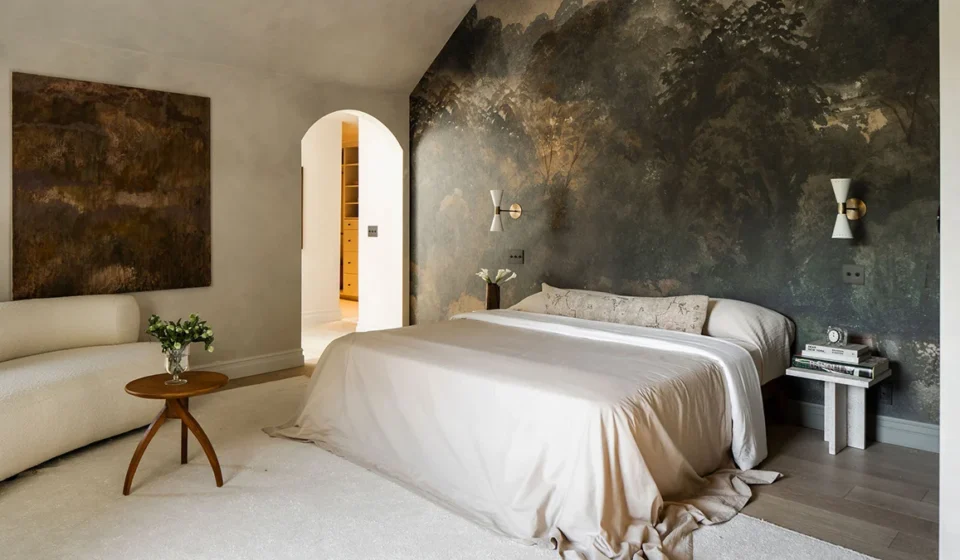
- The Private Quarters: The residence encompasses six distinct bedrooms, each curated as an individual micro-environment rather than a cookie-cutter suite. Highlights include a bedroom featuring a moody accent wall depicting a dark forested landscape, another outfitted with a dedicated reading nook, and a simpler guest room distinguished by whimsical, custom stained-glass windows accented with a delicate hummingbird motif. Across the home’s seven bathrooms, Bakva deployed a kaleidoscopic palette, tiling individual spaces in vibrant hues of blush pink, tranquil blue-gray, and muted sage green.
- The Grounds and Amenities: Beyond the primary structure, the property boasts meticulously manicured landscaping centered around a storybook turtle pond featuring a naturalistic waterfall, alongside a sun-drenched swimming pool. Additional functional upgrades include a private home gym and a detached, studio-style guesthouse complete with a vaulted, beamed cathedral ceiling, galley kitchen, and a cozy sitting area.
Chronology: From 1972 Build to $8 Million Showcase
To understand the current iteration of 1004 North Bundy Drive, one must trace its evolution across architectural eras and market cycles:
- 1972: The original Tudor Revival structure is erected in Brentwood, capturing the architectural zeitgeist of the era that favored pitched gables and heavy European motifs adapted to West Coast sprawling floor plans.
- Circa 2023–2024: Recognizing the property’s untapped potential, developer and design forces—spearheaded by Jordan Bakva—acquire the residence. A comprehensive, stud-level renovation plan is initiated. The mandate is clear: retain the nostalgic Tudor bones while overhauling the layout, systems, and interior design to satisfy contemporary luxury buyers.
- Late 2023 / Early 2024: The property changes hands in its newly reimagined state, selling for $3.5 million just over a year prior to its current listing.
- September 2026: Following final polish and landscaping refinements—including the integration of the turtle pond, pool upgrades, and the styling of the six bedrooms and seven bathrooms—the estate officially returns to the open market. Claire and Sam O’Connor of O’Connor Estates list the turnkey compound for $8 million, marking a staggering valuation leap driven by the scope of the architectural transformation and surging demand in Brentwood.
Supporting Data: Brentwood’s Elite Real Estate Landscape
The listing of 1004 North Bundy Drive arrives amid a remarkably dynamic period for the Brentwood real estate market. Historically favored by titans of industry, entertainment royalty, and cultural icons—ranging from historical legends like Shirley Temple and Audrey Hepburn to modern powerhouses such as Gwyneth Paltrow, Arnold Schwarzenegger, and Chelsea Handler—the neighborhood commands some of the highest price-per-square-foot metrics in Los Angeles.

Current comparable listings and recent trading data underscore the neighborhood’s ultra-luxury baseline:
- The Bundy Drive Valuation: With 5,850 square feet of primary living space, an independent guesthouse, a gym, and resort-style grounds on a prime Brentwood parcel, the $8-million asking price equates to roughly $1,367 per square foot. This figure reflects not only the underlying land value but the premium commanded by a turnkey, designer-renovated historical asset.
- Celebrity Comparables: The local market is currently saturated with high-profile inventory. Sarah Michelle Gellar and Freddie Prinze Jr. recently listed their sprawling Brentwood estate for $10 million. Meanwhile, the late, legendary Diane Keaton’s famously idiosyncratic, Pinterest-inspired Los Angeles compound commands an $18 million price tag, highlighting the market’s appetite for properties defined by uncompromising interior vision.
- Asset Appreciation: The property’s jump from a $3.5 million acquisition price to an $8 million re-listing highlights the immense value created by strategic architectural interventions. Gut-renovating foundational spaces—specifically turning dark, closed-off 1970s floor plans into cohesive, indoor-outdoor entertaining zones—continues to yield massive dividends in prime Westside locations.
Official Responses and Stakeholder Perspectives
While interior designer Jordan Bakva has kept his conceptual statements focused on the synthesis of comfort and heritage, real estate professionals intimately familiar with the Westside market have been vocal about the property’s rare positioning.
Claire and Sam O’Connor of O’Connor Estates, who hold the $8 million listing, emphasize that the property bridges a critical gap in current inventory. "Buyers today are experiencing renovation fatigue," notes a representative close to the O’Connor team. "Acquiring a home that successfully marries the romantic architectural character of a Tudor Revival with the effortless, light-filled lifestyle demanded by contemporary families is exceptionally rare, particularly in a location as coveted as Bundy Drive."

Architectural critics have similarly praised Bakva’s restraint. Rather than stripping the 1972 build of its historical identity to force a generic minimalist white-box aesthetic—a common trope in modern L.A. flips—the design team leaned into the structural drama. By preserving timber cues, introducing bespoke stained glass, and anchoring the kitchen with a legendary La Cornue range, the home maintains an authentic narrative soul that speaks directly to sophisticated buyers seeking character over mere square footage.
Implications: The Future of Westside Historic Conversions
The trajectory of 1004 North Bundy Drive offers a fascinating lens through which to view the broader evolution of Los Angeles real estate development.
1. The Death of the Generic Flip
For years, the standard playbook for Westside developers involved purchasing mid-century or traditional properties, stripping them of all interior detailing, and deploying an identical palette of gray flooring, open-concept white walls, and glass pocket doors. The success of Bakva’s design proves that the luxury consumer has evolved. Buyers are increasingly searching for individuality. The juxtaposition of dark wood paneling in the dining room against the stark-white, double-height living room demonstrates that sophisticated buyers crave emotional contrast and narrative-driven architecture.

2. Brentwood’s Scarcity Premium
As available land in Brentwood, Pacific Palisades, and Santa Monica continues to dwindle, the repurposing of existing 20th-century stock—whether mid-century modern or 1970s Tudor Revival—will become the primary engine of luxury inventory growth. Properties that can successfully navigate local zoning while upgrading infrastructure (such as the total-stud rebuild of Bundy’s seven bathrooms and kitchen) set a new benchmark for what constitutes "move-in ready" at the $5M to $10M price point.
3. The Wellness and Sanctuary Shift
The heavy emphasis on private outdoor amenities—the turtle pond with its natural waterfall, the resort pool, the detached studio guesthouse, and dedicated wellness spaces like the home gym—reflects a permanent post-pandemic shift in buyer psychology. Homes are no longer viewed merely as functional basecamps, but as holistic wellness resorts. By transforming the six bedrooms into distinct psychological retreats (complete with forest murals, reading nooks, and hummingbird stained glass), the property positions itself not just as a house, but as a therapeutic escape from the pressures of urban life.
As 1004 North Bundy Drive makes its way through the market, it stands as a testament to the power of thoughtful, historically respectful design—proving that with the right vision, a 1970s Tudor can find a vibrant, luxurious second life in the heart of 21st-century Los Angeles.