Comments Off on Meetup Lowers the Barrier to Entry: Platform Introduces ‘Meetup Starter’ to Cultivate a New Generation of Community Leaders
By The Tech & Community Desk Published October 11, 2024
Main Facts: A New Gateway for Community Building
In an effort to democratize community management and lower the financial and operational barriers for first-time leaders, the global event platform Meetup has officially announced the launch of Meetup Starter. This newly introduced tier serves as a free, lightweight, and risk-free environment designed explicitly for aspiring and would-be organizers who want to dip their toes into the world of community building without making an immediate financial commitment.
For years, the platform has functioned as a premier digital town square, connecting millions of people offline through shared interests, professional networking hobbies, and local activism. However, the requirement to immediately subscribe to paid tiers historically created hesitation among hobbyists, casual organizers, and those unsure of their ability to sustain a long-term group. Meetup Starter bridges this gap. By offering a curated sampling of the platform’s core management tools at zero cost, the company aims to test-drive leadership potential, encourage experimentation, and ultimately inject fresh, diverse voices into the local event ecosystem.
The rollout arrives alongside a renewed emphasis on Meetup’s core lineup, drawing a sharp operational distinction between the newly minted Starter tier, the robust and widely utilized Standard tier, and the enterprise-grade Pro tier. By diversifying its offerings, Meetup is strategically repositioning itself not just as a utility for established groups, but as an incubator for grassroots community movements.
Chronology: The Evolution of Meetup’s Pricing and Organizer Tools
To understand the significance of the Meetup Starter launch, it is helpful to examine the historical context of how the platform has managed organizer monetization and accessibility over the years.
The Early Era: A Pioneer in Peer-to-Peer Gathering
When Meetup first launched in the early 2000s, it revolutionized how people formed real-world connections following historic societal shifts. For much of its history, the platform operated on a model where organizers paid a monthly subscription fee to maintain groups, while attendees generally joined for free (though individual groups occasionally charged event fees to cover venue rentals or materials).
The Shift Toward Tiered Flexibility
As the digital landscape matured and competitor platforms entered the market—offering varying degrees of free community-hosting tools—Meetup underwent several structural overhauls. The company sought to balance the high costs of maintaining a secure, global-scale platform with the user demand for flexible pricing. This led to the refinement of the Meetup Standard plan as the primary engine for most community leaders, alongside the introduction of Meetup Pro for larger organizations, brands, and multi-chapter networks.
The Missing Middle: The Genesis of ‘Starter’
Despite these options, user research and internal feedback consistently highlighted a recurring friction point: prospective organizers with niche, untested, or low-commitment ideas were hesitant to pay for a Standard subscription before knowing if their group would gain traction. Recognizing that potential community leaders needed a runway to experiment safely, product and engineering teams conceptualized a simplified, free tier.
Culminating in its official rollout in late 2024, Meetup Starter was developed to address this exact friction point. It provides a secure sandbox where first-time hosts can learn the ropes of event scheduling, member communication, and group promotion without financial risk, setting the stage for a smoother transition to paid tiers should their communities take off.
Supporting Data: Starter vs. Standard vs. Pro
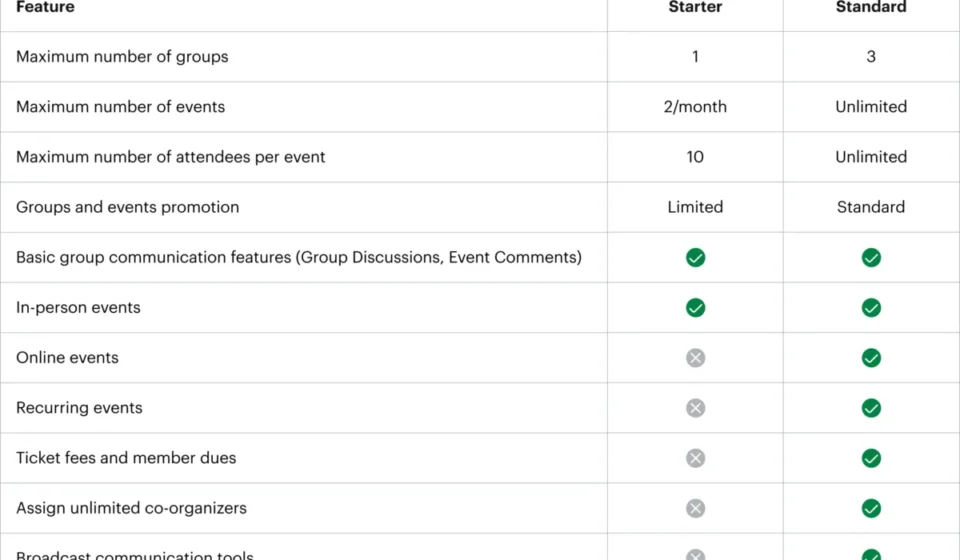
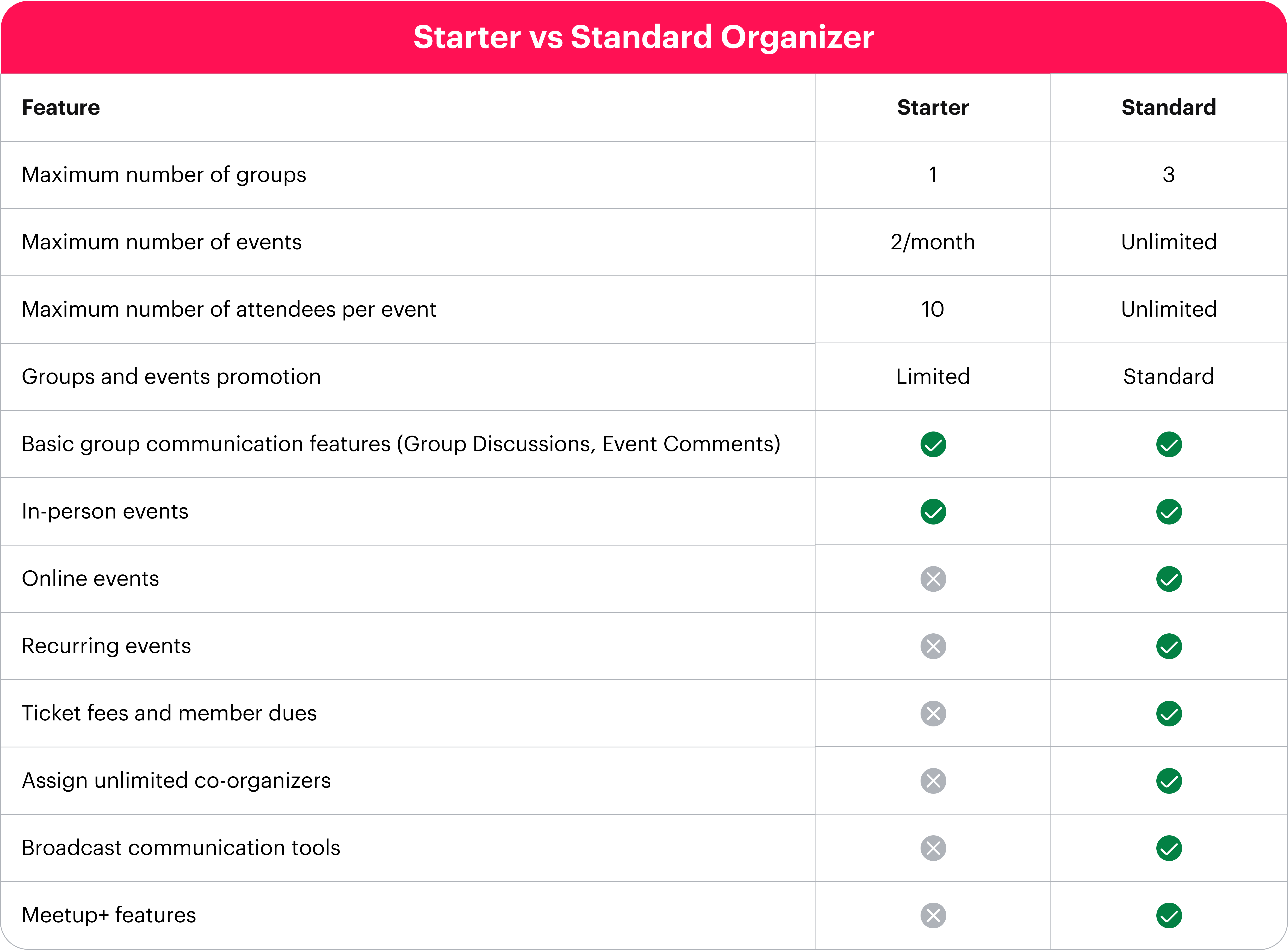
To help organizers choose the right environment for their goals, Meetup has clearly delineated the capabilities, limitations, and target audiences of each tier within its ecosystem. The introduction of the Starter plan creates a clear evolutionary path for community builders.
Meetup Starter: The Incubation Sandbox
Cost: Free
Target Audience: First-time organizers, casual community builders, and those testing out a new group concept.
Core Focus: A simplified, streamlined introduction to event and community management. It cuts away complex administrative overhead to focus purely on the essentials.
Limitations: Designed as a lightweight entryway, it provides a foundational sampling of core benefits rather than the exhaustive toolset required for multi-group empires.
Meetup Standard: The Flagship Organizer Experience
For the vast majority of active community leaders, Meetup Standard remains the platform’s primary and most comprehensive plan.
Target Audience: Dedicated organizers running active, regular local groups.
Key Capabilities:
Full administrative and management tools for up to three different groups simultaneously.
The ability to host an unlimited number of events every single month.
Advanced member management, recurring event scheduling, enhanced communication channels, and deeper customization options.
Strategic Value: According to internal platform data, Standard is optimized for leaders who have validated their concept and are ready to scale their engagement, build loyal followings, and host consistent gatherings.
Meetup Pro: Enterprise-Grade Scale
For organizations operating at a macro level—such as corporate brands, large non-profits, international associations, and multi-city chapters—Meetup offers the Pro tier.
Target Audience: Businesses, global brands, and advanced organizers managing extensive networks of interconnected groups.
Key Capabilities: Unlocks truly unlimited capabilities, centralized analytics, brand customization, cross-group promotion, and dedicated support systems.
The leadership and product teams behind Meetup have emphasized that the introduction of the Starter tier is rooted in a fundamental philosophy: community building should be accessible to anyone with a passion to share, regardless of their immediate access to capital.
In statements accompanying the release, representatives from the Meetup Team highlighted the transformative impact that new organizers bring to the digital and physical landscape:
"By providing new organizers with a simplified option, we hope to make Meetup’s ecosystem richer with an ever more diverse range of organizers, groups, and events. We look forward to welcoming our new Starter organizers to the Meetup community!"
Rather than viewing the free Starter tier as a cannibalization of their paid subscriber base, product strategists view it as a vital top-of-funnel pipeline. By allowing curious individuals to experience the inner workings of event management risk-free, Meetup is actively nurturing a culture of confidence. When a Starter organizer successfully hosts their first few events and sees their membership grow, they naturally encounter the functional ceilings of the free plan—such as group caps or advanced tool requirements—making the transition to Meetup Standard a logical, organic step rather than a speculative gamble.
Broader Implications for the Event and Community Tech Industry
The launch of Meetup Starter carries significant implications not just for the platform itself, but for the broader landscape of social technology, remote-to-in-person bridging, and the creator economy.
1. Lowering Barriers in a Post-Pandemic Social Recovery
As society continues to navigate the long-term impacts of digital isolation, loneliness epidemics, and shifting workplace dynamics (such as the rise of remote and hybrid work), the demand for authentic, localized, in-person communities has never been higher. People are craving niche spaces centered around board games, tech languages, outdoor hiking, mental health support, and creative arts. By removing financial friction for organizers, Meetup is directly stimulating the supply side of community creation, ensuring that grassroots initiatives can spring up organically in neighborhoods worldwide.
2. Diversifying the Organizer Demographic
Historically, paid community-hosting platforms inadvertently favored individuals with disposable income or institutional backing. A free introductory tier levels the playing field. Students, young professionals, artists, and community activists who operate on tight budgets can now trial group leadership without financial anxiety. This democratization is expected to yield a much richer, more culturally and topically diverse tapestry of groups on the platform.
3. Setting a New Standard for Product-Led Growth (PLG) in Community SaaS
From a business strategy perspective, Meetup’s move exemplifies modern Product-Led Growth (PLG) principles. By offering a functional, high-value free tier that naturally demonstrates ROI (Return on Investment—or in this case, Return on Engagement), the platform reduces customer acquisition friction. Users learn by doing, building emotional investment in their groups before ever opening their wallets.
Looking Ahead
As the digital ecosystem evolves, the success of Meetup Starter will ultimately be measured by how many first-time hosts successfully transition their sandbox projects into vibrant, enduring communities. By investing in the grassroots of community management, Meetup is betting that the best way to grow its platform is to empower the individual passions of everyday people.
For those sitting on a community idea—whether it’s a local book club, a niche coding circle, or a weekend running group—the barrier to entry has officially vanished. The tools are ready, the framework is set, and Meetup’s newest generation of organizers is poised to take the stage.