The RTD Revolution: How Convenience Retailers are Mastering the New Alcohol Frontier

The landscape of convenience retail is undergoing a seismic shift as the Ready-to-Drink (RTD) beverage category transitions from a secondary offering to a primary revenue driver. As consumer preferences pivot toward convenience, flavor variety, and portability, convenience store (c-store) operators are being forced to rethink their floor plans, cold vault strategies, and inventory management. For many, this evolution is reminiscent of the transformative 2019 hard seltzer boom, but with significantly more complexity due to the bifurcation between liquor-based and malt-based offerings.
The State of the Segment: A "Must-Have" Evolution
For John Parduski, director of merchandising for Onvo—a retailer operating over 40 locations across Pennsylvania and New York—the current surge in RTD demand is impossible to ignore. "We have expanded both styles of RTDs (liquor and malt) in all of our locations," Parduski notes. "The popularity and demand for these products required us to look at these items as a new category. In the past, they were a ‘nice to have,’ but they are now a ‘must-have’ in every store."
This shift has created operational challenges regarding planograms that haven’t been seen since the industry struggled to accommodate the sudden proliferation of seltzers half a decade ago. RTDs have officially earned their seat at the table, forcing managers to deprioritize slower-moving legacy categories to make room for the high-velocity, high-margin RTD segment.
Chronology: From Novelty to Necessity
The trajectory of the RTD category in convenience retail has been marked by three distinct phases:
- The Seltzer Catalyst (2019): The market was introduced to the concept of convenient, lower-ABV canned beverages. This period proved that shoppers were willing to purchase alcoholic beverages at c-stores that moved beyond the traditional domestic beer portfolio.
- The Diversification Phase (2021–2024): As the "hard seltzer" fatigue set in, consumers began seeking more robust flavor profiles. This paved the way for spirit-based RTDs, which offered the sophistication of a cocktail in a portable format.
- The Current Maturity (2025–Present): We are now in a phase of sophisticated segmentation. Retailers are no longer just "stocking RTDs"; they are managing complex portfolios that include both liquor-based and malt-based variants, requiring distinct merchandising strategies. By late 2025, retailers like Onvo began creating entirely separate planograms for malt-based RTDs, recognizing that the consumer base for these items was distinct enough to warrant its own dedicated shelf space.
Supporting Data: Understanding Consumer Behavior
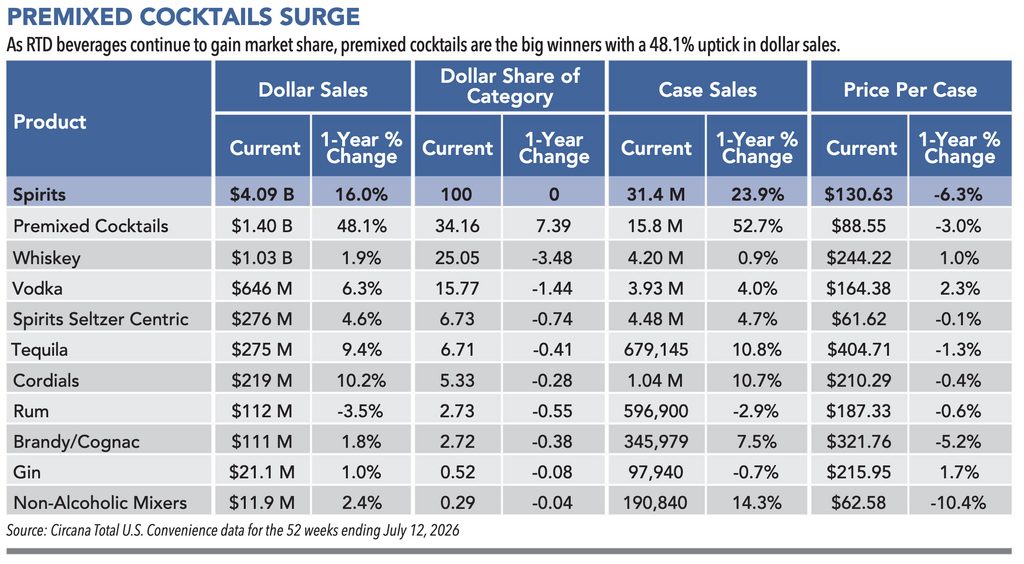
Current industry data suggests that while the RTD market is expanding, the growth is not uniform across all formats.
The Preference for Portability
Customer demand is heavily skewed toward smaller pack sizes. Shoppers visiting c-stores are typically on a "mission-based" trip, looking for immediate consumption rather than stocking up for a week. Consequently, single-serve cans and 6-packs are the primary drivers of growth. This shift mimics the historic behavior seen in the beer industry but with a higher price point per unit, which has bolstered the bottom line for retailers.
The Myth of Cannibalization
A primary concern for many operators entering the RTD space was the fear of cannibalization—the idea that buying a canned cocktail would mean not buying a 6-pack of premium beer or a bottle of wine. However, the data from Onvo’s recent expansion tells a different story. "When we introduced liquor-based RTDs, we weren’t sure if it was going to cannibalize our beer and wine sales," Parduski admits. "We quickly learned that wasn’t the case, and we continue to see growth in both segments." This suggests that RTDs are attracting new consumption occasions rather than simply displacing existing ones.
Official Perspectives and Strategic Merchandising
To navigate this crowded marketplace, retailers are moving away from "blanket stocking" and toward data-driven, localized merchandising.
Leveraging Partnerships
Onvo utilizes a collaborative approach, working closely with the Pennsylvania Liquor Control Board (PLCB). By reviewing purchase data and monitoring trends at a macro level, they can identify which products are gaining traction before they hit the mass market. However, the macro data is only the starting point.
The "Store-by-Store" Philosophy
Parduski emphasizes that "no two stores are alike." The strategy for a high-traffic urban commuter stop differs significantly from a rural, high-volume travel center.
- Introduction Phase: New product lines are introduced to the ambient shelf to test interest.
- Performance Review: If sales velocity hits specific internal benchmarks, the product is promoted to the "cold vault"—the most valuable real estate in the store.
- Local Customization: By listening to local customer feedback and monitoring specific SKU productivity, retailers can tailor their offerings to the demographic of the neighborhood.
Implications for the Future of Convenience Retail
Industry expert Powell, of Foodservice IP, suggests that the success of the RTD segment is a harbinger of how all categories will be managed in the future. "Rather than simply adding new products, retailers should continuously evaluate productivity by SKU and by occasion," Powell notes.
The Danger of Assortment Overload
One of the most significant risks for retailers today is "choice paralysis." When a consumer walks into a cold vault and is faced with 50 different canned cocktail options, the decision-making process slows down, often leading to a lost sale. Successful retailers must balance core, high-performing brands—the "staples"—with a curated selection of emerging segments.
Strategic Implications for Retailers
- Data-Driven Planograms: The era of static shelf space is over. Planograms must be fluid, evolving with seasonal demand and local trends.
- Occasion-Based Merchandising: Retailers should consider how they group products. For example, grouping RTDs alongside premium snacks or ice can drive higher basket sizes by catering to the "impulse" or "pre-party" shopper.
- Margin vs. Volume: Retailers must be wary of chasing every new brand launch. With the sheer volume of RTD entries, shelf space is the most precious resource. Operators must prioritize high-velocity SKUs that provide consistent margin over unproven, trendy items that may only experience a fleeting surge.
Conclusion
The RTD segment has fundamentally changed the convenience store value proposition. By moving from a "nice to have" category to a "must-have" cornerstone of the alcohol department, RTDs have forced retailers to modernize their inventory management and adopt a more sophisticated, data-backed approach to merchandising.
For retailers to thrive in this environment, they must maintain a delicate balance: providing enough variety to satisfy the modern, adventurous consumer while preventing the "assortment clutter" that drives away shoppers. By leveraging local sales data, maintaining close relationships with distributors and regulators, and focusing on the specific "occasion" for the purchase, convenience retailers can ensure that the RTD boom remains a sustainable, long-term profit engine rather than a temporary trend. The future of the category lies not in how many products a retailer can squeeze onto a shelf, but in how effectively they can curate a selection that resonates with the unique community they serve.