
Navigating the Red Tape: A Definitive Guide to Selecting Event Registration Software for Public Sector Agencies

WASHINGTON — For public sector event planners, organizing a gathering is rarely as simple as spinning up a landing page and selling tickets. While corporate planners enjoy immense flexibility in their choice of technology, government event teams at the federal, state, and municipal levels must contend with a labyrinth of stringent accessibility laws, complex procurement rules, and rigorous public accountability standards.
Whether it is a federal agency orchestrating a high-stakes policy briefing, a municipal government hosting a public zoning consultation, or a regional regulatory body organizing a stakeholder forum, the underlying reality remains identical: every digital touchpoint must pass the highest standards of public scrutiny. Consequently, choosing the right event registration software is not merely a logistical decision—it is a compliance imperative.
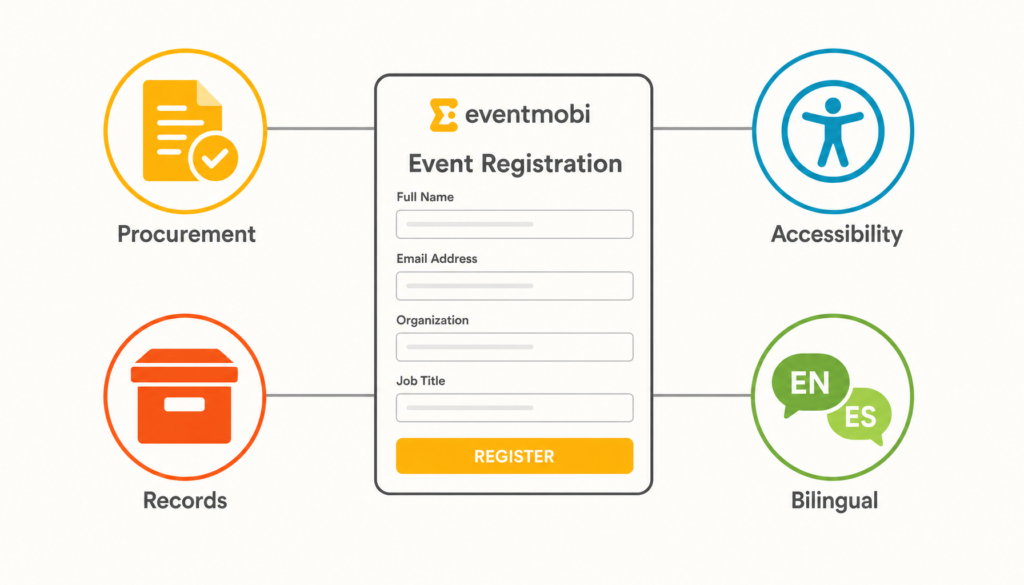
Main Facts: The Four Pillars of Public Sector Registration
Generic, out-of-the-box event registration platforms built for the private sector routinely fail in government environments. According to industry analyses, public sector event teams face four distinct constraints that dictate their technology stack:
- Formal Procurement Approvals: Software acquisition must navigate lengthy Requests for Proposal (RFPs), vendor pre-qualification, and security reviews.
- Mandatory Accessibility Laws: Platforms must legally adhere to strict Web Content Accessibility Guidelines (WCAG) to ensure equal access for citizens with disabilities.
- Public Record-Keeping and Transparency: Registration data must comply with freedom-of-information laws and archival retention policies.
- Bilingual and Multilingual Obligations: Many public agencies are legally required to offer services, including registration flows, in multiple languages.
Failing to account for these variables early in the software selection process can derail an event, invite legal challenges, or stall procurement cycles indefinitely.

Chronology: The Regulatory Evolution Driving Software Demand
The urgency surrounding public sector event technology has intensified significantly over the last several years due to a shifting regulatory landscape:
- December 2024: The General Services Administration (GSA) published its FY24 Governmentwide Section 508 Assessment, revealing a striking compliance gap across federal digital properties—noting that only 23% of federal agencies’ top-viewed public internet pages were fully conformant with Section 508 standards.
- Early 2026: Euna Solutions released its 2026 State of Public Procurement report, highlighting that a staggering 46% of public sector procurement teams still manage vendor acquisitions primarily through spreadsheets, emails, and manual paperwork, keeping approval pipelines slow.
- April 2026 (Upcoming Milestones): Under ADA Title II rulings, state and local governments serving populations of 50,000 or more face a hard compliance deadline of April 26, 2027 (with smaller districts given until April 2028) to bring all digital web content and third-party software into total WCAG 2.1 AA conformance. This regulatory pressure has forced event planners to audit their registration vendors well in advance.
Supporting Data: By the Numbers
Understanding the quantitative realities of public sector procurement and digital accessibility helps event organizers build a bulletproof business case for specialized software:
- 46%: The proportion of public sector procurement teams still relying on manual spreadsheets and email chains for vendor onboarding, contributing to friction and project delays.
- 23%: The low percentage of federal agencies maintaining fully Section 508-compliant public-facing web pages, emphasizing the widespread vulnerability agencies face when utilizing unvetted third-party software.
- 50,000 Residents: The demographic threshold dividing state and local government compliance deadlines under ADA Title II rules, with larger municipalities facing enforcement actions by April 2027.
- 1 Platform: The ideal consolidated system architecture required to manage both open public consultations and restricted internal briefings without fragmenting data or multiplying subscription costs.
Official Responses and Industry Guidance
Public sector regulatory bodies and event technology leaders have increasingly emphasized that utilizing a third-party software vendor does not absolve a government agency of its legal responsibilities.
According to guidance from federal compliance officers, the agency hosting the event remains wholly responsible for ensuring that any registration portal meets required accessibility benchmarks—such as WCAG 2.0 AA for federal entities or WCAG 2.1 AA for state and local governments.
Platform providers, meanwhile, are responding to these pressures by integrating specialized compliance features. For instance, modern enterprise event solutions like EventMobi have adapted by building dedicated public sector frameworks into their offerings. These include specialized form-gating tools for secure RSVPs, advanced promo-code tiering for restricted stakeholder sessions, and AI-driven multilingual concierges designed to satisfy official language mandates without requiring redundant administrative setups.
Implications: How to Evaluate and Select the Right Platform
Selecting a procurement-ready event platform requires moving past flashy sales pitches and demanding hard, verifiable documentation. Government event teams should establish a rigorous checklist before entering contract negotiations.
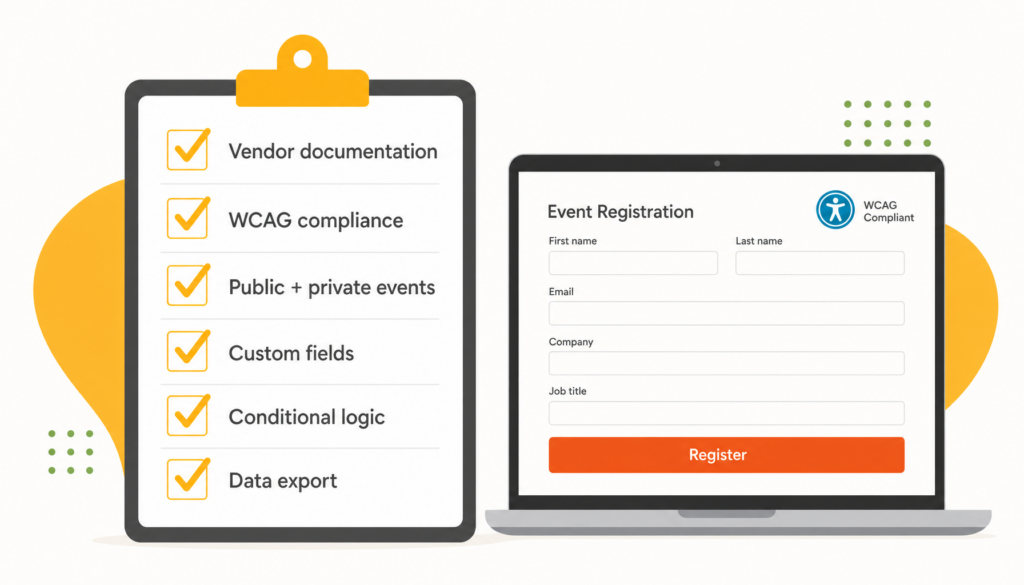
1. Procurement-Friendly Documentation
Vendors must be capable of supplying standard contract terms, robust data processing agreements, clear privacy policies, and verified security attestations—such as SOC 2 or ISO 27001 reports—at the very beginning of the evaluation.
2. Verified Accessibility Conformance
Accessibility is non-negotiable. Planners must push vendors on specific technical capabilities, including keyboard navigation, screen reader compatibility, color contrast ratios, and proper form field labeling. Sample outputs should always be run through independent accessibility checkers prior to commitment.
3. Unified Public and Private Event Management
Government departments frequently alternate between open public town halls and highly restricted internal staff briefings. Using a single subscription platform that features public form gating, invitation-only RSVP tracking, and conditional logic eliminates operational silos and safeguards sensitive data.
4. Robust Custom Fields and Conditional Logic
Generic registration forms often omit critical public sector data points, such as department affiliations, employee identification numbers, security clearance levels, or official language preferences. Advanced conditional logic ensures that diverse audiences—ranging from everyday citizens and media personnel to elected officials—receive a streamlined, relevant registration journey.
5. Seamless Data Export for Records Management
Because registration data is routinely subject to freedom-of-information requests, public audits, and strict data retention schedules, the chosen software must support clean, structured data exports compatible with institutional records management systems.
The Bottom Line
Ultimately, successful event execution in the public sector rests upon four foundational pillars: strict adherence to accessibility laws, streamlined procurement compatibility, the ability to manage both public and private events within a single ecosystem, and data governance that can withstand an exhaustive audit.

By eliminating vendors who cannot immediately produce verified security credentials and accessibility certifications, government event planners can clear bureaucratic hurdles efficiently—ensuring that every public gathering begins on a secure, accessible, and legally compliant foundation.
Related posts: