
Navigating the Shift: A Comprehensive Analysis of Meetup’s Transition to a Tiered Subscription Model

By the Tech Industry Reporting Desk
Published: November 2024
Main Facts: The Structural Evolution of a Community Giant
In a significant strategic pivot, Meetup—the long-standing global platform dedicated to connecting people through local in-person and virtual events—has officially restructured its service offerings. As of October 11, 2024, several of the platform’s advanced, high-engagement features are now locked behind a paywall, reserved exclusively for subscribers of Meetup+, the company’s newly prominent premium membership tier.
The changes went live immediately on Meetup.com upon launch, with a coordinated global rollout across the official iOS and Android mobile applications following closely within a week. While the platform continues to offer a robust free tier designed to preserve its core mission—facilitating community building and event discovery—the division between casual users and power users has never been sharper.
At its core, Meetup+ functions as a paid subscription model available in weekly, monthly, and annual increments. By introducing this tiered structure, Meetup is fundamentally altering how millions of users interact, communicate, and network across its vast ecosystem. The features now restricted to Meetup+ subscribers include, but are not limited to:
- Direct Messaging: Unrestricted 1-on-1 communication with other members.
- Waitlists: Priority and access to event waitlists when popular gatherings reach maximum capacity.
- Expanded Visibility: Comprehensive access to group member directories and detailed event attendee lists.
- Advanced Profile Capabilities: Enhanced visibility, tracking, and customization options within individual member profiles.
Despite these restrictions, Meetup leadership has emphasized that the fundamental heartbeat of the platform remains accessible to all. Users operating on the free tier retain the ability to discover groups, browse public event schedules, RSVP to gatherings with open slots, and attend local meetups without incurring any financial cost.
However, the introduction of Meetup+ marks a definitive end to the era of uniform access, forcing both long-time community organizers and casual participants to reevaluate how they utilize the platform.
Chronology: The Road to Meetup+
Understanding the gravity of this update requires a look at the timeline of events leading up to the October 11 implementation, as well as the immediate aftermath and ongoing deployment across global markets.
Early 2024: Conceptualizing the Tiered Model
For years, Meetup’s monetization strategy heavily relied on organizer subscriptions (charging the creators of groups to maintain their communities). While members could join groups and interact for free, shifting market dynamics, rising operational costs, and an increased demand for enhanced mobile networking features prompted product teams to look closely at member-side value propositions. Internal user research revealed a stark polarization in how people utilized the platform: a large segment used it purely for casual discovery and attendance, while a smaller, highly active cohort relied on advanced networking tools for professional and social advancement.
October 11, 2024: The Global Launch Date
Meetup officially deployed the Meetup+ feature restrictions on its web platform. Users logging into Meetup.com were greeted with prompts detailing the new subscription tiers. The deployment immediately affected key community workflows, such as event waitlist management and direct member outreach, sparking instantaneous discussions across various online forums and community message boards.
Mid-October 2024: Mobile App Rollout
Within seven days of the web launch, the update reached the Apple App Store and Google Play Store. Users downloading or updating the Meetup iOS and Android applications experienced the integration of paywalls for features like direct messaging and attendee lists. Customer support channels experienced an influx of inquiries, prompting the publishing of comprehensive Frequently Asked Questions (FAQ) documentation and support articles.

November 8, 2024: Documentation and Final Adjustments
Meetup finalized its formal documentation revisions, updating its help center articles to provide granular clarity on feature parity between free and paid tiers. The company committed to monitoring user feedback closely as the global community adapted to the structural change.
Supporting Data: Feature Breakdown and User Segmentation
To comprehend the scale of this update, one must examine the precise delineation between what remains free and what now requires a financial commitment. Meetup has categorized user behaviors into distinct usage patterns, shaping a two-pronged structural philosophy.
The Free Tier: Core Accessibility
Meetup’s leadership has maintained that the platform’s foundational utility must remain open to all. The data supporting free tier capabilities includes:
- Group Discovery: Unrestricted searching and browsing of local and global groups based on hobbies, professions, and interests.
- Event Browsing: Full visibility into public event calendars, descriptions, locations, and schedules.
- Standard RSVPs: The ability to secure a spot for any event with available capacity.
- Attendance: Checking into and participating in live meetups without platform-imposed subscription barriers.
The Meetup+ Tier: Advanced Tools
For those seeking an optimized, frictionless networking experience, Meetup+ introduces specialized capabilities designed for power users:
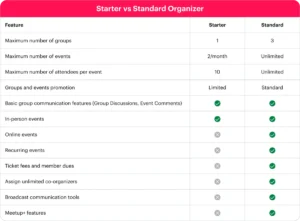
| Feature Category | Free Tier Experience | Meetup+ Subscriber Experience |
|---|---|---|
| Direct Messaging | Restricted / Read-only in many contexts | Full, unrestricted 1-on-1 messaging capabilities with fellow members |
| Waitlist Access | Limited or blocked when events fill up | Priority access to waitlists, increasing chances of securing a spot |
| Attendee/Member Lists | Restricted view of group rosters and event participants | Comprehensive visibility into who is attending events and who belongs to a group |
| Member Profiles | Standard profile creation and viewing | Enhanced profile management and advanced networking metrics |
Usage Segmentation Analysis
According to internal metrics cited by Meetup’s product strategy team, user interactions naturally fall into two distinct buckets:
- The Casual Explorer: Individuals who use Meetup intermittently to find a weekend hiking group, a local book club, or a professional networking mixer. Their needs are transactional—find an event, RSVP, attend.
- The Active Networker: Users who rely on Meetup as a primary relationship-building tool. They actively message speakers, organizers, and attendees, manage tight event schedules with waitlists, and deeply audit community rosters to forge targeted connections.
By restructuring the platform, Meetup is effectively asking the second group—the active networkers—to financially support the infrastructure that makes their high-engagement use cases possible.
Official Responses and Rationale
The transition to a gated feature model is rarely without friction. Recognizing this, the Meetup Team released a formal statement detailing the philosophy and economic reasoning behind the introduction of Meetup+.
Bridging the Value Gap
In their official communication, platform representatives explained that the traditional monetization model—focused primarily on group organizers—failed to capture the diverse ways individual members derived value from the platform.
"We believe that the plans we offer to our members should reflect the different ways individuals use the Meetup platform," the Meetup Team stated in their official release. "While the range of unique use cases is endless, we’ve identified that the vast majority of members’ needs can be separated into two distinct categories."
These categories informed the architectural split: providing a completely free, accessible community and events platform for casual users, while curating a high-performance, tool-rich environment for subscribers willing to invest in their social and professional capital.

Addressing Community Concerns
Anticipating pushback from long-standing users accustomed to decades of uninhibited access, the company directed community members to a dedicated support hub—Update FAQ: Advanced features moving to Meetup+ (October 2024)—to address common points of confusion.
The platform emphasized that the decision was not made lightly, framing the subscription model as a necessary step to ensure the long-term technological sustainability, moderation, and security of the platform. By introducing paid tiers, Meetup can invest more heavily in engineering resources, anti-spam protocols, and user experience enhancements that benefit the entire ecosystem.
Implications: What This Means for the Future of Community Building
The rollout of Meetup+ carries profound implications for the broader landscape of social technology, event planning, and digital community building. As legacy platforms search for sustainable monetization models in an era of ad-revenue volatility and privacy regulations, Meetup’s strategy serves as a critical case study.
Impact on Local Organizers
While Meetup+ targets members rather than organizers, the ripple effects for group leaders are undeniable. Organizers rely on vibrant, communicative communities to keep attendance high. If active members hesitate to pay for direct messaging or view event waitlists, organizer retention and event engagement could experience short-term volatility. Conversely, organizers who heavily vet their members may appreciate the filtering effect of a paid platform, which could theoretically reduce low-intent RSVPs and no-shows.
The Consumer Subscription Fatigue Factor
Introducing a weekly, monthly, or annual subscription model puts Meetup in direct competition with a myriad of other digital services vying for consumers’ wallets. From streaming services to productivity apps and professional networks like LinkedIn Premium, modern internet users face pervasive subscription fatigue. Convincing everyday users that community networking features are worth a recurring monthly fee will require sustained proof of value.
Competitor Landscape
For years, Meetup held a near-monopoly on localized, interest-based group formation. However, the rise of alternative platforms—ranging from professional spaces like Guild and Geneva to decentralized social networks and hyper-local community apps—means users have options. If the paywall for direct messaging and waitlists alienates too many casual power users, some portion of the community may migrate to free, ad-supported, or open-source alternatives.
Long-Term Viability and Innovation
Ultimately, Meetup’s long-term success hinges on whether Meetup+ delivers tangible, undeniable utility to its subscribers. If advanced profile tracking, guaranteed waitlist progression, and seamless direct messaging lead to higher-quality human connections and professional opportunities, the subscription fee will be viewed as a modest investment.
As the digital world continues to grapple with the tension between open-access idealism and the harsh economic realities of running global internet infrastructure, Meetup’s October 2024 pivot represents a bold, defining moment. Whether it fortifies the platform for the next decade or prompts a mass reevaluation of digital community spaces remains one of the most closely watched experiments in the tech industry today.