
Rebuilding the Social Muscle: Why Intentional Networking is the Core of Modern Event ROI

By [Author Name]
Published in partnership with EventMobi & Industry Insights
Main Facts: The Atrophy of Professional Connection
Networking muscles atrophy faster than most professionals care to admit. Following years of hyper-focused corporate environments, remote work models, and all-consuming project deadlines, returning to the live event circuit can feel less like a professional homecoming and more like physical therapy for the socially rusty.
For the average conference-goer, the primary motivation for attending a live event is rarely the slide decks or keynote presentations. According to data from the Freeman Trends Report, cited via the Professional Convention Management Association (PCMA), networking ranks as one of the four foundational pillars of event attendance. When surveyed on what matters most during an event:
- 81 percent of attendees prioritize interacting with industry experts.
- 68 percent focus on meeting new professional contacts.
- 64 percent value peer-to-peer exchange.
Yet, despite these staggering statistics, event networking is frequently left entirely to chance. Organizers invest heavily in production design, catering, and audiovisual setups while treating organic human connection as an afterthought. The result? Attendees scrolling through their phones at the edges of ballrooms, missed business opportunities, and an invisible retention crisis hiding in plain sight.

Chronology: A Personal Comeback Story from Rehab to the Main Stage
The Three-Year Hiatus
For three years, I worked head-down at a fast-growing production company. The role was intellectually stimulating and deeply rewarding, but it was all-consuming. It left zero breathing room for conferences, industry mixers, or community building. When I finally stepped back onto the event circuit, the transition was jarring. The art of the elevator pitch and the casual conference hallway chat felt foreign.
Stop One: Minnesota Meetings & Events Day
My rehabilitation began at Minnesota Meetings & Events Day, where I stumbled into Nicole Coon’s session, "Five-Star Connections: Networking in Action."
Coon’s approach was deceptively simple: strip away the agonizing "trust falls" and the desperate searches for a "fun fact" about oneself. Instead, participants rotated from table to table armed with specific, industry-relevant prompts. We discussed our likes, dislikes, and daily pain points within the events industry. Around the third or fourth shuffle, something remarkable happened—the artificial constraints dissolved. The groups quietly abandoned the formal rotation and simply kept talking. The lesson was immediate: the hardest part of networking isn’t the conversation itself; it’s the opening. Remove the friction, introduce relevance, and let natural human curiosity take over.
Stop Two: The Smart Meetings Innovation Experience in Boise, Idaho
If Minnesota was physical therapy, Boise was my first real game back on the court. Surrounded by familiar faces like Dalia El Gazar and Nick Borelli, I was forcefully reminded of a golden rule of event engagement: stop taking yourself so seriously.

Before I realized what was happening, I found myself wrapped up in a full conga line snaking through the venue, later transitioning to traditional Basque street dancing. Was there embarrassing photographic evidence? Almost certainly. But that was precisely the point. Relationships cannot be built from a distance. At some point, you have to get in the room, join the activity, and let the collective energy of the crowd pull you past your inhibitions.
Stop Three: IMEX Frankfurt and the Washington D.C. Finale
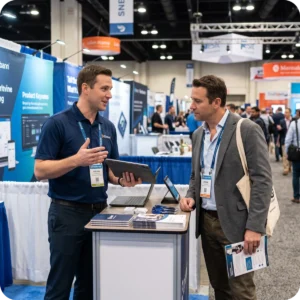
By the time I reached IMEX Frankfurt, my networking stamina was fully restored. Pressed into unexpected booth service, I executed 22 appointments instead of my six scheduled ones. Meeting scores of new connections transformed from a chore into genuine joy. My comeback ultimately culminated in leading a conga line at the subsequent Smart Meetings experience in Washington, D.C. The social muscle, it turns out, never truly dies—it merely awaits your decision to use it.
Supporting Data: The Hidden Costs of Passive Attendance
The modern corporate landscape treats attendee engagement as a soft metric, but the downstream economic impacts are severe. When event organizers fail to architect intentional networking environments, the financial toll manifests in declining retention rates.
+--------------------------------------------------------------------------+
|                  ATTENDEE PRIORITIES (Freeman / PCMA Data)               |
+--------------------------------------------------------------------------+
| Interacting with Experts       | [81%] ===========================       |
| Meeting New Contacts           | [68%] ======================            |
| Peer-to-Peer Exchange          | [64%] ====================              |
+--------------------------------------------------------------------------+
Observe any networking reception, and a familiar sociological divide emerges. On one side are the engaged participants—those lingering at tables long after a workshop concludes, or actively participating in group activities. On the other side are the wallflowers: professionals standing at the periphery with their phones out and heads down, opting out of the social ecosystem entirely.

The contrast in outcomes is stark. Those who lean into the discomfort leave with robust relationships, collaborative partnerships, and tangible business value. Those hiding behind screens leave with slightly cleaner email inboxes and little else. Crucially, attendees who depart an event without making genuine, lasting connections rarely return for subsequent editions. Consequently, bad networking design transforms straight into a compounding attendee retention crisis.
Official Industry Responses: Designing for Connection on Purpose
Industry leaders are taking note of this shift, moving away from passive room setups toward engineered, intentional community-building.
"You can’t build relationships from a distance. At some point, you have to get in the conga line," reflects veteran event strategists. The consensus across event management circles is clear: spontaneous networking is a luxury of the past. Modern attendees demand predictable, psychologically safe pathways to connection.
Event technology companies are stepping in to bridge this gap. Platforms like EventMobi are redefining how event tech translates intent into actual attendee engagement. By embedding structured and organic networking mechanisms directly into the event app, organizers can replicate the physical magic of Boise or Minnesota on a global scale.

How Event Tech Bridges the Gap:
- Rich Profiles & Smart Matchmaking: Digital profiles act as an asynchronous version of table prompts, helping attendees identify peers with shared interests, challenges, or geographical regions before stepping foot on-site.
- Frictionless Appointment Booking: Built-in 1:1 scheduling tools remove the awkwardness of asking for contact information in crowded hallways.
- Moderated Group Discussions: Facilitated conversations and digital icebreakers give participants an easy entry point into professional dialogues.
Implications: The Future of Intentional Event Design
The evolution of professional networking carries deep implications for corporate event planners, marketers, and executive leaders. As budgets tighten and the ROI of business travel faces heightened scrutiny, events must prove their enduring worth beyond simple content consumption. Content is ubiquitous; it can be streamed via YouTube or absorbed through a podcast. Live events must anchor their value proposition on human proximity.
To future-proof events against declining satisfaction scores, organizers must adopt a three-tiered blueprint:
- Design for Relevance, Not Reception Size: Stop prioritizing packed, chaotic cocktail hours where no one can hear themselves think. Instead, curate smaller, topic-driven roundtables with specific prompts that lower the barrier to entry.
- Appoint an Owner of Connection: Treat networking design with the same operational rigor as stage production or catering. Assign a dedicated owner within your event team whose sole Key Performance Indicator (KPI) is connection density.
- Measure Connection: Track metrics that matter beyond badge scans—monitor in-app 1:1 meetings booked, repeat attendee rates, and post-event survey data regarding relationship formation.
Summary FAQ for Reluctant Networkers
- What is the hardest part of networking at an event?
The opening. Give people a specific reason to talk—such as a shared industry challenge or a moderated prompt—and remove the social friction so professional relevance can take over. - How do I network when I feel socially awkward or out of practice?
Stop taking yourself so seriously. Be willing to look a little ridiculous, step outside your comfort zone, and allow the collective energy of active participants to pull you in. - Can I network simply by showing up to an event?
No. Networking is not a passive activity. It requires conscious effort, a tolerance for mild discomfort, and a willingness to be seen. Put the phone away and get involved. - How many connections should I aim for?
Prioritize quality over quantity. A handful of deep, meaningful conversations that extend long after the conference doors close will always beat a pocketful of forgotten business cards.
Networking muscles may atrophy over time, but with the right intentional design—and a willingness to embrace a little discomfort—they can be rebuilt stronger than ever. Leave it to chance, and you leave brand loyalty on the table. Design it on purpose, and the engagement follows naturally.
Related posts: