The Architecture of Arrival: Engineering High-Performance QR Code Check-In for Modern Events

When the doors to a major conference swing open at 8:00 a.m., the difference between a seamless start and a chaotic bottleneck often comes down to a single, tiny square of pixels. When a badge QR code fails to scan, the consequences are immediate and tangible: check-in lines lengthen, exhausted staff are forced to resort to slow manual database lookups, and attendees begin their event experience with frustration rather than engagement.
In the high-stakes environment of live events, a QR code is not merely a design element—it is the digital handshake between an attendee and your registration infrastructure. Achieving a frictionless, sub-two-second check-in requires a departure from traditional "marketing-style" QR thinking and a move toward an "identity-key" architecture.
The Identity-Key Paradigm: Shifting from Marketing to Utility
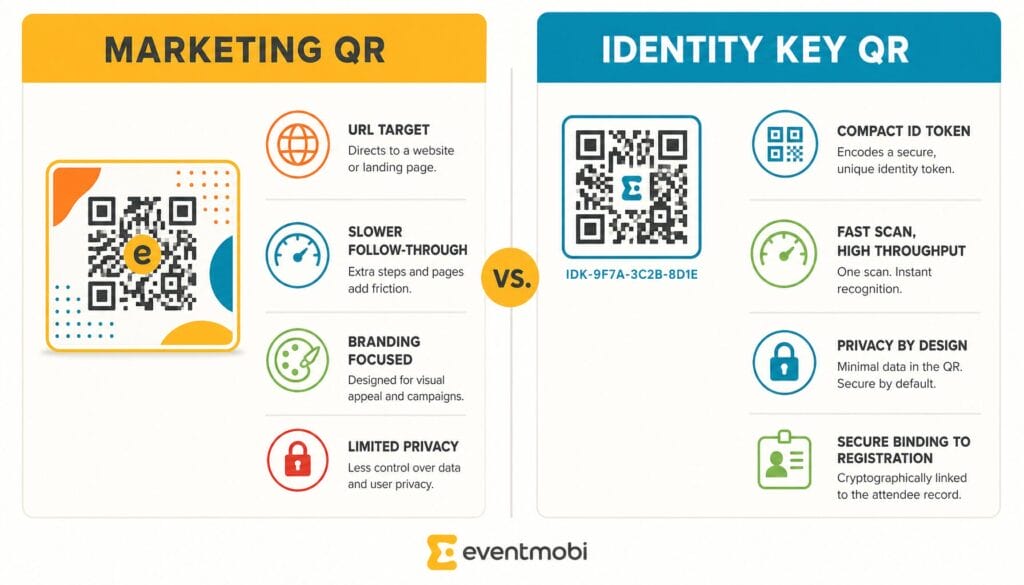
The most common misconception in event management is treating a badge QR code like a marketing asset. In a consumer context, a QR code is a destination—a link to a website, a digital menu, or an app download. However, an event badge QR code must serve as an identity key.
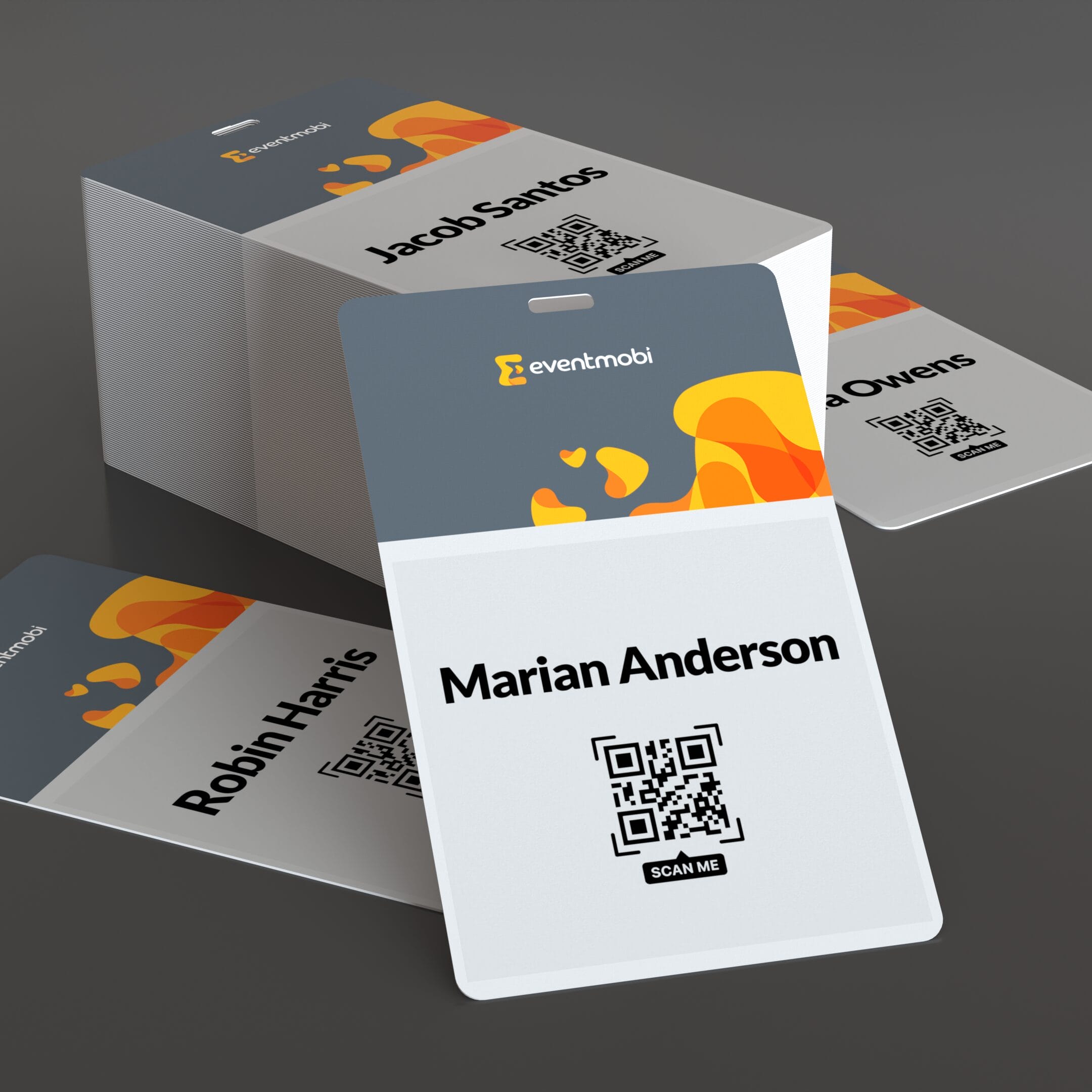
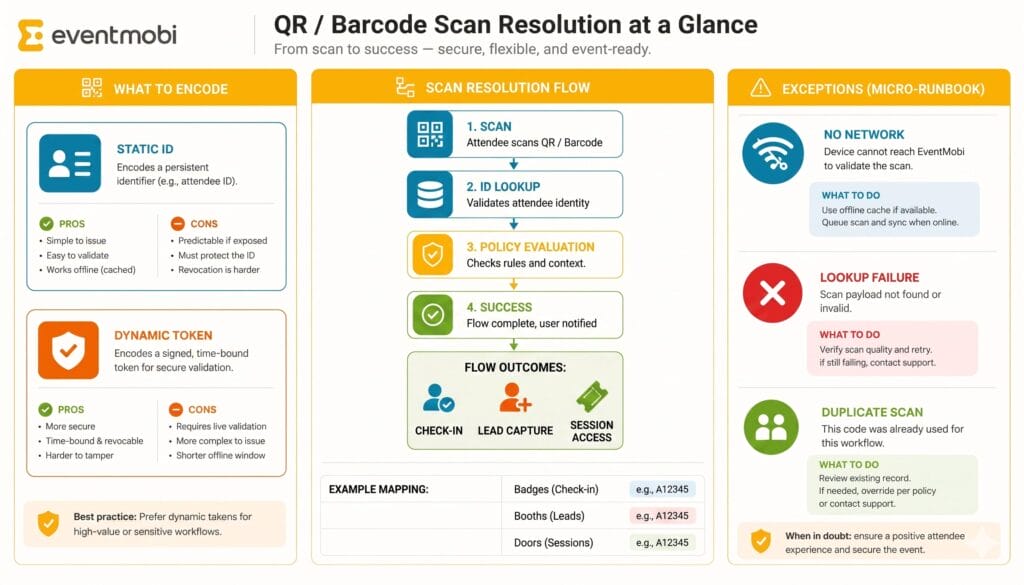
When a scanner reads an attendee’s badge, it should not be "navigating" to a URL; it should be querying a unique, secure identifier that resolves instantly to a live registration record. By encoding a Universally Unique Identifier (UUID) or a specific Registration ID (e.g., REG-000123) rather than a public-facing URL, organizers ensure that the scan serves one, singular purpose: identifying the individual within the system of record.
This distinction is vital for operational speed. Destination-based codes often rely on external web redirects that can lag, whereas identity keys are designed to trigger an immediate database "handshake." When you treat the QR as a key, you eliminate the risk of the code becoming stale, as the underlying system-of-record can update permissions or status in real-time without ever needing to reprint the badge.
Chronology of a Successful Data Workflow
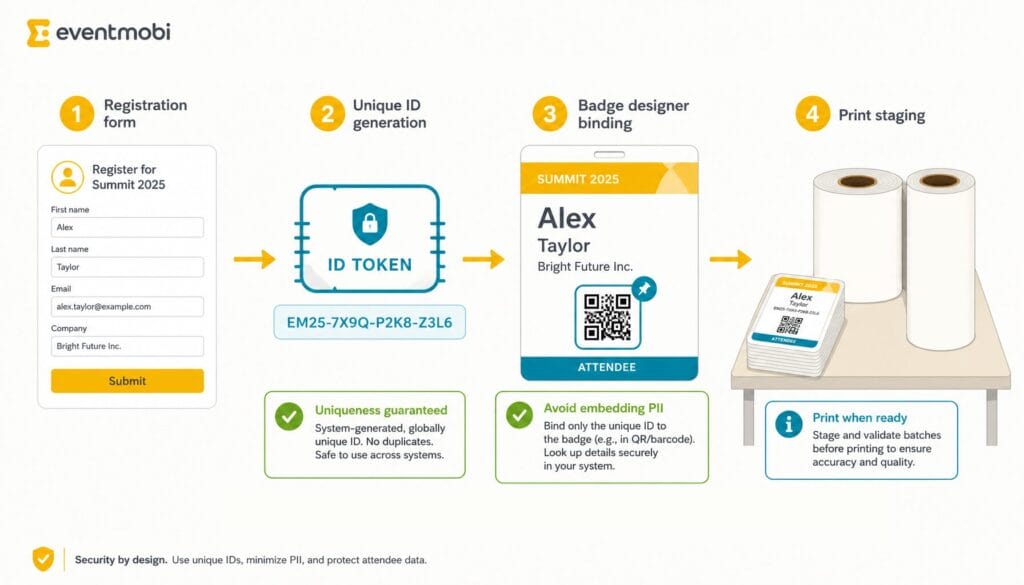
To achieve maximum reliability, the journey of an attendee’s data must be strictly managed from the moment they sign up to the moment they walk through the door. The following workflow represents the industry standard for preventing scan failures:
- Registration: The attendee submits their details. The platform captures this in a centralized database.
- Unique Identifier Generation: Upon completion, the system assigns a unique, immutable ID to that specific record.
- Binding: The event badge designer is linked directly to this database field. When the template is generated, the QR code is dynamically bound to that unique ID.
- Real-Time Sync: By keeping the badge generation and registration system in a single platform, any last-minute changes to a title, company, or registration status are automatically reflected in the QR data at the moment of printing.
The "anti-pattern" that causes most onsite disasters is the use of offline CSV exports. When organizers export data, modify it in a spreadsheet, and then import it into a secondary, disconnected printing software, they create a "brittle handoff." If an attendee updates their registration details after the export, or if a late registrant is added to the system but not the spreadsheet, the QR code becomes a liability rather than an asset.
Supporting Data: Why Uniqueness Trumps "Name-Matching"
A common error in amateur event planning is attempting to use attendee names or emails as the primary key. In a room of hundreds or thousands, name collisions are a statistical certainty. Between common names, assistants registering multiple executives, and attendees providing different versions of their contact information, relying on human-readable data leads to duplicate records and check-in errors.
By utilizing a UUID, you ensure that even if two attendees share the same name, the system will never confuse their access permissions or session registrations. This is particularly critical for high-security environments or events with paid-tier upgrades, where verifying an attendee’s exact status is a necessity.
Operational Implications: Designing for Throughput
Once the data architecture is secured, the focus must shift to physical operational constraints. A well-designed check-in lane accounts for the reality of "peak arrival"—typically the 30-minute window before the keynote begins.
Lane Strategy and Exception Handling
To maintain a high-throughput environment, organizers should implement a two-tier lane system:
- The Express Lane: Dedicated to attendees with pre-printed or digital badges that scan on the first attempt.
- The Exception Lane: A secondary station for attendees whose codes fail, those who haven’t registered, or those needing badge reprints.
By separating these flows, a single problematic check-in—such as a last-minute walk-in who requires a payment transaction—does not paralyze the entire line.
Staff Training and the "Two-Try" Rule
Even the best technology is subject to human error. Training staff to follow a "two-try" rule is essential. If a code does not scan after two attempts, staff should immediately escalate to the manual search workflow. This prevents the "scanning dance," where staff spend 30 seconds tilting and waving a scanner at a badge while the line behind them grows. The objective is to keep the line moving; the goal of the scanner is to facilitate that, not to dictate the pace of the event.
Print Quality and Hardware Reliability
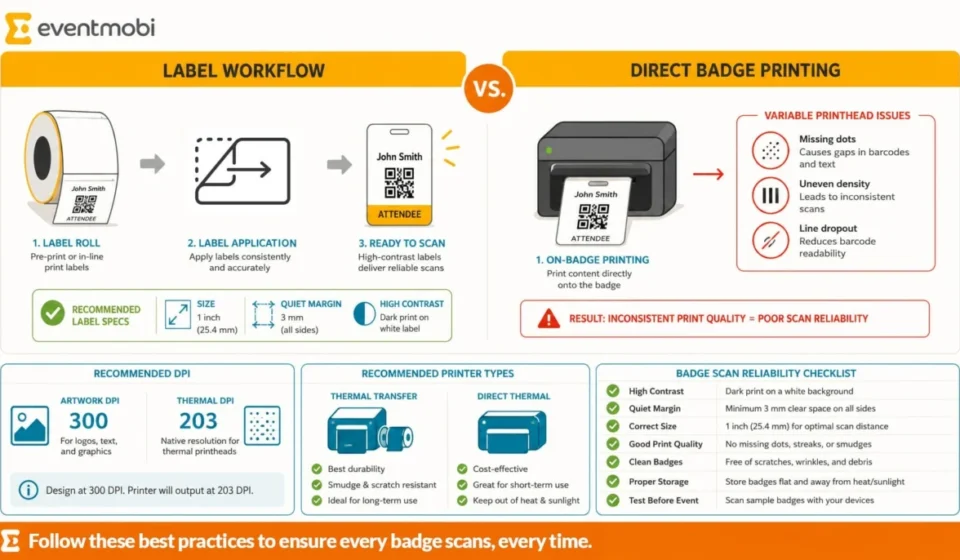
The choice of printing method significantly impacts scan reliability. Direct thermal printing, commonly used for adhesive labels, is generally superior to direct-to-card printing for high-volume, last-minute onsite operations.
Labels offer several advantages:
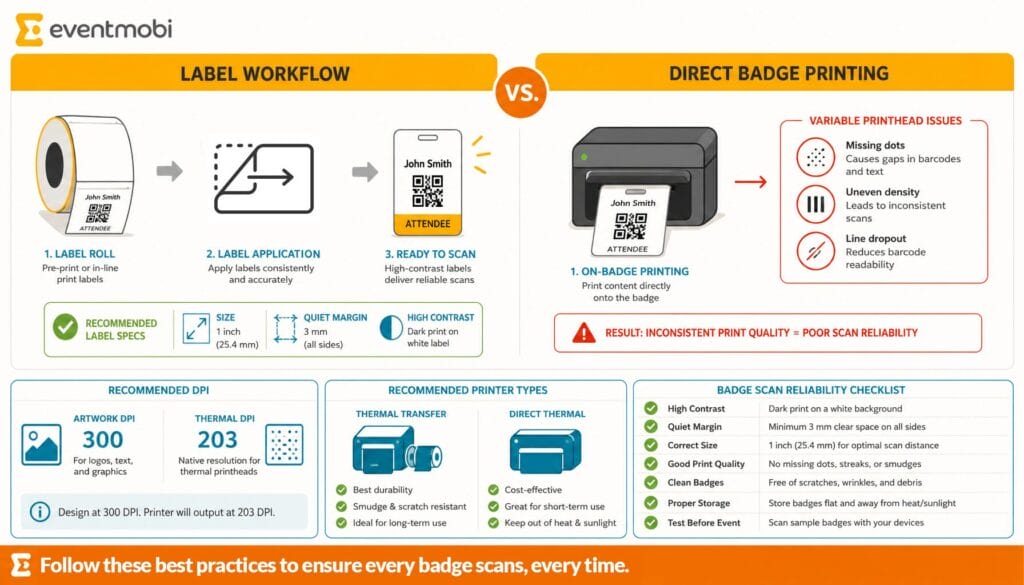
- Glare Reduction: Matte labels are less reflective than some plastic badge stocks, making them easier to scan under harsh, overhead venue lighting.
- Flexibility: If an error is detected, a label can be reprinted and applied in seconds.
- Consistency: Using dedicated, calibrated hardware like the Brother QL-820NWB ensures that the "quiet zone"—the white space surrounding a QR code—is always sufficient.
The "quiet zone" is one of the most overlooked factors in QR design. If a design element, such as a logo or border, encroaches on this space, the scanner will be unable to distinguish the code from the background. Always test your badges using the same lighting conditions and scanners you expect to have onsite.
Official Best Practices and Compliance
For organizers seeking a rigorous framework, it is recommended to align with ISO/IEC 18004 standards. These standards dictate the error-correction levels necessary for QR codes to remain readable even if they become partially obscured or damaged.
Beyond hardware, there is the matter of privacy. By encoding only an identity key rather than PII (Personally Identifiable Information), you significantly lower the risk of data leaks. If a badge is lost or a code is photographed, the malicious actor only sees an arbitrary string of characters—not an email address, phone number, or home address. The resolution of that ID should only happen within the secure, encrypted confines of your event management platform.

Conclusion: The Invisible Infrastructure
When implemented correctly, QR code scanning becomes "invisible infrastructure." Attendees do not notice it because it works instantly, and staff are not stressed by it because the process is predictable.
By ensuring that your registration data, badge generation, and onsite scanning are all part of a single, unified ecosystem, you eliminate the fragmentation that leads to failure. Whether you are hosting a 100-person executive retreat or a 10,000-person global conference, the principle remains the same: treat the QR code as the key to a secure, fast, and professional check-in.
As a final recommendation, organizers should conduct a "drill" 48 hours before the event. Print a random sample of 50 badges from your system and scan them under the same lighting you expect to find at the venue. If you can move through those 50 badges in under two minutes without a single failure, your system is ready for the peak arrival of your attendees. The effort invested in this preparation is the ultimate insurance policy against the frustration of a stalled check-in line.
Related posts: